


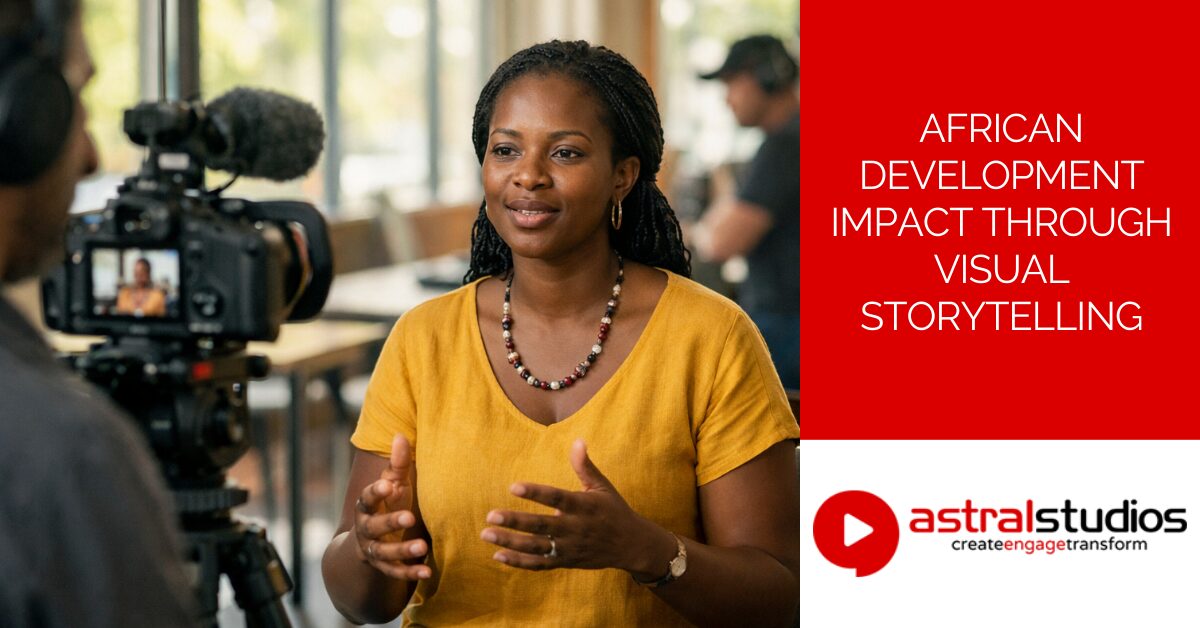
African Development Impact Through Visual Storytelling
Last Updated: 3 weeks ago by Astral Studios Staff
African development is one of the most talked-about topics on the continent right now. If you lead an international development or aid organisation in South Africa, this article is for you. It’s about how video – both live action and animated – can help you tell your story better.
Here’s something I hear a lot from comms teams at NGOs: “We do incredible work, but nobody sees it.” A programme manager I spoke to recently said her organisation had just wrapped a three-year food security project in Limpopo. The M&E data was strong. The community outcomes were real. But when it came time to report to donors, all they had was a 40-page PDF. The donor read page one and skimmed the rest. Sound familiar?
That’s the gap video fills. Not because it’s flashy, but because it’s human.
Why African Development Communication Is at a Crossroads
The African development sector is under serious pressure right now. Aid budgets are shrinking globally. Major development partners have announced aid cuts driven by shifting domestic priorities, creating a funding squeeze for countries that depend heavily on international development assistance. At the same time, Africa’s economy grew by around 4.2% in 2025 and is projected to reach 4.3% in 2026, according to the African Development Bank. This makes it the world’s second-fastest-growing region after Asia.
So there’s growth on one hand and a funding crunch on the other. What does that mean for your organisation? It means competition. More organisations chasing fewer donor rands. The ones that communicate their impact clearly will win. The ones that don’t, won’t.
South Africa sits in a unique spot here. In 2024, South Africa took over the G20 Presidency under the theme “Fostering Solidarity, Equality, and Sustainable Development.” The country handed the presidency over to the US in late 2025, but the spotlight that came with it hasn’t fully faded. Johannesburg spent a year at the centre of African development dialogue – and the networks, conversations, and expectations that built up during that time are still very much alive. For organisations that are ready to tell their story well, that’s a real advantage.
What African Development Organisations Actually Need to Communicate
Before we talk about video formats, let’s talk about what’s at stake. Development organisations juggle a lot of audiences at once – donors, beneficiary communities, government partners, the media, and the general public. Each audience needs something a bit different.
The SDG clock is ticking
Only 6% of the 32 measurable SDG targets reviewed for Africa are on track to be achieved by 2030. That’s a sobering number. With just a few years left, organisations face real pressure to show progress – not just report it. Video is one of the most direct ways to do that.
The aid funding squeeze
Core institutional funding to international NGOs decreased by 14-19% between 2022 and 2025, with many mid-sized NGOs reporting budget cuts of 30-50%. In that kind of environment, a compelling impact video isn’t a nice-to-have. It’s how you stay in the conversation with funders.
African development and the localization shift
There’s another big change happening. A major push in the sector is moving decision-making and resources to residents of the communities where NGOs deliver goods and services. That means local voices, local stories, and yes – local production partners. More on that later.
Climate and food security
Around 120 million Africans currently face acute food insecurity, most of them in conflict-affected countries. Organisations working in climate resilience, food security, and humanitarian response need content that moves fast and moves people. Video does both.
Why Video Works for African Development Storytelling
Let’s get practical. Why video, specifically?
Your brain processes visuals about 60,000 times faster than text. That’s not a metaphor – it’s just how human cognition works. A two-minute film can land what a twenty-page report can’t.
There’s also a reach argument. Most of Southern Africa accesses digital content via mobile phone. Short-form video on WhatsApp, YouTube, or a simple landing page gets to communities that a PDF never will.
Then there’s the fundraising case. Campaigns that use video raise around four times more money than those without. That number tends to get attention in budget meetings.
NGOs can use storytelling to win donor support by crafting narratives that show real-life programme impact, using visuals like photos and video to carry the story, and sharing across social media, websites, and fundraising events.
One thing I’ve noticed working with development sector clients – the organisations that invest in quality video content early tend to build donor relationships that last. The ones waiting for “more budget” often find themselves explaining why they didn’t communicate better.
Live Action Video: Putting People at the Centre of African Development Stories
Live action film is still the most powerful format when you want to show the human side of your work. Nothing beats a real face, a real voice, a real place.
What makes a great impact film
A well-made impact video should let people speak for themselves – about how a programme changed their lives, the before and after, their dreams and hopes. The small moments of emotional expression are what make a story rich and real.
That’s the difference between a corporate video and a story. A corporate video tells you what an organisation does. A story makes you feel why it matters.
Formats that work for development organisations
There’s no one-size-fits-all here. The format depends on the audience and the goal. Here’s a quick breakdown:
| Video Format | Best For | Typical Length |
| Donor impact film | Major funder reporting (USAID, FCDO, EU) | 3–6 min |
| Community testimonial | Beneficiary voices, fundraising appeals | 1–3 min |
| Advocacy film | Public awareness, policy influence | 2–5 min |
| Event documentation | Conferences, launches, annual reviews | 2–4 min |
| Behaviour change video | Community mobilisation, health, sanitation | 1–3 min |
| Annual report companion | Visual summary for written reports | 2–4 min |
African development and ethical storytelling
This is something the sector talks about a lot – and rightly so. The days of “poverty porn” are behind us. Informed donors and global audiences see through it. More than that, it’s simply wrong.
The goal isn’t just connecting with an audience – it’s having a greater impact on the work itself. When you follow the lead of the people you serve, the outcomes are better.
That means consent. It means dignity. It means telling stories where the person on screen is a protagonist, not a prop. Johannesburg-based production teams who work regularly in the Southern African context understand these dynamics well. That local knowledge isn’t something you can fly in from London.
A note on load shedding
For international partners wondering about production reliability in South Africa – load shedding has eased considerably since the crisis years of 2022 and 2023. It’s no longer the day-to-day obstacle it once was. That said, for field shoots in remote areas, off-grid equipment and battery backup remain standard kit. Good production teams plan for it regardless.
Animation: The Secret Weapon in African Development Communication
If live action is the emotional heartbeat of your content strategy, animation is the brain. It makes complex ideas clear. It works across languages. And it scales like nothing else.
Why animation suits the African development context
Whether explaining a programme mission, detailing the impact of a specific initiative, or making a donation appeal, animated explainer videos offer a versatile medium that both simplifies complex ideas and connects emotionally with viewers.
Think about what development organisations actually need to explain – funding mechanisms, multi-year programme logic, policy frameworks, data trends. These things are genuinely hard to show with a camera. Animation handles them naturally.
There’s also the literacy and language issue. Southern Africa has a huge variety of languages and literacy levels across communities. Video-based content has been shown to improve understanding among people with lower literacy levels. Animation goes further – you can swap dialogue and on-screen text across languages without reshooting a single frame. That’s a big cost saving for organisations working across multiple countries.
African development data brought to life
One of the most underused applications of animation in the development sector is data visualisation. M&E teams work hard to generate good data. Then that data sits in spreadsheets and appendices that nobody reads past page three.
Motion graphics can turn your results framework into a story. A UNDP Human Development Report explainer – combining photography, footage, and animated data visualisations – is a good example of what’s possible. Donors respond to this kind of content because it’s clear, honest, and professional.
Animated explainer videos bring complex concepts to life with visuals that make it easier for audiences to understand and remember a message. That’s exactly what a donor presentation or SDG progress update needs.
Where animation outperforms live action
Animation drives emotional connection, supports advocacy and behaviour change campaigns, improves donor engagement, and increases reach across digital platforms.
A specific example: a client once requested an animated explainer video for a UN Migration project targeting diaspora communities. The video’s sign-up goal was 1,500 people. The campaign smashed that target. The animation worked because it was clear, culturally appropriate, and easy to share across the Internet.
African development behaviour change campaigns
Behaviour change communication – or BCC – is a big part of development work in health, sanitation, nutrition, and climate adaptation. Animation is often the right tool here. You can show a hand-washing technique without a camera crew. You can demonstrate climate adaptation practices without expensive field production. And you can do it in isiZulu, Sepedi, or Tsonga for roughly the same budget.
The Johannesburg Advantage: Local Production for African Development Impact
Here’s an opinion: outsourcing your African development video content to a production company in Europe or North America is a mistake. Not because those companies aren’t skilled. It’s because they don’t know what you know.
The principle of trusting those closest to the challenge to lead the change – crafting solutions in close partnership with the communities most impacted – applies just as much to who produces your content as to who delivers your programmes.
Johannesburg is home to regional offices for UNDP, UN Women, USAID, the EU Delegation, the African Development Bank, FCDO, and hundreds of NGOs. It’s Africa’s development communications hub. A production team based here works in your context every day. They understand the ethics, the visual language, the community dynamics, and the cultural nuance that you simply can’t brief in on a Zoom call.
There’s also a practical point. Johannesburg production rates offer genuinely competitive value compared to UK or US alternatives. You get broadcast-quality work, and you keep more budget for the programme itself.
Making Your African Development Video Work Harder
Producing a great video is half the job. Getting it to the right people is the other half.
Think about your distribution from the start – not after the edit is done. A donor impact film needs a different home than a community behaviour change video. One lives on your website and in a funder presentation. The other travels via WhatsApp voice notes and community screenings.
Videos under two minutes get the highest engagement. That’s worth keeping in mind when you’re tempted to fit everything into one film. Sometimes a series of short, focused videos does more work than one long one.
Also think about your content as a library, not a single output. An annual impact film, a series of community testimonials, a programme explainer animation, and a fundraising appeal video – each serves a different purpose, but together they tell a complete story about your organisation.
Ready to Tell Your African Development Story?
If your organisation is doing good work – and I’d imagine it is – the story deserves to be told well. Not in a 40-page report that gets skimmed. In a film that a donor watches twice, shares with a colleague, and remembers six months later.
Astral Studios works with corporates, government agencies, and development organisations across South Africa to produce live action and animated video content that genuinely moves audiences and delivers results.
Contact us to talk about your next African development communications project.
Glossary of Technical Terms
Animated explainer video – A short animated film that explains a concept, process, or organisation in a simple and visual way.
Behaviour change communication (BCC) – Content designed to shift the knowledge, attitudes, or actions of a target audience, often used in health, sanitation, and development programmes.
Data visualisation – The use of charts, graphs, and motion graphics to make numerical or statistical information easy to understand visually.
Donor impact film – A video produced specifically to show funders how their money has been used and what results it has achieved.
Live action – Video filmed with real people, locations, and cameras, as opposed to animation.
M&E (Monitoring & Evaluation) – The process of tracking and measuring whether a development programme is achieving its intended outcomes.
Motion graphics – Animated visual elements, such as moving text, icons, or charts, used in video production.
SDGs (Sustainable Development Goals) – The 17 goals set by the United Nations in 2015 to be achieved by 2030, covering poverty, climate, health, education, and more.
South-South cooperation – Development partnerships between countries in the Global South, rather than traditional North-to-South aid relationships.
VNR (Voluntary National Review) – A country’s self-assessment report on its progress toward the SDGs, presented to the UN High-Level Political Forum.
Frequently Asked Questions
How much does a video for an African development organisation cost?
It depends on the format, length, and where you shoot. A short animated explainer can cost less than a live action field production. That said, a Johannesburg-based production team will generally offer better value than a European or North American company – without any compromise on quality. The smartest thing to do is talk to a local producer early, tell them your budget honestly, and let them design something that works within it.
How long should an impact video be?
Short is almost always better. Videos under two minutes get the most engagement online. For donor impact films, three to six minutes is a reasonable range – long enough to tell a real story, short enough to hold attention. If you have a lot to cover, consider a series of short focused videos rather than one long one. Each video can serve a different audience or purpose.
What’s the difference between live action and animation for development work?
Live action puts real people on screen. It’s powerful for emotional storytelling – testimonials, community voices, field documentation. Animation is better for explaining how something works, showing data, or reaching communities with varying literacy levels. Many organisations use both. A donor impact film might be live action, while a community behaviour change campaign runs as animation. The two formats work very well together.
Do we need a big budget to get started?
Not necessarily. Even a two-minute video recorded simply can get visibility and reach new donors if the story is strong. That said, poorly produced video can do more harm than good – it signals a lack of professionalism to funders. The goal is to match the production quality to the audience. A WhatsApp-shared community clip has different requirements than a film going to a USAID programme officer. A good production partner helps you figure out what level of production each piece needs.
How do we make sure our video content is ethically produced?
Start by asking who controls the story. The people on screen should understand how the content will be used, agree to it freely, and ideally have input into how they’re represented. Avoid framing community members as helpless. Show agency, resilience, and context. A production team with real experience in the Southern African development sector understands these dynamics – it’s not something you want to learn on the job.
Can video actually help us raise more money?
Around 72% of donors say they’re very likely to give after watching a video about a charity’s work. That’s a strong number. Beyond fundraising, video builds the kind of ongoing donor relationship that keeps people giving year after year. Regularly updating supporters through visual content – on social media, at events, and on your website – keeps donors engaged and invested in your mission.
What languages can we produce video content in?
This is one of the big advantages of animation – you can produce in one language and adapt to others without reshooting anything. For live action, a Johannesburg-based production company can work across South Africa’s 11 official languages and has access to crew, translators, and community partners across the Southern African region. If you’re working in Limpopo, the Eastern Cape, or cross-border in Mozambique or Zimbabwe, local language production is absolutely achievable.
How do we use video for donor reporting?
The most common approach is a short impact film that accompanies your written report – a visual summary of what the programme achieved, told through the voices of the people involved. Some organisations also use motion graphics and animated data visualisation to bring their M&E results to life. A two to four minute film sent alongside your annual report gives a donor something to watch, share, and remember in a way a PDF simply can’t.
How long does production take?
For a simple animated explainer, expect four to eight weeks from brief to delivery. A live action impact film with field shoots and interviews can take six to twelve weeks depending on location, access, and post-production complexity. The more clearly you brief the project upfront – objectives, audience, key messages, distribution platform – the faster and smoother the process tends to go.
Why should we use a South African production company rather than an international one?
Local knowledge matters enormously in development storytelling. Using local experts brings an unrivalled understanding of the land’s language, culture, and customs, and this is often reflected in the authenticity of the content produced. A Johannesburg-based team works in your context every day. They know the communities, the ethical considerations, the visual language, and the practical logistics of filming across Southern Africa. That’s context you simply can’t brief in on a video call.

