


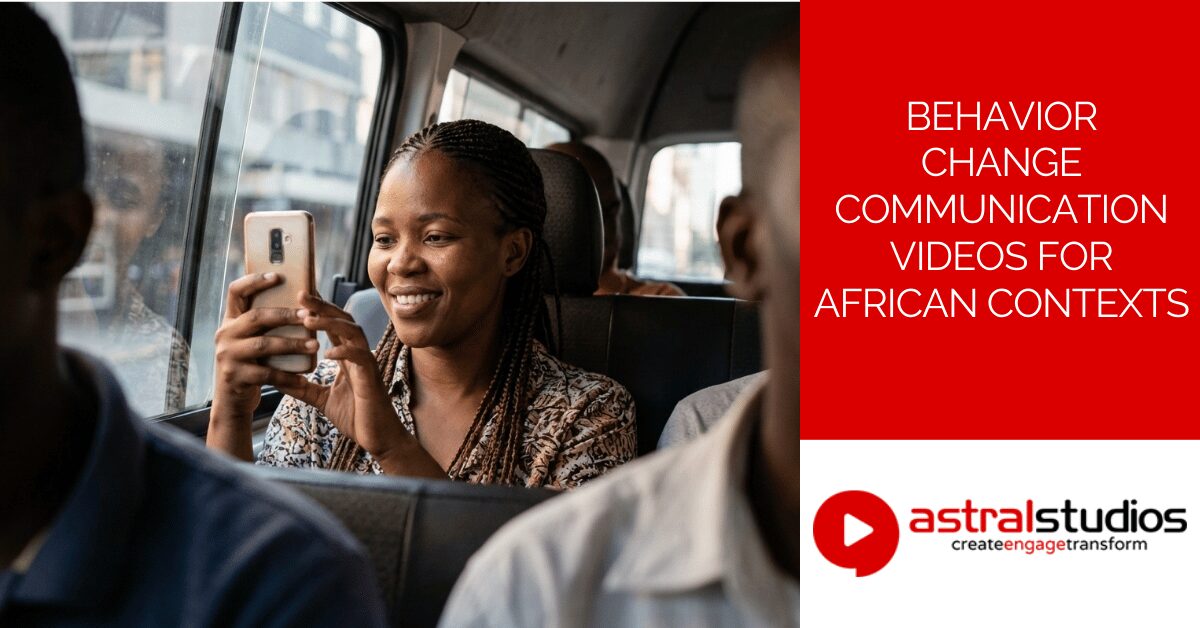
Behavior Change Communication Videos for African Contexts
Last Updated: 1 month ago by Astral Studios Staff
Behavior change communication uses video to shift health behaviours across African communities. This article shows how international development organisations can create videos that work.
I remember watching a health worker in Soweto try to explain HIV prevention using a flip chart. The message was clear to her. But half the audience couldn’t read the text. Three weeks later, the same organisation came back with a short animated video. People watched it twice. They asked questions. They shared it on WhatsApp. That’s the difference video makes.
What Is Behavior Change Communication?
Behavior change communication is a strategic process. It uses various channels to shift how people think and act. The goal isn’t just awareness. You want actual behaviour shifts that improve health outcomes.
Think of it like this: telling someone smoking is bad doesn’t make them quit. But showing them a story about a father who couldn’t play with his kids? That hits differently. Behavior change communication (BCC) is designed to develop positive behaviors and promote individual, community, and societal behavior change.
The World Health Organisation tracks health communication efforts across Africa. Recent data shows that video interventions get better results than traditional methods. People remember stories better than facts.
Why Traditional Methods Fall Short
Pamphlets get thrown away. Radio doesn’t show you how to do something. Posters work in clinics but not in taxis or homes. Video travels everywhere. It fits in pockets. Gets shared. Works across languages.
A colleague once told me about a family planning campaign in rural KZN. They printed 50,000 brochures. Most ended up lining chicken coops. Then they made one 90-second video. Community health workers showed it on tablets. Clinic visits went up by 40% in three months.
The Science Behind Behavior Change Communication
Several theories guide how we create effective videos. You don’t need a PhD to understand them. Just think about what makes you change your mind.
Key Theoretical Models
The Health Belief Model says people change when they believe two things. First, the problem affects them personally. Second, they can do something about it. A good video shows both.
The Theory of Planned Behavior adds social proof. People watch what others do. If your neighbour tests for TB, you’re more likely to test too. Videos can show these social norms in action.
The COM-B Model breaks behaviour into three parts:
- Capability: Can you do it?
- Opportunity: Do you have access?
- Motivation: Do you want to?
Your video needs to address all three. Otherwise you’re just making noise.
| Theory | Focus | Video Application |
|---|---|---|
| Health Belief Model | Perceived risk and benefits | Show personal stories of impact |
| Theory of Planned Behavior | Social norms and attitudes | Feature community leaders and peers |
| COM-B Model | Capability, opportunity, motivation | Demonstrate how-to steps and resources |
| Social Cognitive Theory | Learning through observation | Use role models and success stories |
Why Video Works for Behavior Change Communication
Numbers don’t lie. Research shows that 86.6% of video interventions in African contexts improved health knowledge and outcomes. That’s not a small bump. That’s transformation.
Overcoming Literacy Barriers
South Africa has 11 official languages. Literacy levels vary wildly between communities. A video speaks to everyone. Animation works even better because it simplifies complex medical concepts into visuals anyone can grasp.
Short animated storytelling videos overcome literacy barriers effectively. You don’t need to read to understand a character getting sick, visiting a clinic, and getting better.
Mobile Penetration Makes Distribution Easy
Everyone has a phone now. Even in townships where electricity is unreliable, people keep their phones charged. WhatsApp is everywhere. A 2-minute video can reach thousands in hours.
The Government Communication and Information System notes that mobile video content spreads faster than any other format. During COVID-19, technology platforms such as WhatsApp and social media helped disseminate information quickly.
Emotional Connection Drives Action
Facts inform. Stories inspire. When someone on screen looks like you, talks like you, faces your struggles? That’s when behaviour shifts happen. A video about maternal health featuring a real Soweto mother connects better than a medical textbook ever could.
Neuroscience backs this up. Our brains process visual information 60,000 times faster than text. We remember 80% of what we see versus 20% of what we read.
Animation vs Live-Action for Behavior Change Communication
Both formats work. The question is which one fits your goals and budget.
When Animation Makes Sense
Animation shines when you need to show things cameras can’t capture. How does malaria spread? What happens inside your body during TB? Where do germs hide on your hands?
A client requested a video about water purification for rural communities. Live-action would’ve required microscopes and lab equipment. Instead, animation showed bacteria as little monsters. Kids loved it. Adults remembered it. Clinic staff reported more families boiling water.
Animation also sidesteps cultural sensitivities. Need to show childbirth? Contraception use? Stigmatised conditions? Animation keeps it educational without making anyone uncomfortable.
Advantages:
- Shows abstract concepts (disease transmission, internal body processes)
- Creates universal characters that don’t favour one ethnic group
- Easy to update without reshooting everything
- Works across literacy levels
- Cost-effective for multiple language versions
Limitations:
- Can feel less authentic than real people
- Requires skilled animators
- May not convey emotional depth as well
When Live-Action Works Better
Real people tell real stories. When you want authenticity, live-action wins. Community health workers gain trust when people see their faces. Survivors sharing experiences create powerful testimonials.
Live-action also shows your actual community. Real clinics. Familiar streets. Local languages and accents. This builds relatability in ways animation can’t match.
A maternal health campaign in Limpopo used real mothers talking about their experiences. The response was immediate. Women said “that could be me” and “she sounds like my neighbour.” Behaviour change skyrocketed.
Advantages:
- Builds trust through real faces and voices
- Shows genuine emotion and connection
- Features actual communities and locations
- Perfect for testimonials and survivor stories
Limitations:
- Higher production costs (crew, actors, locations)
- Weather and logistics can delay shoots
- Harder to update or modify
- Language-specific (expensive to reshoot for different regions)
The Hybrid Approach
Why choose? Many successful campaigns mix both. Start with live-action testimonials. Add animated segments explaining medical concepts. Overlay motion graphics with statistics.
This combo gives you authenticity plus clarity. Real people hook viewers emotionally. Animation explains the science. Together they create comprehensive understanding.
Cultural Adaptation for South African Contexts
Making a video in English and slapping on isiZulu subtitles isn’t localisation. That’s lazy translation. Real cultural adaptation goes deeper.
Understanding South Africa’s Linguistic Diversity
Eleven official languages means eleven worldviews. Each community has different health beliefs, social structures, and communication styles. What works in Johannesburg might flop in Mpumalanga.
A video about diabetes prevention used the phrase “sweet disease” in isiZulu. The translation was technically correct. But it confused older viewers who associated “sweet” with positive things. After consulting community leaders, they changed it to “sugar sickness.” Comprehension improved immediately.
Beyond Language: Cultural Elements That Matter
Colours carry meaning. White means purity in some cultures, mourning in others. Hand gestures vary. Food, dress, family structures – all these details matter.
When creating behaviour change communication videos, involve local communities from day one. Don’t just consult them. Co-create with them. Their input catches cultural missteps before they become expensive mistakes.
Dubbing vs Subtitling
Both have trade-offs. Subtitles are cheaper but require literacy. Dubbing costs more but works for everyone. For health communication in diverse communities, dubbing usually wins. People focus on the visuals instead of reading text.
Voice actors need cultural fluency, not just linguistic skill. A Joburg accent sounds different from a Durban accent. Match your voice talent to your target community.
Storytelling Techniques That Drive Behavior Change Communication
Story structure matters more than production budget. A well-told story shot on a phone beats a poorly structured video shot with high-end equipment.
The Problem-Solution-Outcome Framework
This three-act structure works every time:
- Show the problem (relatable situation)
- Present the solution (specific action)
- Demonstrate the outcome (positive result)
Keep it simple. A 90-second video showing a mother noticing her child’s symptoms, taking them to a clinic, and seeing them recover teaches more than a 10-minute lecture.
Using Real People as Messengers
Community health workers, traditional leaders, and religious figures carry trust. When they appear in your videos, people listen. Their authority lends credibility to your message.
But authenticity matters. Don’t script them too heavily. Let them use their own words. People can tell when someone’s reading from a teleprompter.
Balancing Education and Entertainment
Health videos shouldn’t be boring. But they shouldn’t sacrifice accuracy for laughs either. The sweet spot is “edutainment”- content that educates while keeping people engaged.
MTV Shuga proved this works. The show tackled HIV, relationships, and sexual health through drama. Young people watched because it was entertaining. They learned because the information was accurate.
Timing and Length
Mobile data costs still matter. Keep videos under 2 minutes for social sharing. Longer videos work for community screenings or clinic waiting rooms.
Test different lengths. Sometimes a 30-second teaser leading to a full video works better than forcing someone to watch 3 minutes upfront.
The Production Process for Behavior Change Communication Videos
Good videos don’t happen by accident. They need planning, research, and testing at every stage.
Pre-Production: Research and Strategy
Start with formative research. What behaviours do you want to change? Barriers need identifying. Understanding what motivates your audience matters too. You can’t create effective behaviour change communication without understanding your audience first.
A malaria prevention campaign in Limpopo discovered something surprising during research. People knew mosquitoes spread malaria. But they believed expensive bed nets worked better than affordable ones. The video addressed this misconception directly. Sales of affordable nets increased.
Audience segmentation helps too. Young mothers need different messages than teenage girls. Urban professionals face different challenges than rural farmers. One video rarely works for everyone.
Creative Development
Script first. Storyboard second. Get feedback from actual community members before production starts. This catches problems early.
Include stakeholders throughout. NGO partners, health experts, community representatives – their input strengthens the final product. But too many cooks spoil the broth. Assign one decision-maker to keep things moving.
Production Phase
For animation, this means character design, asset creation, and rendering. For live-action, it’s location scouting, casting, and filming. Either way, quality matters. Bad audio or blurry visuals undermine your message.
Johannesburg offers excellent production facilities. Astral Studios has created videos for corporates and government agencies since 1991. Their experience with both animation and live-action makes them ideal partners for behaviour change communication projects.
Post-Production and Testing
Editing sets the pace. Music creates emotion. Colour grading maintains consistency. Don’t rush this phase.
Then test with your target audience. Show rough cuts to community focus groups. Do they understand the message? Does anything confuse them? Would they share this video?
Make adjustments based on feedback. Sometimes small tweaks make huge differences in comprehension and impact.
Distribution Strategies for Maximum Reach
A brilliant video that nobody sees is useless. Distribution needs as much planning as production.
Multi-Channel Approach
Don’t rely on one channel. Use WhatsApp for peer-to-peer sharing. YouTube for searchability. Facebook for broad reach. Community screenings for group discussions.
The Media Online reports that modern audiences expect accessibility and responsiveness, making platforms like Instagram and Twitter vital for fostering trust. But don’t ignore traditional media. Radio spots can drive people to watch videos online.
Working with Community Health Workers
Community health workers are your best distribution partners. Community health worker teams in Gauteng typically consist of six CHWs plus a team leader. Each CHW manages around 250 households. These workers visit homes, build trusted relationships, and use tools like tablets to share health information with families.
Optimising for Mobile and Data Constraints
Compress videos without sacrificing quality. Offer different resolution options. A 720p version for WiFi users. A 360p version for mobile data. People appreciate the choice.
WhatsApp has a file size limit. Keep videos under 16MB for easy sharing. Or create a landing page where people can watch without downloading.
Community Screenings Still Work
Don’t underestimate old-school gatherings. Church halls, community centres, clinic waiting rooms – these spaces foster discussion. People ask questions. Share experiences. Learn from each other.
After a screening, facilitate conversations. What did people think? What questions do they have? This feedback improves future videos and deepens behaviour change.
Measuring Impact of Behavior Change Communication
You need proof your videos work. Funders demand it. But measuring behaviour change takes more than counting views.
Setting Clear Objectives
“Raise awareness” is too vague. “Increase clinic visits by 25% in six months” is specific and measurable. Define what success looks like before you start.
Different behaviours need different timeframes. Handwashing adoption happens quickly. Quitting smoking takes longer. Set realistic timelines.
Tracking Engagement Metrics
Views tell you reach. But completion rates tell you whether people actually watched. Shares indicate resonance. Comments reveal understanding.
YouTube Analytics, Facebook Insights, and WhatsApp Business tools provide data. Track where people drop off. If everyone stops at 45 seconds, that’s where your message loses them.
Measuring Behavior Change
The hard part. Self-reported surveys work but people lie. Clinic attendance data is more reliable. Product sales show adoption. Disease incidence proves impact.
Partner with health facilities to track changes. Before the video: 100 people tested monthly. Three months after: 180 people tested. That’s measurable behaviour change.
Cost-Effectiveness Analysis
Compare costs per person reached. A R500,000 video reaching 100,000 people costs R5 per person. If 5% change behaviour, that’s R100 per behaviour change. Is that good? Depends on the behaviour’s impact.
Maternal health interventions saving lives have different value than handwashing campaigns. Context matters.
Recent Developments in Behavior Change Communication
The field keeps evolving. Staying current helps you create better videos.
Climate Change Communication
Local Climate Voices examines communication for social change as a critical dimension of climate justice, showing that behaviour change communication now addresses environmental issues too. Videos about water conservation, recycling, and sustainable farming need the same strategic approach as health videos.
Social Media Integration
TikTok and Instagram Reels changed how young people consume content. Vertical video is now standard. Shorter formats dominate. Health organisations adapting to these platforms reach youth more effectively.
But don’t chase trends blindly. A 15-second TikTok works for awareness. Behaviour change needs more depth. Use short videos to drive traffic to longer content.
Interactive Video Technologies
Choose-your-own-path videos let viewers make decisions. This increases engagement and personalises messages. Technology costs are dropping, making interactive videos more accessible.
Virtual reality might seem futuristic but it’s already being tested. Imagine medical students practicing procedures in VR. Or community health workers training in simulated environments. The applications for behaviour change communication are enormous.
AI and Automation
AI-powered translation and dubbing tools are improving. Soon you’ll create one video and localise it into 11 languages faster and cheaper than before. This democratises access to quality health communication.
But be careful. AI can’t replace cultural understanding. Use it as a tool, not a replacement for human insight.
Working with Video Production Partners
Choosing the right production company makes or breaks your project. Look for partners who understand behaviour change communication, not just video production.
What to Look For
Ask about previous health communication work. Do they understand your target audience? Can they navigate cultural sensitivities? Will they involve communities in the process?
Technical skills matter but strategic thinking matters more. A producer who asks about your behaviour change objectives before discussing cameras is worth their weight in gold.
Budget Considerations
Animation typically costs R150,000 to R350,000 for a 90-second video. Live-action varies widely based on locations, actors, and crew size. But cheap videos often look cheap. And cheap-looking videos undermine serious health messages.
Consider it an investment, not an expense. One effective video used for three years reaches more people than five mediocre videos used once.
Building Long-Term Partnerships
Don’t treat video production as a one-off transaction. Build relationships with producers who learn your organisation, understand your mission, and improve with each project.
Astral Studios in Johannesburg has worked with government agencies and international organisations for over three decades. Their experience includes documentaries, corporate videos, and educational content – all skills that transfer to behaviour change communication work.
Case Studies from South African Contexts
Real examples show what works.
Perinatal Health in Gauteng
A study tested short animated videos for expectant mothers. The videos covered warning signs, nutrition, and clinic visits. People who watched the videos attended more prenatal appointments. Their babies had better health outcomes.
The key? Videos were in multiple languages. Characters looked like the target audience. Messages addressed specific local barriers to care.
HIV Disclosure Campaign
Stigma keeps people from testing and disclosing their status. A campaign using digital storytelling featured real people sharing their experiences. Viewers saw themselves in these stories.
Testing rates increased in targeted communities. More importantly, people felt less shame asking questions and seeking treatment.
Youth Sexual Health Initiative
MTV Shuga’s South African season tackled relationships, consent, and HIV prevention through entertainment. Young people watched because the story was compelling. They learned because the information was accurate and relevant.
The show sparked conversations in schools, homes, and online. It proved behaviour change communication doesn’t have to be preachy to be effective.
Common Pitfalls to Avoid
Learn from others’ mistakes.
Ignoring Cultural Context
A well-meaning NGO created a beautiful animation about family planning. But they showed women making decisions without consulting partners. In many South African communities, family decisions are joint. The video flopped.
Always involve local communities in development. Their input prevents expensive errors.
Overcomplicating the Message
Trying to cover too much confuses viewers. Focus on one clear behaviour. Do that one thing well instead of five things poorly.
A nutrition video tried to teach portion sizes, food groups, cooking methods, and shopping tips. Viewers remembered nothing. A second video focusing only on vegetable portions worked brilliantly.
Neglecting Testing
Skipping audience testing to save money costs more later. You might produce 10,000 videos only to discover people don’t understand the message.
Test early. Test often. Adjust based on feedback.
Treating Translation as Localisation
Hiring someone to translate your script isn’t enough. Cultural adaptation means rethinking examples, changing visuals, and sometimes restructuring the entire message for different communities.
Ignoring Audio Quality
People forgive shaky camera work more than terrible audio. Bad sound makes professional videos seem amateur. Invest in proper audio recording and mixing.
The Future of Behavior Change Communication in Africa
The field is growing fast. The International Social and Behavior Change Communication Summit happens in June 2026, bringing together experts from around the world. South African practitioners should attend and share their experiences.
Increased Investment
International development organisations recognise video’s power. Funding for behaviour change communication videos is increasing. This creates opportunities for South African production companies to specialise in this niche.
Local Production Capacity
Building African expertise matters. Training local animators, directors, and scriptwriters ensures videos reflect authentic African perspectives. It also builds sustainable industries that don’t rely on foreign production teams.
Research and Evidence
More rigorous studies are measuring what works. This evidence base helps everyone create better videos. Share your results. Contribute to the knowledge pool.
Technology Access
As phones improve and data costs drop, distribution gets easier. More people can watch longer videos. Higher quality becomes standard. This raises the bar for everyone.
Practical Tips for Development Organisations
Some concrete advice for getting started.
Start Small
Don’t try to create a massive campaign immediately. Test with one community. One behaviour. One video. Learn from that experience before scaling up.
Involve Communities Early
Co-creation isn’t just nice to have. It’s necessary. Communities know their challenges better than outside experts. Their input makes videos relevant and effective.
Plan for Distribution from Day One
The best video is worthless if nobody sees it. Budget for distribution the same way you budget for production.
Measure What Matters
Views are vanity metrics. Behaviour change is what counts. Design evaluation frameworks before production starts.
Be Patient
Behaviour change takes time. Don’t expect overnight transformation. Track progress over months and years, not days and weeks.
When something works, tell others. When something fails, share that too. The development community benefits when we learn from each other.
Why South Africa Is Ideal for Behavior Change Communication Video Production
Our country has unique advantages for this work.
Linguistic Diversity
Producing videos in 11 languages isn’t a bug. It’s a feature. Production teams that handle this complexity can work anywhere in Africa.
Production Infrastructure
Johannesburg and Cape Town have world-class facilities. Equipment, studios, and post-production resources match international standards. But costs are lower than Europe or North America.
Cultural Understanding
South African producers understand African contexts. They navigate cultural sensitivities naturally. They build trust with communities. This local knowledge is harder to teach than technical skills.
Regional Access
South Africa connects easily to other African countries. Production teams can work across borders. This regional perspective creates videos that work beyond South African contexts.
Contact Astral Studios
Ready to create behaviour change communication videos that actually work? Astral Studios brings over 30 years of experience in video production and animation. We understand corporate and government communication needs.
Our team handles everything from concept development to final delivery. Animation, live-action, or hybrid approaches – we’ve done it all. And we’re based right here in Johannesburg.
Whether you need one video or an entire campaign, whether you’re targeting urban youth or rural communities, Astral Studios can help. Our work combines technical excellence with strategic thinking. That’s the combination behaviour change communication demands.
Contact us to discuss your project. Let’s create videos that don’t just inform – videos that transform.
Frequently Asked Questions About Behavior Change Communication Videos
How long should a behavior change communication video be?
Keep it under 2 minutes for social media sharing. Mobile data costs still matter to many viewers. Shorter videos get watched completely and shared more often. Community screenings can use longer formats since people aren’t using their own data. Test different lengths with your target audience.
What’s the difference between animation and live-action for health videos?
Animation works best for showing abstract concepts like disease transmission or internal body processes. Live-action builds trust through real faces and authentic stories. Animation costs less to update and localise. Live-action creates stronger emotional connections. Many successful campaigns use both formats together.
How much does behavior change communication video production cost?
Animation typically costs R150,000 to R350,000 for a 90-second video. Live-action varies based on locations, actors, and crew needs. Budget for multiple language versions from the start. Distribution and testing add costs too. Think of it as an investment that reaches thousands of people over several years.
Do behavior change communication videos actually work?
Research shows 86.6% of video interventions in African contexts improved health knowledge and outcomes. Videos work when they’re grounded in behaviour change theory, culturally adapted, and properly distributed. You need to measure results beyond just view counts. Track clinic visits, product adoption, or disease incidence.
How do you localise videos for different South African languages?
Real localisation goes beyond translation. You need voice actors who understand cultural context and local accents. Visual elements might need changing too – colours, gestures, and examples carry different meanings across cultures. Involve community members in reviewing translations before finalising. Dubbing usually works better than subtitles for health communication.
What makes a behavior change communication video culturally appropriate?
Co-create with target communities from day one. Their input catches cultural missteps early. Consider dress, gestures, family structures, religious beliefs, and local health practices. Test your video with community focus groups before wide distribution. What seems fine to outsiders might confuse or offend local viewers.
Which distribution channels work best for health videos in South Africa?
WhatsApp spreads content fastest through personal networks. YouTube provides searchability and permanence. Facebook reaches broad audiences. Community health workers showing videos on tablets creates discussion opportunities. Don’t ignore community screenings in churches, clinics, and community centres. Use multiple channels together for maximum reach.
How do you measure if a video changed behaviour?
Views and shares show reach but not impact. Partner with health facilities to track changes in clinic visits, testing rates, or product sales. Self-reported surveys work but people sometimes lie. Disease incidence data proves long-term impact. Set specific measurable goals before production starts. Track progress over months, not days.

