


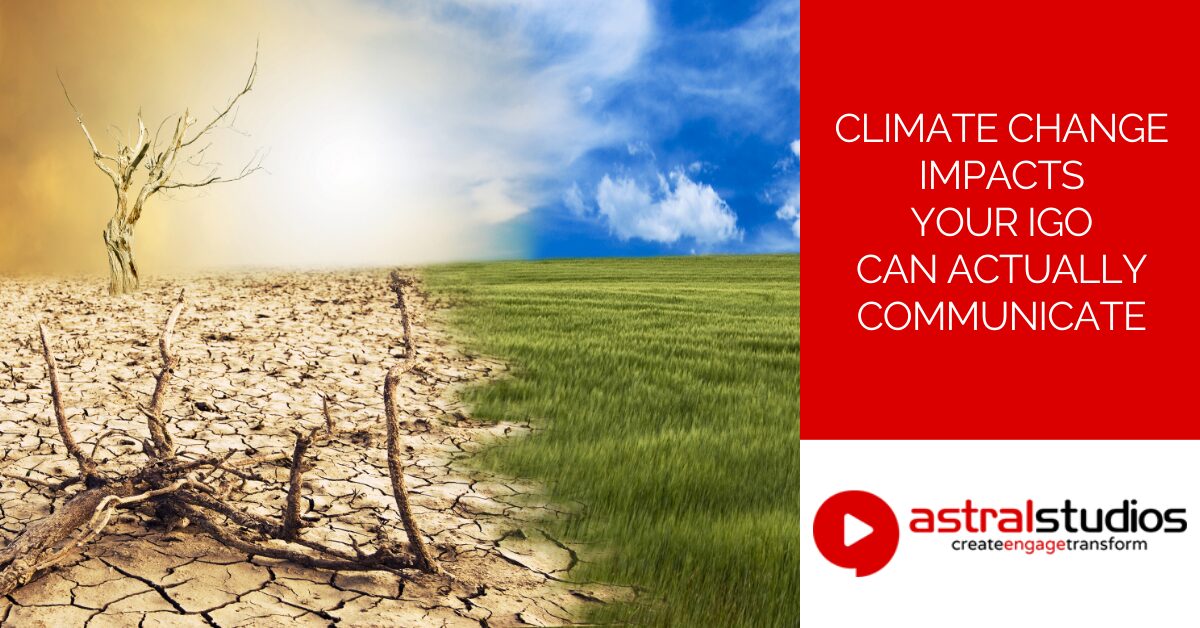
Climate Change Impacts Your IGO Can Actually Communicate
Last Updated: 2 weeks ago by Astral Studios Staff
Climate change impacts are hitting Southern Africa right now, in real time, and the IGOs working here need to say so clearly. This article shows how live action and animated video can help you do exactly that.
Let’s start with something that happened just two months ago.
Between late December 2025 and mid-January 2026, parts of Mozambique, South Africa, Eswatini, and Zimbabwe received more than a year’s worth of rain in ten days. The floods killed at least 280 people, displaced 150,000, and destroyed over 105,000 hectares of farmland. UNEP’s Richard Munang put it plainly in an email to Mongabay: those same communities were still recovering from the 2023/2024 drought when the floods arrived. “Before they could stand up from the drought, the flood knocked them down again.”
That’s not a policy document. That’s a story. And stories are exactly what IGOs need to get better at telling.
Why Climate Change Impacts Are Especially Serious in South Africa
South Africa is one of the driest countries in the world. With an average of just 464mm of rain per year- less than half the global average of 857mm- the country starts from a position of water stress. Then you add rising temperatures, shifting rainfall patterns, and an economy still heavily dependent on water-intensive industries like mining and agriculture.
According to the World Resources Institute, less than 9% of South Africa’s rainfall ends up in rivers, and less than 5% recharges groundwater aquifers. High evaporation rates sometimes exceed annual rainfall in certain regions. That’s the baseline. And climate change is making it worse.
Climate change is intensifying rainfall in Southern Africa. Rapid urbanisation and poor drainage have already made flooding in places like Botswana and eastern South Africa deadly. Scientists working with the World Weather Attribution group say such episodes are becoming more frequent in a warming world.
Scientists estimate that similar five-day rainfall events are now around 60% more intense than in pre-industrial times. That’s not a distant projection. That’s now.
And the economic knock-on effects? PwC’s South Africa Economic Outlook for 2025 found that extreme weather events like droughts, floods, and heatwaves are already causing disruption to supply chains, food production, and mining operations across the country. Nearly half of South African workers surveyed said they believe extreme weather will affect their ability to do their jobs.
For IGOs operating in South Africa – bodies like UNDP, UNICEF, WHO, UNEP, SADC, and the African Union – these climate change impacts are not background noise. They are the work. The question is how to communicate that work to the people who need to understand it.
The Problem With Most IGO Climate Communication
Here’s something that comes up a lot in conversations with people who work in institutional communications. An organisation spends months compiling a thorough report on, say, water security in the Limpopo basin. The science is solid. The recommendations are clear. The design team produces a clean, well-formatted PDF.
It gets sent to 200 stakeholders. Twelve open it. Two read past page five.
This isn’t unusual. It’s the norm.
Climate Change Impacts Are Hard to Picture
Climate science deals in abstractions. Carbon budgets. Temperature anomalies. Parts per million. These are real and important, but they don’t land emotionally for most people. Audiences can’t connect with a chart the same way they connect with a face.
Stories are perceived as more accessible, persuasive, memorable, and engaging than data alone. They are a powerful tool for climate change engagement, particularly when they wrap facts in emotion.
Video does this better than almost any other format. A three-minute film showing a subsistence farmer in Limpopo explaining that her well ran dry for the first time in 40 years will move people in a way that a bar graph simply won’t. The bar graph is evidence. The farmer is the story. You need both, and video can carry both at once.
South Africa’s Language and Literacy Context
South Africa has 12 official languages and a wide range of formal education levels across its population. A well-produced video- especially an animated one with voiceovers in isiZulu, Sesotho, or Afrikaans – can reach audiences that written reports never will.
Animation excels at simplifying complex processes without losing scientific accuracy. Visual representations can accurately depict scientific processes whilst making them more comprehensible than traditional academic presentations.
That’s not a small thing in a country where roughly 20% of adults have limited literacy in English, which is still the primary language of most institutional communication.
The Doom Trap
There’s another problem with a lot of climate communication, and it’s worth naming directly: too much of it is all catastrophe, no agency.
Research published in a 2025 study on climate change communication found that a majority of climate communicators (69%) emphasised the importance of simple, solution-focused messaging. Effective climate communication needs to show audiences not just what’s going wrong, but what they can do about it.
When people feel hopeless, they disengage. Video that shows only disaster, with no path forward, can actually work against behaviour change. The message needs urgency and agency in the same breath.
How Video Brings Climate Change Impacts to Life
This is where production choices really matter.
Live Action Video: When Real Is Best
Live action builds emotional authenticity. It’s best suited to human stories, field documentation, expert interviews, and documentary-style content. There’s no substitute for real footage when the goal is to show that climate change impacts are happening to real people in real places.
Think about what’s possible right now, in early 2026. A production team could film the flood-damaged roads in Gaza Province, Mozambique. They could interview a dam operator in the Northern Cape watching water levels drop. They could follow a community health worker in KwaZulu-Natal managing a spike in waterborne disease cases after flooding.
By sharing personal stories and highlighting the human faces behind the statistics, communicators can make climate change relatable to audiences. Whether it’s a farmer struggling with drought or a coastal community facing rising sea levels, storytelling brings the reality of climate change closer to home.
This is live action’s power. It says: this is not a model. This is not a projection. This is happening.
On the production side, it’s worth noting that Johannesburg operates reliably as a production hub in 2026. Load shedding is no longer the constant disruption it was two years ago. Professional studios have backup power systems in place, and location shoots across Gauteng and beyond are manageable. Eskom has flagged potential risks further down the line, but current production conditions in South Africa are solid.
Animation: When You Need to Show the Invisible
Some of the most important climate change impacts are completely invisible to the naked eye. The greenhouse effect. The carbon cycle. Ocean temperature changes affecting Southern Africa’s rainfall via the La Niña/El Niño cycle. Rising groundwater salinity. These processes can’t be filmed. They have to be drawn.
Government agencies and non-profit organisations use animation to explain policy changes, demonstrate environmental programmes, or encourage public participation in environmental initiatives. The medium’s ability to simplify complex information proves especially valuable for public communication where audiences have varying levels of environmental knowledge.
A client once requested an animated explainer showing how warmer Indian Ocean temperatures push more moisture into Southern African weather systems- exactly the kind of dynamic that drove the January 2026 floods. A live action shoot couldn’t have told that story. But a well-crafted two-minute animation could show the whole chain of events: warm ocean, rising moisture, overloaded river systems, flooded farmland, disease risk. Simple. Clear. Shareable.
Animation is also far more flexible for revisions. When policy changes- and in the climate space, it does- you update the animation digitally rather than booking a reshoot.
The Hybrid Approach: The Best of Both
For most IGO campaigns, the strongest option is a hybrid. Open with live action footage of real climate impacts. Move into animation to explain the science or show future projections. Close with real people and a clear call to action.
This structure works because it triggers two different kinds of audience response. The live action footage creates emotional connection. The animation creates understanding. Together, they move audiences from “I feel something about this” to “I understand what’s happening and what can be done.”
Motion graphics and data animation can also be overlaid onto live footage- showing temperature rise projections, for example, as a visual layer over real footage of a drought-stricken landscape.
Choosing the Right Format: A Quick Guide
| Factor | Live Action | Animation | Hybrid |
|---|---|---|---|
| Best for | Human stories, real events, testimonials | Abstract concepts, data, projections | Complex campaigns needing both |
| Emotional impact | High- real people, real places | Medium- strong with well-developed characters | Highest- combines both |
| Language adaptability | Moderate- reshoots needed for new languages | High- easy to swap voiceovers and subtitles | High |
| Revision flexibility | Low- reshoots are costly | High- changes are made digitally | Medium |
| Climate data communication | Limited | Excellent | Excellent |
| Typical use case | Field documentation, interviews | Explainers, policy communication | Full campaigns, social media series |
The Climate Change Impacts IGOs Should Be Communicating Right Now
South Africa’s Climate Change Act came into operation in March 2025. It sets binding targets, creates accountability mechanisms, and requires government departments to report on climate adaptation progress. That means more public communication is needed- not less. Here are the issues most worth covering.
Water Security
The impacts of climate change are being felt increasingly all over South Africa, and water is the key medium through which these impacts unfold.
Water demand in South Africa is projected to grow by up to 24.6% by 2050 even in a low-carbon scenario. Groundwater levels are falling. Coastal aquifers face saltwater intrusion. Rural communities in Limpopo and the Eastern Cape face unreliable supply from ageing infrastructure. This is a strong topic for both live action (dry riverbeds, water queues, dam operators) and animation (the water cycle, aquifer dynamics, rainfall distribution).
For more detail on South Africa’s water situation, see Greenpeace Africa’s water crisis overview and the World Resources Institute’s work on South African city water resilience.
Flooding and Extreme Weather
Periods of intense rainfall over southern Africa have become around 40% more severe since pre-industrial times, according to observations. Researchers have confidence that climate change has increased both the likelihood and the intensity of extreme rainfall events in the region.
The January 2026 floods are a current, compelling case study. Any IGO working on disaster risk reduction, humanitarian response, or infrastructure resilience has a story to tell here- and live action documentary content is the right format.
Food Security
Since late December 2025, severe flooding has destroyed more than 173,000 acres of crops in the region, compounding vulnerability in areas already affected by the 2023/2024 drought.
Food security is one of the most accessible climate change topics for general audiences. People understand what it means when crops fail. Animation can show how shifting rainfall patterns affect planting seasons, while live action can put faces on the farmers experiencing those changes.
Public Health
The World Health Organisation has noted that the January 2026 flooding disrupted access to health services and increased the risk of water-borne and mosquito-borne diseases, as well as respiratory infections across southern Africa.
Malaria and cholera risk areas are expanding as temperatures shift. Animation is ideal here- it can show disease transmission pathways without using distressing imagery.
The Just Energy Transition
South Africa’s coal-to-renewables transition is one of the biggest IGO communication topics in the country right now. It combines economic risk, job creation, community impact, and long-term climate goals in a single story. That story needs to be told well, in multiple formats, to multiple audiences. For a detailed look at the tensions involved, see Climate Scorecard’s analysis of South Africa’s climate mitigation and economic development.
What to Look for in a Video Production Partner
Not every production company understands the IGO context. Large international bodies have specific needs: multilingual content, long approval chains, accessibility requirements, multiple deliverable formats for different platforms, and a need for scientific accuracy in every frame.
A good production partner for climate communication work will understand how to work with subject matter experts during the scripting phase- not just filmmakers and animators. They will have experience with institutional clients and know how to move through approval processes without losing momentum.
They will also understand that a single shoot or animation project can produce content for multiple platforms. A 10-minute documentary can yield a 90-second social media cut, a 3-minute conference version, and a series of short animated explainers- all from the same production budget. That kind of thinking matters when IGO budgets are finite and the communication need is large.
Ready to Tell Your Climate Story?
If your organisation is sitting on important work around climate change impacts and you’re not sure how to communicate it in a way that actually reaches people- that’s a solvable problem.
Contact us at Astral Studios. We work with corporate and government clients across South Africa to produce live action and animated video content that gets the message across. Let’s talk about what your audiences need to hear, and how to make sure they actually listen.
Get in touch with Astral Studios
Glossary
Animated explainer video
A short animated film that breaks down a complex concept or process into simple, visual terms. Often used for science communication, policy explainers, and public awareness campaigns.
Behaviour change communication (BCC)
A communication strategy designed to shift attitudes and actions in a target audience. In the climate space, this means moving people from awareness to action.
Carbon budget
The total amount of carbon dioxide that can be released into the atmosphere while keeping warming below a given temperature target, such as 1.5°C above pre-industrial levels.
Climate adaptation
Actions taken to adjust to actual or expected climate change and its effects. Examples include building flood barriers, switching to drought-resistant crops, and updating early warning systems.
Climate mitigation
Actions taken to reduce or prevent the emission of greenhouse gases. Switching from coal to renewable energy sources is one example.
Climate whiplash
The rapid alternation between extreme drought and extreme flooding in the same region. Climate scientists have documented this pattern in Southern Africa, the Horn of Africa, and East Africa.
Data visualisation
The use of charts, infographics, and animated graphics to represent data in a visual format. Particularly useful in climate communication for showing temperature trends, rainfall changes, and economic projections.
El Niño-Southern Oscillation (ENSO)
A climate pattern involving temperature changes in the Pacific Ocean that affects rainfall across much of Africa, including South Africa. La Niña (the cool phase) typically brings wetter conditions to Southern Africa.
Greenhouse gas emissions
Gases, primarily carbon dioxide and methane, released by human activity that trap heat in the atmosphere and drive global warming.
Hybrid video
A production format combining live action footage and animation. Often used in complex communication campaigns where both emotional authenticity and conceptual clarity are needed.
IGO (Intergovernmental Organisation)
An organisation established by treaty or agreement between two or more governments. Examples active in South Africa include the United Nations agencies (UNDP, UNICEF, WHO, UNEP), SADC, and the African Union.
Just Energy Transition (JET)
South Africa’s policy framework for shifting from coal-based energy to renewable energy in a way that minimises job losses and supports affected communities.
La Niña
The cool phase of the El Niño-Southern Oscillation (ENSO). During La Niña, Southern Africa typically experiences above-average rainfall. The January 2026 floods occurred during a La Niña period.
Live action video
Film or video recorded with real cameras in real locations, featuring real people and environments. Contrasted with animation.
Motion graphics
Animated graphic elements, including text, icons, and data visuals, often overlaid onto live action footage or used in standalone animated content.
Visual storytelling
The use of images, video, and animation to communicate a narrative. In climate communication, visual storytelling makes abstract processes tangible and emotionally accessible.
World Weather Attribution (WWA)
An international scientific group that rapidly analyses whether and how climate change has influenced specific extreme weather events. The WWA group analysed the January 2026 Southern African floods.
Frequently Asked Questions
What are the main climate change impacts affecting South Africa right now?
South Africa faces several serious climate change impacts at the same time. Rainfall is becoming less predictable, with long dry spells followed by extreme floods. The January 2026 floods across Mozambique, South Africa, Eswatini, and Zimbabwe killed at least 280 people and destroyed over 173,000 acres of crops. Temperatures in the interior are rising faster than the global average. Water security is under pressure, with demand projected to grow by up to 24.6% by 2050. Food production, public health, and economic output are all affected.
Why should IGOs use video to communicate climate change impacts?
Most people don’t read long reports. A well-made video reaches audiences that written documents never will, especially in a country with 12 official languages and varying levels of literacy. Video combines emotional storytelling with factual clarity, which makes it far more likely to shift attitudes and drive behaviour change than a PDF or slide deck. For IGOs with complex, data-heavy messages, video is one of the most effective communication tools available.
What is the difference between live action and animated video for climate communication?
Live action video uses real footage of real people and places. It builds emotional connection and authenticity. It works best for human stories, field documentation, expert interviews, and showing that climate change impacts are happening to real communities right now. Animation, on the other hand, is ideal for making invisible or abstract processes visible, like the greenhouse effect, the water cycle, or disease transmission pathways. Animation also works across literacy levels and adapts easily to multiple languages. Many IGO campaigns use a hybrid approach that combines both formats.
How long should a climate change video be?
It depends on the platform and the audience. For social media, keep it under 90 seconds. In the case of conferences or ministerial briefings, three to five minutes works well. For community outreach, shorter and simpler is better. For internal stakeholder use, a longer documentary format is acceptable. A good production partner can help you get multiple cuts from a single production, so you cover several platforms without blowing the budget.
How do you avoid making climate change communication too scary or discouraging?
This is a real risk. Research consistently shows that audiences disengage when climate messaging focuses only on catastrophe with no sense of agency. The most effective climate communication balances urgency with solutions. Show what’s going wrong, but also show what’s being done about it and what the audience can do. Video is particularly good at this balance because it can hold both a difficult reality and a hopeful possibility in the same short film.
Can animated video work for audiences with low literacy levels?
Yes, and it’s one of animation’s biggest strengths. A well-designed animated explainer can communicate clearly without relying on written text. Voiceovers in the audience’s home language, clear visuals, and simple character-driven storytelling can get complex messages across to audiences who would struggle with a written report. This matters a lot in South Africa, where English is the primary language of most institutional communication but is not the home language of the majority of the population.
How does South Africa’s Climate Change Act affect IGO communication work?
South Africa’s Climate Change Act came into operation in March 2025. It sets binding emissions targets, creates accountability mechanisms, and requires government departments to report on climate adaptation progress. This means more public-facing communication is coming, not less. IGOs working in South Africa need to be ready to explain what the Act means for communities, industries, and government bodies in plain language. Video is one of the clearest ways to do that.
Is video production in Johannesburg reliable given South Africa’s electricity situation?
Yes, in 2026 it is. Load shedding is no longer the constant disruption it was two years ago, and professional production studios have backup power systems in place. Johannesburg is a well-established production hub with strong infrastructure, diverse creative talent, and good access to locations across Gauteng and beyond. Eskom has flagged potential risks further into the decade, so it’s worth keeping an eye on the energy situation, but current production conditions are reliable.
What should an IGO look for in a video production partner in South Africa?
Look for a company with experience working with institutional clients, not just commercial brands. IGO projects involve long approval chains, scientific accuracy requirements, multilingual deliverables, and multiple output formats for different platforms. A good production partner will work with your subject matter experts during the scripting phase, understand how to move through approval processes without losing momentum, and know how to get maximum value from a single production by creating multiple cuts and formats.

