


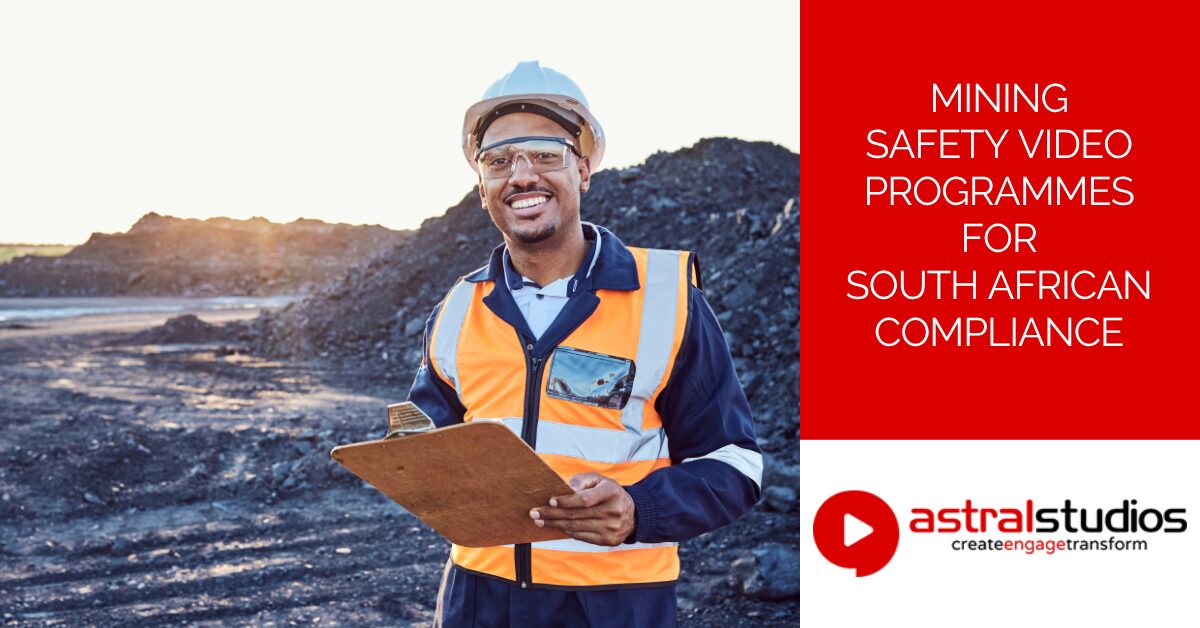
Mining Safety Video Programmes for South African Compliance
Last Updated: 1 month ago by Astral Studios Staff
Mining safety training can mean the difference between a worker coming home at the end of their shift or not. This article explains how video programmes help South African mines meet new compliance requirements while actually keeping people safe.
I remember sitting in a boardroom two years ago when a mining HR director told me something I’ll never forget. They’d just lost a young operator in a fall-of-ground accident. The guy had completed all his classroom training. He’d signed off on the safety documents. But when the moment came, he froze. He didn’t know what to do with his body, how to move, where to go. The training hadn’t stuck.
That conversation changed how we think about safety training at Astral Studios. Because here’s the thing: your workers aren’t going to remember a PowerPoint presentation when rocks start falling. They need something that gets into their bones.
The Compliance Pressure Is Real Right Now
South Africa’s mining industry just recorded its lowest fatality rate ever in 2024. Forty-two deaths. That’s still forty-two families destroyed, but it’s a 24% drop from the year before. Something’s working.
The Department of Mineral Resources and Energy isn’t letting up though. Between October and November 2025, four new Mandatory Codes of Practice came into effect. Fire prevention. Road and railway safety. Change management. Mental health and non-communicable diseases.
If you’re not training your people on these codes, you’re breaking the law. The Mine Health and Safety Act doesn’t mess around. Failure to implement these codes is a criminal offence. Not a fine. An offence.
Your inspectors know this. They’re looking harder at training documentation than ever before. The 2024 amendments to the MHSA made penalties stricter. Legal risks for workplace accidents went up. Way up.
Why Mining Safety Video Training Actually Works
Here’s what the research shows. People remember 80% of what they see and do. They remember 10% of what they read. Maybe 20% of what they hear.
When a miner watches another miner demonstrate the right way to inspect a stope before entering, something clicks. When they see the consequences of skipping a step, even in animation, it creates a memory anchor.
We worked with a platinum mine last year that was struggling with repeat transportation accidents. Same mistakes. Different people. The problem wasn’t that workers didn’t care. They just couldn’t visualize the danger until it was too late.
So we created a series of short videos. Three to five minutes each. Half were animated to show what happens inside the machinery when things go wrong. Half were live action with their own experienced drivers explaining near-misses.
Six months later, transportation incidents dropped by 40%. The safety manager told me the videos did something their classroom sessions never could. They made the invisible visible.
The Language Challenge Nobody Talks About Enough
South African mines are incredible melting pots. One operation might have workers speaking Zulu, Xhosa, Sotho, Tswana, Ndebele, plus migrants from Mozambique, Malawi, Swaziland.
You can’t train someone effectively in a language they don’t fully understand. That’s not compliance. That’s theatre.
Video solves this in ways that classroom training never will. You produce the content once. Then you adapt it. New voiceovers in different languages. Subtitles. Even the on-screen text gets translated.
Animation gives you extra flexibility here. No need to reshoot because your supervisor doesn’t speak Sotho. You just swap the audio track. Update the text layers. Done.
One gold mine we work with rolled out the same safety module in seven languages. Total cost was maybe 30% more than doing it in English only. But now every single worker can learn in their home language. Comprehension rates jumped. So did test scores.
Animated vs Live Action: When to Use What
This question comes up in every single discovery meeting. Should we animate this or film it?
The answer is: it depends on what you’re teaching.
Use Animation When You Need To
Show things that are impossible or dangerous to film. What happens underground during a rock burst. How gases behave in confined spaces. The internal mechanics of a winder system.
Animation lets you slow down time. Zoom into places cameras can’t reach. Make the invisible visible. Plus, you can show the worst-case scenario without risking a single person.
It’s also brilliant for multilingual rollouts. The visual language of animation often needs less explanation. A falling rock looks dangerous in any language. Add the appropriate voiceover and subtitles, and you’re speaking to everyone.
Updates are easier too. When the regulations change in two years, you don’t need to get everyone back on set. You adjust the animated sequences. Record new narration. Much cheaper than reshoots.
Use Live Action When Trust Matters
Some training needs a human face. PPE demonstrations. Physical tasks like lifting techniques or equipment inspections. Testimonials from workers who survived accidents.
There’s something powerful about seeing a respected shift boss look directly at the camera and say “I almost died because I skipped this step. Don’t be me.”
Live action builds trust faster. Your workers see someone who looks like them, sounds like them, works where they work. That connection matters when you’re trying to change behaviour.
The best approach? Hybrid. Start with a live supervisor introducing the topic. Cut to animation for the technical explanation. Back to live action for the practical demonstration. This combination keeps people engaged while covering all the learning angles.
What the New Codes of Practice Actually Require
Let me break down what you need to cover in your training programmes right now.
Fire Prevention
Your workers need to know fire risks specific to their area. How to use firefighting equipment. Evacuation procedures. Where the assembly points are. What to do if they discover a fire.
Video is perfect for this because you can show different scenarios. Surface fires. Underground fires. Electrical fires. Each needs different responses.
Road and Railway Safety
Trackless mobile machinery caused some of the worst accidents in previous years. Your training must cover vehicle inspections. Safe operating procedures. Pedestrian awareness. Collision avoidance systems.
This is where live action shines. Film the actual inspection process. Show the right way to approach a crossing. Demonstrate proper signalling.
Change Management
This code might seem abstract, but it’s crucial. Any change to mining methods, equipment, or procedures creates new risks. Workers need to understand why changes happen and how to stay safe during transitions.
Animation helps here. You can show the old way and new way side by side. Highlight what’s different. Explain the safety improvements.
Mental Health and Non-Communicable Diseases
This is brand new territory for many mines. Your training needs to cover stress management. When to ask for help. How to support colleagues. Warning signs of mental health struggles.
Live action testimonials work best. Real people sharing real experiences. It reduces stigma and normalizes asking for help.
Building Mining Safety Training Programmes That Meet DMRE Standards
The Mine Health and Safety Act requires more than just showing videos. You need documentation. Assessment. Proof of competency.
Here’s what compliant programmes include:
Clear learning objectives. Each module states exactly what workers will know and be able to do afterwards.
Knowledge checks. Questions throughout the video. Not just at the end. This keeps people engaged and helps with retention.
Practical assessments. Video training covers the theory. But competency requires demonstration. Your programme should link to hands-on assessments.
Completion tracking. You need records of who watched what and when. Learning management systems handle this automatically.
Regular updates. Training content must reflect current codes and site-specific procedures. Video makes updates practical.
The ROI Nobody Expects
Yes, professional video production costs money upfront. But look at what it replaces.
Classroom training pulls workers off the job. Travel costs add up if you’ve got multiple sites. Instructor time isn’t free. Training quality varies depending on who’s teaching that day.
Video flips this model. Produce once. Deploy everywhere. Consistent quality every time. Workers train during downtime or shift changes. No travel needed.
One coal mine calculated their ROI at 300% over three years. They included reduced incident costs, lower insurance premiums, and saved instructor time. The videos paid for themselves in eighteen months.
Another client saw their inspection scores jump from 73% to 88% in one year. The inspector specifically noted improved training documentation and better worker understanding of procedures.
How Different Sectors Need Different Approaches
Platinum, gold, and coal mining each have unique hazards. Your training programmes need to reflect this.
Platinum Sector Challenges
Platinum mines recorded 19 fatalities in 2024. The highest of any sector. These operations go deep. Really deep. Fall-of-ground risks increase with depth. So does heat stress.
Training needs to cover stope support. Rock engineering basics. Heat illness recognition. Emergency evacuation from extreme depths.
Gold Mining Evolution
Gold operations saw an amazing 45% drop in fatalities last year. Down to 11 deaths. This sector has pushed hard on mechanization and technology adoption.
Training programmes should cover both traditional mining methods and new remote-operation systems. Automation changes everything about how workers interact with equipment.
Coal Mining Specifics
Six fatalities in coal last year. The sector’s main risks are different. Gas explosions. Spontaneous combustion. Roof collapses in board-and-pillar operations.
Video training can show gas testing procedures. Safe withdrawal protocols. How to read warning signs of heating coal.
Making Mining Safety Training Stick: The Assessment Question
The MHSA demands competency-based training now. This means you can’t just show someone a video and call it done. You need proof they understood and can apply what they learned.
Smart video programmes build assessment right in. Pause points with questions. Branching scenarios where choices lead to different outcomes. “What would you do next?” decision points.
After the video, practical assessments follow. Can they actually inspect that conveyor belt? Do they know where the fire extinguishers are? Can they demonstrate proper lifting technique?
This combination of video learning and practical testing creates defensible documentation. When the inspector asks for proof of training, you’ve got timestamps, test scores, and practical assessment records.
The Technology Side: Delivery and Tracking
Video training only works if people can actually access it. Most mines now use learning management systems. These platforms host the videos. Track who watched what. Generate completion certificates. Produce reports for audits.
Mobile delivery matters too. Tablets at the mine site. Offline access for areas without Internet connectivity. Workers can complete training during their shift without leaving the property.
Some progressive mines are exploring VR training for high-risk scenarios. The CSIR has a virtual reality facility at Kloppersbos for competency-based training. VR creates incredibly immersive learning experiences. But it’s still expensive and requires specialized equipment.
Standard video training delivers 80% of the benefit at 20% of the cost. Start there. Add advanced tech later if budget allows.
What Makes a Good Production Partner
Not every video company understands mining. You need a partner who gets the regulatory environment. Who knows what the DMRE inspectors look for. Who can work with your safety team to create content that’s both engaging and compliant.
Look for these things:
Mining industry experience. Have they done this before? Do they understand the terminology? Can they tell a rock drill from a rock bolt?
Multilingual capabilities. Can they handle seven language versions without making a mess of it? Do they work with native speakers for voiceovers and cultural review?
Compliance knowledge. Do they know what the MHSA requires? Can they help structure content to meet code of practice specifications?
Update flexibility. What happens when regulations change? How much does it cost to modify content? How long does it take?
Assessment integration. Can they build interactive elements into the videos? Do they work with LMS platforms?
What This Looks Like In Practice
Let me paint you a picture of how this actually works on the ground.
A platinum mine needed to train 800 workers on the new fire prevention code. Different shifts. Multiple languages. Literacy levels varied across the workforce.
The solution was a modular programme. Five videos, each under six minutes. Animation showed how fires start and spread underground. Live action demonstrated equipment use and evacuation procedures.
Each video came in seven languages. Knowledge checks appeared every two minutes. The LMS tracked completion automatically.
Rollout took three weeks. Every worker completed training on their own shift. No production time lost. Assessment scores averaged 87%. The next inspector visit found zero non-compliance issues on fire prevention training.
Total cost was less than bringing in external trainers for a month. And the content will serve them for years.
The Mistakes to Avoid
I’ve seen enough projects go sideways to know the common pitfalls.
Don’t make videos too long. Attention drops hard after six minutes. Break complex topics into shorter modules.
Don’t skip the SME involvement. Your safety officers and experienced miners know what workers actually struggle with. Use that knowledge.
Don’t ignore cultural context. What’s acceptable humour or imagery in one culture might offend another. Get cultural review from native speakers.
Don’t forget about updates. Build revision costs into your long-term budget. Regulations change. Procedures evolve.
Don’t skip practical assessments. Video alone doesn’t prove competency. Combine it with hands-on testing.
Measuring What Matters
How do you know if your training programmes actually work? Look at these metrics:
Incident rates. Are they dropping? Specifically, are repeat accidents going down?
Inspection scores. What do DMRE inspectors say about your training documentation and worker knowledge?
Knowledge retention. Test workers 30, 60, 90 days after training. Are they remembering the critical information?
Completion rates. Is everyone actually finishing the training? Low completion might mean content is too long or boring.
Worker feedback. Ask them directly. Did the training help? Was it clear? What would improve it?
One mining group tracks all of this in a dashboard. They correlate training completion with incident rates by section and shift. When they spot patterns, they adjust content.
The Future Is Already Here
Technology keeps evolving. AI-powered personalized learning paths. Augmented reality for on-site guidance. Real-time translation that actually works.
But here’s what won’t change: people still need to understand what can kill them and how to prevent it. Video remains one of the best tools for that job.
The mines doing this well aren’t waiting for perfect technology. They’re using what works now. Professional video programmes that cover the regulations, speak to workers in their own languages, and actually teach safety skills that save lives.
When to Choose Video Format: Quick Reference
Here’s a simple breakdown to help you decide:
| Training Need | Best Format | Why |
|---|---|---|
| Underground hazard explanation | Animation | Shows dangerous scenarios safely |
| Equipment inspection procedure | Live Action | Physical demonstration required |
| Emergency response steps | Hybrid | Live intro, animated scenario, live demonstration |
| Multilingual rollout | Animation | Easier to update voiceovers |
| Testimonials and stories | Live Action | Human connection builds trust |
| Complex machinery operation | Animation | Can show internal processes |
| PPE usage demonstration | Live Action | Workers see real equipment |
| Regulation overview | Hybrid | Supervisor intro with animated examples |
Your Next Steps
Mining safety isn’t getting easier. Regulations get stricter. Penalties get harsher. But here’s the good news: the tools to meet these challenges keep improving.
Video training programmes give you consistency. Scalability. Documentation. And most important, they actually work at changing behaviour and saving lives.
If you’re still relying on classroom training alone, you’re playing catch-up. The mines leading on safety have already moved to video-first training strategies.
Start by identifying your biggest compliance gaps. Which of the new mandatory codes need immediate attention? Where are your repeat accidents happening? What does your workforce actually struggle with?
Then build training that addresses those specific needs. Make it short. Keep it clear. Deliver it in the languages your workers speak.
Partner With Experts Who Understand Mining
Astral Studios has worked with mines across South Africa to create training programmes that meet DMRE requirements while actually improving safety outcomes. We understand the regulations. We know the industry. And we can help you develop video training that protects your workers and your compliance status.
Contact us to discuss your mining safety training needs. Let’s create programmes that work.
Frequently Asked Questions
What makes video training better than classroom sessions for mining safety?
Video training sticks in people’s memories better. Workers remember 80% of what they see and do, compared to just 10% of what they read. Plus, video gives you consistency. Every worker sees the same high-quality content, regardless of which shift they’re on or who’s available to teach that day.
How much does professional mining safety video production cost?
Costs vary based on length, format, and language requirements. A simple five-minute live action module might run R50,000 to R80,000. Animation typically costs more upfront but saves money on multilingual versions and updates. Most mines see full ROI within 18 to 24 months through reduced incidents and saved instructor time.
Do we need separate videos for each language or can we just add subtitles?
Subtitles help, but voiceovers work better. Many miners have varying literacy levels, and reading while trying to absorb visual information splits their attention. Audio in their home language ensures better comprehension. The good news is that adding language versions costs much less than creating new videos from scratch.
How long should each training video be?
Keep videos under six minutes. Attention drops hard after that point. Break complex topics into multiple short modules instead of one long video. Workers retain more information from three five-minute videos than one fifteen-minute video.
Will the DMRE accept video training as proof of compliance?
Yes, if it’s done properly. Your programme needs clear learning objectives, knowledge checks, completion tracking, and links to practical assessments. The DMRE wants proof of competency, not just proof someone sat in a room. Video with proper documentation and assessment delivers exactly that.
What happens when regulations change and we need to update content?
Animation is easiest to update. You modify the affected scenes and record new narration. Live action requires reshoots, which cost more. Build update flexibility into your contract with your production partner. Ask about revision costs and turnaround times upfront.
Can workers access training offline at remote mine sites?
Absolutely. Modern learning management systems let you download content to tablets or local servers. Workers complete training on-site without needing Internet access. The system syncs completion data when connectivity returns.
How do we prove workers actually learned the material?
Combine video with assessment. Build knowledge checks into the videos themselves. Follow up with practical demonstrations. Test workers 30, 60, and 90 days after training to measure retention. Good LMS platforms track all of this automatically and generate audit-ready reports.
Should we use our own workers in the videos or hire actors?
Real workers build more trust, especially for testimonials and cultural authenticity. But they’re not professional presenters. A hybrid approach works well. Use respected supervisors and experienced miners for credibility moments. Use professional narration for technical content. Animation avoids this question entirely.
How many languages do we really need?
That depends on your workforce. Most South African mines need at least four to six languages. Zulu, Xhosa, Sotho, and English cover many operations. Add Tswana, Ndebele, or Portuguese based on your demographics. Training someone in a language they don’t fully understand isn’t training at all.

