


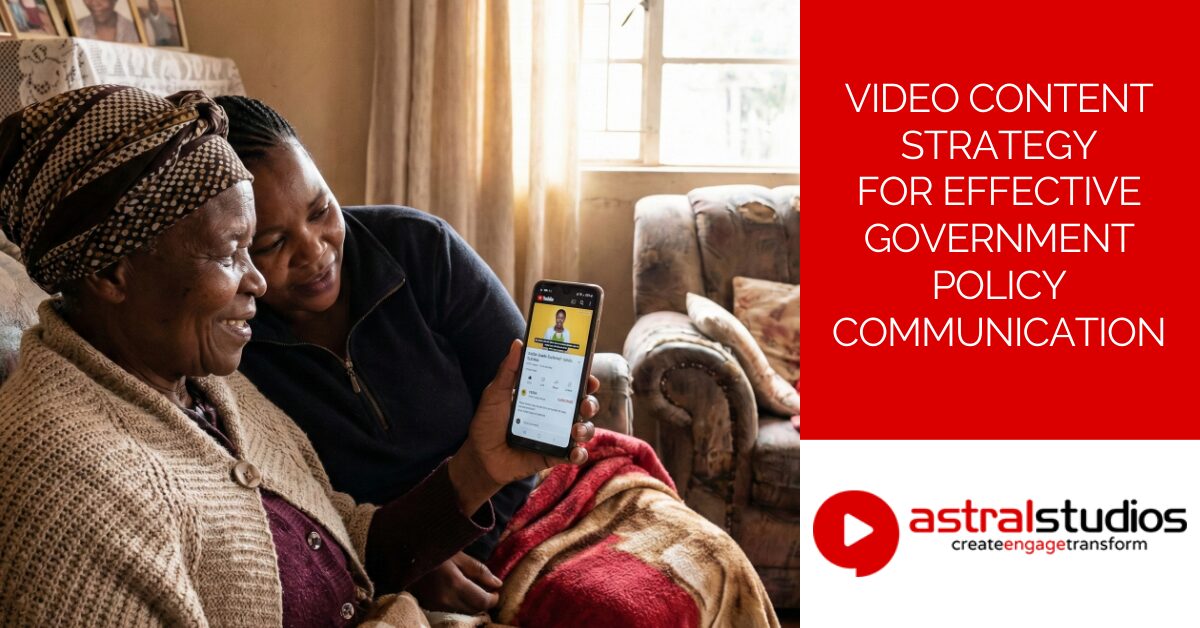
Video Content Strategy for Effective Government Policy Communication
Last Updated: 3 months ago by Astral Studios Staff
A video content strategy helps government departments plan, create, and share videos that actually reach people. This article shows you how to build one that works for South African audiences.
I’ll never forget sitting in a municipal office in 2023, watching a frustrated communications officer try to explain a new water tariff policy. She had a 47-page PDF document. The queue of residents asking the same questions stretched out the door. “If only we had a simple video,” she said, “people would get it.”
She was right. But here’s the thing—just making a video isn’t enough. You need a proper plan.
Why Your Department Needs a Video Content Strategy
Let me be straight with you. Government communication is stuck in the past. You’re still printing pamphlets that people bin immediately. You’re drafting press releases that journalists ignore. Meanwhile, your residents are on their phones watching videos.
The numbers don’t lie. South Africans watch over 1 billion hours of video on YouTube every month. That’s where your audience is. Not reading your 20-page policy document.
GCIS shifted Vuk’uzenzele to digital-only distribution in 2024, focusing on photography and audio-visual content. They saw what was coming. The question is—are you ready?
A video content strategy isn’t complicated. It’s just a plan for what videos you’ll make, who they’re for, and how you’ll share them. Think of it like a cookbook for your communication team.
What Makes Government Video Different
Here’s what I’ve learnt working with departments across Gauteng and Free State: government video has unique challenges.
You’re not selling sneakers. You’re explaining policy changes that affect people’s lives. Tax regulations. Housing applications. Health services. These topics aren’t naturally exciting, but they’re dead important.
Plus, you’ve got 11 official languages. Your audience ranges from teenagers in Soweto to pensioners in the Eastern Cape. Some have unlimited data. Others are counting megabytes.
That’s before we even talk about trust. Let’s be honest—public trust in government communication isn’t great. A slick video might work for a private company. For you, authenticity matters more.
Understanding Video Content Strategy Basics
A video content strategy answers five simple questions:
- What are we trying to achieve?
- Who are we talking to?
- What will we say?
- Where will we share it?
- How will we know it worked?
Sounds obvious, right? But I’ve seen departments spend R200,000 on a beautiful animated video without answering question two. They made a video for “everyone.” Guess what? It reached no one.
Your strategy should match your budget. A small municipality doesn’t need the same approach as a national department. Start small. Test things. Learn what works for your specific audience.
Building Your Video Content Strategy Step by Step
Step 1: Set Clear Goals
Don’t just say “we want more engagement.” That means nothing. Be specific. What exactly do you want?
Maybe it’s:
- Reduce queries about grant applications by 40%
- Increase clinic registration among youth by 25%
- Improve understanding of new bylaws before implementation
Notice these are measurable. You can check if you hit them. That’s how you prove your video content strategy actually works.
I worked with a provincial health department last year. Their goal was simple: get more pregnant women to book early antenatal visits. They made short videos in isiZulu and Sesotho showing real clinic visits. Bookings went up 31% in three months. That’s a clear win.
Step 2: Know Your Audience Inside Out
This is where most departments mess up. They think about themselves, not their audience.
Your audience doesn’t care about your org chart. They don’t care which sub-directorate handles what. They care about solutions to their problems.
Start by asking:
- What keeps them up at night?
- What government services do they need most?
- Where do they get information now?
- What language do they speak at home?
A municipality in Limpopo did something clever. They sent junior staff to taxi ranks and shopping centres. Just to listen. They discovered people had loads of questions about property rates. But everyone thought the process was more complicated than it actually was.
So they made a 90-second animated explainer. Simple, clear, in Sepedi and English. Problem solved.
Step 3: Choose Between Animation and Live Action
This question comes up every single time. Should we animate or film real people?
The answer is: it depends what you’re explaining.
Use animation when:
- The concept is abstract (like how a tax rebate works)
- You need to show processes that are hard to film
- You want to keep it simple and universal
- Budget is tight (animation can be cheaper than location shoots)
Use live action when:
- You want to build trust and connection
- You’re showcasing real success stories
- You need to show actual facilities or services
- The human element is what matters most
Often, the best approach mixes both. Show a real person talking, then animate the complex bit they’re explaining. Like explaining the e-Visa application process—film someone at Home Affairs welcoming applicants, then animate the actual online steps.
Here’s a comparison to help you decide:
| Factor | Animation | Live Action |
|---|---|---|
| Best for complex ideas | Yes | No |
| Shows real people | No | Yes |
| Easy to update | Yes | No |
| Builds emotional connection | Moderate | High |
| Production time | Medium | Fast |
| Language flexibility | Excellent | Good |
| Works for all ages | Yes | Depends |
Step 4: Plan Your Content Calendar
Random videos don’t work. You need a plan. When will you release what?
Match your videos to your annual calendar. Tax season? Make tax videos. School registration period? Make education videos. Budget speech coming? Make explainers.
Think in campaigns, not one-offs. A single video gets lost. A series of three related videos creates momentum.
One department I know plans everything in quarters:
- Q1: Budget and financial literacy
- Q2: Service delivery updates
- Q3: Youth programmes and internships
- Q4: Year-end and planning for next year
They batch-film everything. Saves money. Keeps content consistent. Makes the team’s life easier.
Step 5: Choose Your Distribution Channels Wisely
Making a great video means nothing if no one sees it. Distribution is where your video content strategy lives or dies.
Don’t just post on YouTube and hope. Think about where your specific audience actually spends time.
WhatsApp is king in South Africa. More people use it than any other platform. Can you share your video in WhatsApp-friendly formats? Keep it under 16MB. Make it work without sound (add captions).
Facebook reaches older demographics. Parents and grandparents are there. If you’re targeting families, don’t skip it.
TikTok and Instagram Reels reach the youth. Short, punchy, entertaining. If you’re hiring or running youth programmes, this is where you need to be.
Your website matters. It’s your official home. Every video should live there too. Good for SEO. Good for Google searches.
The Department of Home Affairs does this well. They put service videos on their website, share short clips on social media, and provide WhatsApp-friendly versions to municipalities. One video, multiple uses.
Step 6: Make It Accessible for Everyone
Remember those 11 official languages? Here’s where they matter. The Government Communication and Information System (GCIS) requires timely, accurate, accessible information. That means language access isn’t optional.
You don’t need to translate everything into everything. Be smart. Check your data. Which languages does your audience actually speak?
A municipality in the Western Cape serves mainly Afrikaans and isiXhosa speakers. They make two versions of important videos. A national department? Probably needs more.
Subtitles are your friend. They’re cheaper than dubbing. They work for people watching without sound (which is most people on social media). They help people with hearing difficulties.
Beyond language, think about:
- Clear fonts that are easy to read
- Good colour contrast for visually impaired viewers
- Simple language (avoid jargon)
- Audio descriptions for completely blind viewers on critical content
Step 7: Measure What Matters
Views are nice. But views alone don’t tell you if your video content strategy is working. You need to track things that connect to your goals.
If your goal was reducing queries, check your call centre data. Did calls drop after the video went live?
If your goal was improving service uptake, check registration numbers. Did they increase?
Beyond that, look at:
- Watch time: Are people actually watching or clicking away?
- Engagement: Are they sharing, commenting, asking questions?
- Traffic: Are they clicking through to your website?
- Feedback: What are people saying in comments?
YouTube Analytics gives you loads of data for free. Use it. Facebook Insights too. Don’t just guess—look at the numbers.
One thing I’ve noticed: government officials worry too much about negative comments. Yes, you’ll get them. But you’ll also get genuine questions you can answer. That’s valuable. That’s engagement.
Creating Videos That Actually Work
Here’s what separates good government videos from rubbish ones:
Keep it short. People’s attention spans are shocking. Aim for 60-90 seconds for social media. Maybe three minutes maximum for detailed explainers. If you need longer, break it into a series.
Get to the point fast. You’ve got about three seconds to hook someone. Don’t waste it with long intros or logos. Start with the problem or question.
Use simple words. Does your policy document use “remuneration” ? Your video should say “payment” or “salary.” Does your document say “municipal infrastructure development” ? Your video could say “fixing roads and pipes.”
Show, don’t just tell. This is video, not radio. If you’re explaining how to apply for something, show the form. Show someone filling it in. Show what happens next.
Make it human. Real people are more believable than corporate speak. Interview actual service users. Show real staff members. Let them talk naturally, not from a script.
I watched a home affairs video recently about smart ID cards. Instead of listing features, they showed a young woman getting hers for the first time. Her excitement was real. Her questions were questions real people ask. It worked.
The Technical Side (Without Getting Too Technical)
You don’t need expensive equipment. Seriously. A decent smartphone, a microphone, and good natural light will get you 80% there.
What matters more than gear:
- Good sound. Bad audio kills videos faster than bad visuals. Invest in a simple microphone.
- Stable footage. Use a tripod. Shaky videos look unprofessional.
- Decent lighting. Film near windows. Avoid filming with windows behind people (they’ll be silhouettes).
For animation, work with a proper studio. Don’t let your nephew who “knows Photoshop” do it. Government communication deserves professional quality.
Keep file sizes reasonable. Most South Africans are watching on mobile data. A 500MB video file is useless if nobody can afford to download it. Compress smartly.
Common Mistakes to Avoid
I’ve seen departments make the same mistakes repeatedly. Learn from their pain:
Mistake 1: Making videos about what you want to say, not what people need to know. Your org restructure? Nobody cares. How the restructure improves service delivery? That matters.
Mistake 2: Forgetting mobile users. If your video only works on desktop, you’ve failed. Over 90% of South African Internet users access it on phones.
Mistake 3: No captions. Most social media video plays with sound off. No captions? No message.
Mistake 4: Ignoring comments and questions. Social media is two-way. If people ask questions and you ignore them, you’ve wasted an opportunity.
Mistake 5: Trying to say everything in one video. One message per video. If you’ve got five messages, make five videos.
Mistake 6: Being boring. Government doesn’t have to be dull. You’re helping people access services that change lives. That’s actually exciting if you frame it right.
Real South African Success Stories
Let me share what’s working right now.
The Gauteng Department of Health ran a video campaign about mental health services. Simple animated characters. Clear messaging about where to get help. Available in five languages. Views topped 2 million. More importantly, calls to their helpline increased 47%.
eThekwini Municipality created a series of short videos about rates payments and service queries. They used real residents asking actual questions. Then showed real staff answering. Watch time averaged 85%. That’s exceptional.
Parliament’s YouTube channel streams committee meetings and shares clips. Sounds dry, but it builds transparency. Journalists use the clips. Civil society groups reference them. It works.
The pattern? Keep it simple. Keep it real. Make it useful.
What’s Coming Next in Government Video
The landscape is changing fast. Here’s what you should watch:
Vertical video is taking over. TikTok and Reels aren’t going anywhere. Get comfortable with 9:16 format.
Interactive video is growing. Clickable elements, quizzes, choose-your-own-path. Still early days for government, but coming.
AI tools are getting better. Automated subtitles. Translation. Even basic editing. These will make your life easier. Don’t be scared of them.
Live streaming matters more. Town halls. Service announcements. Q&A sessions. People want real-time connection.
The Department of Communications and Digital Technologies is pushing for universal Internet access through initiatives like SA Connect. More connected citizens means more video consumption. Your video content strategy needs to keep up.
Your Action Plan: Getting Started This Week
Enough theory. Here’s what to do right now:
This week:
- List your three most-asked questions from the public
- Identify which language(s) your audience speaks
- Check what videos your department already has (you might have content gathering dust)
This month:
- Set one specific, measurable goal for video
- Make a simple 60-second video answering your most-asked question
- Post it on two platforms and track response
This quarter:
- Create a three-month content calendar
- Film or animate three videos in a series
- Test different formats and see what works
Don’t overthink it. Done is better than perfect. The worst video strategy is the one you never start.
Get Professional Help When You Need It
Look, some things you can do yourself. Basic smartphone videos? Sure. But professional animation, scripting, and strategy? That’s where working with experts makes sense.
A good video production partner understands government communication. They know GCIS guidelines. They get accessibility requirements. They’ve dealt with procurement processes.
They’ll help you:
- Develop a video content strategy that fits your budget
- Create professional content that builds credibility
- Navigate technical requirements you didn’t know existed
- Plan campaigns that actually achieve your goals
The key is finding partners who listen. Who ask about your audience before pitching ideas. Who care about results, not just pretty videos.
Final Thoughts
Video isn’t the future of government communication. It’s the present. Your residents are already watching videos to learn, to understand, to make decisions. The question isn’t whether to use video. It’s whether you’ll do it strategically.
A video content strategy doesn’t have to be complicated. Set clear goals. Know your audience. Make useful content. Share it where people actually are. Measure if it worked. Improve next time.
Start small. You don’t need a R5 million budget. You need a clear plan and the commitment to stick with it. One video won’t change everything. But a consistent video content strategy? That changes how people see your department. How they understand your services. How they trust government communication.
The communications officer I mentioned at the start? Her department now has a series of short videos about water services. Queries dropped. Satisfaction increased. Residents actually understand the new tariffs.
That’s the power of doing video content strategy right.
Work With Video Experts Who Understand Government
Ready to build a video content strategy that connects with your audience? Astral Studios specialises in creating animated and live action videos for government departments across South Africa. We understand your communication challenges, compliance requirements, and budget realities.
Contact us to discuss how we can help your department communicate more clearly through strategic video content.
Frequently Asked Questions About Video Content Strategy
How much does a video content strategy cost for government?
It depends on your scope. A basic strategy document costs between R15,000-R35,000. That includes audience research, content planning, and distribution guidelines. Production costs are separate—simple smartphone videos cost almost nothing, while professional animated explainers range from R8,000-R25,000 per minute. Most departments start with R50,000-R150,000 for their first quarter.
Do we need different videos for each of our 11 official languages?
Not necessarily. Start with your audience’s main languages. Check your service area demographics. Most municipalities need two or three language versions, not eleven. Subtitles work well and cost less than full dubbing. National departments serving all provinces might need more versions, but even then, prioritise based on actual need.
How long should government videos be?
Keep social media videos under 90 seconds. Detailed explainers can go to three minutes maximum. Anything longer loses people. Break complex topics into a series instead. Training videos for staff can run longer, but public-facing content needs to be short.
Can we make videos ourselves or do we need a production company?
Both work. Simple announcement videos? Use a smartphone, decent microphone, and natural light. Animation, complex explainers, or anything representing your department officially? Get professional help. Poor quality damages credibility. Think about what the video says about your department.
How do we measure if our video content strategy is working?
Track metrics that connect to your goals. If you wanted fewer queries, check call centre data. If you wanted more applications, check submission numbers. Beyond that, watch completion rates (are people finishing the video?), engagement (shares, comments), and traffic to your website. YouTube and Facebook give you this data free.
What’s the best platform for government videos in South Africa?
There’s no single best platform. YouTube works for searchable content that lives forever. Facebook reaches older demographics. WhatsApp is huge here—make sure videos work there. TikTok and Instagram Reels reach youth. Use multiple platforms. Different audiences live in different places.
How often should we post new videos?
Consistency beats frequency. One good video monthly is better than four rushed ones. Start with quarterly campaigns—three related videos every three months. Build from there. Match your content calendar to your department’s annual schedule and communication priorities.
Do government videos need to follow specific guidelines?
Yes. GCIS has communication guidelines. Your videos need to be accessible (captions, clear audio). They should be available in relevant languages. Content must be accurate and approved through proper channels. Work with your communications team to understand your specific compliance requirements.
What if people leave negative comments on our videos?
That’s feedback, not failure. Some negative comments are trolls—ignore those. But many are genuine questions or concerns. Answer them. Show you’re listening. It builds trust. Don’t delete criticism unless it’s abusive or contains false information. Transparency matters more than perfect comments.
Can we repurpose one video across different platforms?
Absolutely. Make one main video, then adapt it. Create a short teaser for social media. Pull out key quotes for clips. Add platform-specific captions. Change the aspect ratio for different platforms. One shoot can give you content for months if you plan smart.

