


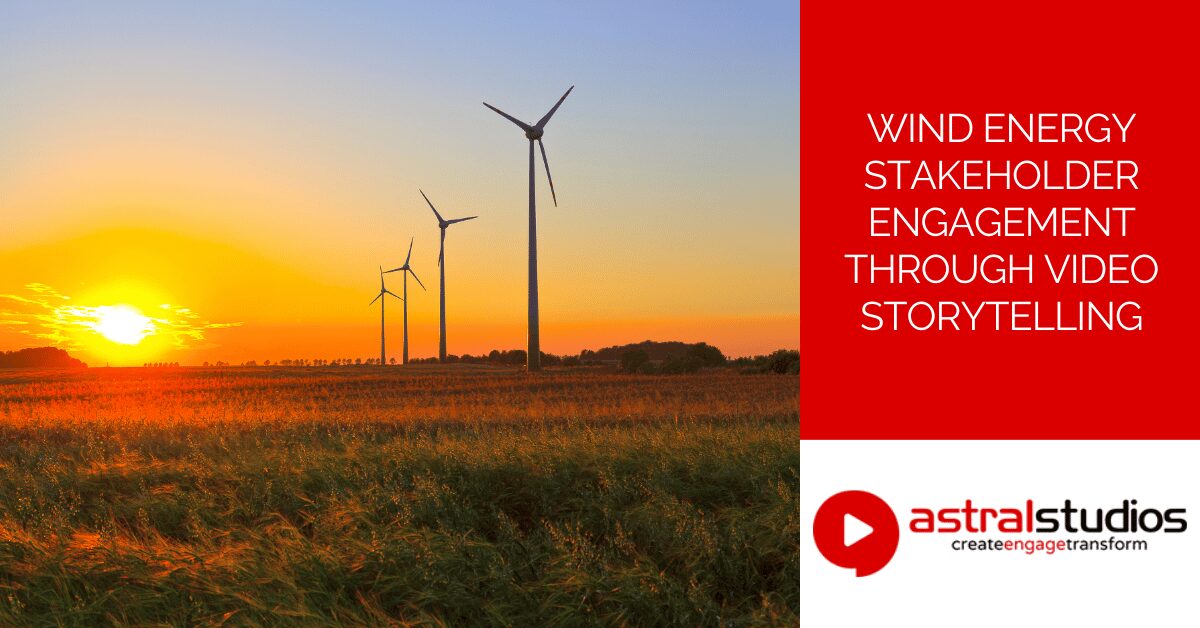
Wind Energy Stakeholder Engagement Through Video Storytelling
Last Updated: 1 month ago by Astral Studios Staff
Wind energy projects in South Africa need powerful visual storytelling to secure funding, gain approvals, and build community support. This guide shows you how professional video production helps renewable energy organisations communicate effectively at every project phase.
I’ll never forget standing on a dusty ridge in the Eastern Cape, watching a project manager try to explain their proposed wind farm to a room full of sceptical community members. He had charts, graphs, and a thick environmental impact report. But what changed everything was a three-minute video showing actual turbines spinning against the Karoo sunset, overlaid with simple animations explaining how the project would create local jobs and keep schools powered. The room went quiet. Questions shifted from “why here?” to “when do we start?”
That’s the thing about wind energy. You’re selling something invisible. An idea. A promise of clean power from air currents that nobody can see. And in South Africa’s competitive renewable energy market, where REIPPPP has attracted over R250 billion in investment, the organisations that tell their stories best are the ones that win.
Why Wind Energy Communication Matters Now
South Africa’s wind sector is growing fast. Total wind energy capacity reached 3,442 megawatts by 2023, and wind energy will contribute between 69 and 76 GW of new capacity by 2050. That’s massive growth. But with 21 wind projects representing 2.5 GW in the REIPPPP pipeline, competition for approvals and funding is fierce.
Here’s what’s changed. A few years back, load shedding dominated every energy conversation. Now the focus has shifted. Investors want proof of project viability. Communities want transparency. Government wants results. And everyone expects you to show, not just tell.
Video does that. It makes the invisible visible.
Understanding Your Wind Energy Stakeholders
Different audiences need different stories. A pension fund manager in Sandton cares about returns. A farmer in the Northern Cape wants to know how turbines affect his cattle. The DMRE needs compliance proof. Your content strategy must speak to all of them.
Investors Want Numbers That Move
Financial stakeholders aren’t swayed by pretty pictures alone. They need data wrapped in narrative. A client once told us their investor presentation failed because it looked “too much like a PowerPoint and not enough like proof.” Fair point.
Video lets you show actual construction progress. Real turbines generating real megawatts. Revenue flowing. Jobs created. When you combine drone footage of your operational site with animated graphs showing actual energy output, investors can see their money at work.
Communities Need Trust Before Technology
Community engagement videos are different. We’ve noticed that the most successful ones start with faces, not facts. Show the local team members. Film at the spaza shop, not just the site office. Let community members speak in their home language.
One organisation we worked with filmed their entire public consultation process. Nothing fancy. Just honest documentation of questions asked and answers given. When concerns arose months later, they had proof of transparency. That’s worth its weight in rand.
Regulators Require Evidence
Environmental approvals demand documentation. Grid connection applications need technical specs. Safety protocols must be recorded. Video provides this evidence whilst keeping it accessible.
Animation helps here. Trying to explain noise propagation patterns or bird flight paths with static diagrams? Good luck. But show it moving, with clear annotations, and suddenly everyone understands.
The Wind Energy Project Lifecycle
Each project phase needs its own visual approach. Here’s how video serves you from concept through to commissioning.
Phase 1: Making the Invisible Visible
Wind is invisible. Your job is to make people believe in it anyway. This is where animation earns its keep.
We’ve created countless wind resource visualisations. Showing air currents flowing across terrain. Demonstrating seasonal patterns based on actual WASA data. Explaining why your specific site will generate the megawatts you’re promising. 3D models incorporating realistic textures, motion, and environmental conditions like sunlight, wind patterns, and terrain help stakeholders grasp what’s coming.
Combine this with drone footage of your proposed site. Show the landscape. The access roads. The grid connection point. Help people picture 80-metre turbines in that exact location before you pour a single foundation.
Phase 2: Environmental Truth-Telling
Environmental impact assessments are heavy documents. Nobody reads all 400 pages. But everyone watches a well-made video.
Documentary-style filming works brilliantly here. Capture baseline conditions. Film the wildlife surveys. Document the heritage assessments. Show the actual consultation meetings, not just minutes typed up later.
A renewable energy developer once asked us to film their entire ESIA process. Seemed excessive at the time. But when questions arose about whether they’d properly consulted affected parties, that footage became gold. Transparency builds trust. Trust gets projects approved.
Phase 3: Securing the Money
REIPPPP bids are competitive. Everyone submits the required documents. What makes yours stand out?
Investment presentations that combine live footage with clear animation tend to win. Show your team’s track record through real project footage. Demonstrate technical competence through detailed animations of turbine installation sequences. Present your financial models with motion graphics that actually make sense.
Virtual site tours also work wonders. Film everything. The substations. The access routes. The laydown areas. Let investors explore your project remotely before they commit to a site visit.
Phase 4: Building on Camera
Construction documentation serves multiple purposes. It keeps investors informed. Provides marketing content. Creates training material. And becomes part of your organisational history.
Time-lapse is your friend. Progress monitoring via drone, site management media, live-stream timelapse services, give you comprehensive coverage without constant film crews on site.
We usually set up cameras to capture key sequences. Foundation excavation. Road construction. Turbine delivery. Blade installation. Each becomes a story point in your larger narrative.
Drone work really shines during construction. Success is measured not only by megawatts installed, but by public perception and stakeholder support. Aerial visuals and Drone Filming promote and inform. Plus, giant modern-day windmills are marvels to behold, and the best vantage point is an aerial one captured by drone.
Safety training videos matter too. Site inductions. Working at heights. Emergency procedures. Film once, use forever. Much cheaper than repeated in-person training sessions.
Phase 5: Celebrating Success
First power generation is a big moment. Official commissioning events deserve professional coverage. Get the politicians. The community leaders. The investors. Everyone who helped make it happen.
But don’t stop there. Operational videos show your wind farm actually working. SCADA systems monitoring performance. Maintenance teams keeping turbines running. Real megawatts flowing to real homes and businesses.
This content feeds into annual reports. ESG disclosures. Social media. Community updates. One commissioning film can be repurposed into dozens of shorter pieces.
Live Action vs Animation: Choosing Your Approach
Both have their place. The trick is knowing when to use which.
When to Film Real Life
Live action brings authenticity. Nothing beats actual footage of actual turbines spinning against an actual African sky. Use it for:
- Community testimonials (people trust people)
- Construction progress (proof of work done)
- Site-specific conditions (your unique location)
- Leadership messaging (faces build connection)
- Operational facilities (show it working)
Filming on wind farms isn’t easy though. Weather changes fast. Wind plays havoc with audio. Remote locations mean difficult logistics. Safety protocols are strict. You need experienced crews who understand industrial filming.
We’ve learned this the hard way. Trying to capture interviews in 60km/h winds? Useless. Filming without proper wind protection on microphones? Disaster. Not coordinating with site operators before flying drones near turbines? Dangerous and illegal.
When to Animate Instead
Animation lets you show what cameras can’t. Internal turbine components. Future-state visualisations. Complex data. Environmental impacts that haven’t happened yet.
Visualising intricate details of renewable infrastructure, energy generation methods, and environmental compliance requires animation. You can’t film inside a spinning gearbox. You can’t capture wind patterns with a camera. Animation solves these problems.
Different animation styles serve different purposes. Photorealistic 3D models impress investors. Simple 2D explainers teach communities. Motion graphics present data clearly. Choose based on your audience and message.
The Hybrid Sweet Spot
The best wind energy videos combine both approaches. Start with sweeping drone footage to establish location and scale. Cut to animation explaining technical processes. Return to live interviews for human context. Overlay motion graphics with performance data. End with real footage for authenticity.
This keeps viewers engaged whilst delivering complete information. It satisfies both emotional and rational decision-making.
Technical Challenges You’ll Face
Wind energy filming presents unique problems. Here’s what we’ve encountered and how to handle it.
Problem: Showing Wind When It’s Invisible
You can’t point a camera at wind and expect viewers to see it. So you get creative.
Film trees bending. Grass rippling. Flags snapping. Show turbine blades spinning. Include wind speed data overlays. Use particle effects in animation to visualise airflow.
One particularly effective technique: film the same location on a still day and a windy day. The contrast helps people understand why your site works for wind generation.
Problem: Conveying Massive Scale
An 80-metre turbine blade is huge. Absolutely massive. But stick it in the middle of the Karoo and suddenly it looks tiny on camera. Scale is hard to communicate.
Always include reference objects. People work well. So do vehicles, buildings, trees. Progressive reveal shots help too. Start tight on a detail. Pull back slowly. Keep pulling back. And back. Until viewers finally grasp the full size.
Split screens comparing turbines to familiar objects also work. “This blade is longer than a rugby field” means more than “78 metres long.”
Problem: Remote Location Logistics
Most good wind sites are far from civilisation. That’s kind of the point. But it makes filming complicated.
Scout thoroughly beforehand. Understand what infrastructure exists. Plan for limited power, shelter, and communications. Build weather contingency into schedules. Budget properly for accommodation and transport.
We once spent three days waiting for weather to clear in the Eastern Cape. Expensive. Frustrating. But better than risking crew safety or getting unusable footage.
Problem: Audio in Wind
Wind noise ruins audio. Simple as that. You need professional wind protection. Deadcats. Blimps. Proper baffling. Even then, some days are just too windy to record useable dialogue.
Record interviews in sheltered spots when possible. Inside vehicles works. Behind buildings. In equipment containers. Or plan for voice-over recorded later in a studio.
Sometimes you embrace the wind sound as atmosphere. Other times you fight it with everything you’ve got. Experience teaches you which approach fits which situation.
Problem: Drone Safety Near Turbines
Flying drones near spinning turbines is risky. Electromagnetic interference can cause control issues. Turbulence from blades creates unstable flight conditions. And crashing into a multi-million rand turbine is nobody’s idea of a good day.
Coordinate with site operators. Request turbine shutdowns for critical shots. Maintain safe distances. Use experienced pilots. Follow SACAA regulations religiously. Get proper insurance.
3D models of the SHIFT gearboxes to show how they could work in a wind turbine sometimes offer a safer alternative to filming actual internals with drones or cameras.
Content Types That Actually Work
Different formats serve different purposes. Here’s what we’ve seen work in the SA renewable energy sector.
Project Overview Films
These are your flagship pieces. Two to four minutes showcasing the entire project. Scale, technology, benefits, and people. Target them at general audiences, media, and potential partners.
Keep them cinematic but honest. Sweeping vistas yes, but also real people doing real work. Inspiring music absolutely, but let the natural sound of turbines humming come through too.
Social Media Snippets
Short form content rules on LinkedIn, Facebook, and Instagram. Fifteen to sixty seconds. Construction milestones. Community moments. Quick facts. Behind-the-scenes glimpses.
One effective approach: take your main project film and cut it into themed snippets. Each highlights one aspect. Jobs created. Megawatts generated. Wildlife protected. Community benefits delivered.
Technical Explainers
How do turbines actually generate electricity? How does grid integration work? What happens during maintenance? These questions need clear answers.
Animation dominates here. Showing electrons flowing through circuits. Gears turning inside nacelles. Control systems responding to wind changes. Make the complex simple without being simplistic.
Training Materials
Safety inductions. Equipment operation. Emergency protocols. Film once, use repeatedly. Much more cost-effective than bringing trainers to remote sites constantly.
These don’t need to be fancy. Clear, well-lit, easy to follow. That’s what matters.
Stakeholder Reports
Quarterly updates for investors. Annual community reports. ESG disclosures. These all benefit from video components.
Combine talking heads (leadership updates), data visualisation (performance metrics), and location footage (proof of progress). Keep them factual but not boring.
Distribution Strategy
Creating great content means nothing if nobody sees it. Think about distribution from the start.
YouTube for Discoverability
YouTube is the world’s second-largest search engine. Optimise titles and descriptions. Create playlists by topic. Tag properly. Enable subtitles.
Long-form content lives here. Project documentaries. Detailed explainers. Complete stakeholder presentations.
LinkedIn for Professional Reach
Your investors, partners, and industry contacts live on LinkedIn. Share thought leadership. Company updates. Industry commentary. Professional achievements.
LinkedIn’s algorithm favours native video over links. Upload directly rather than sharing YouTube URLs.
Facebook for Community Engagement
Local stakeholders often prefer Facebook. It’s where community conversations happen. Share updates in local languages. Respond to comments. Be present and accessible.
Your Website as Home Base
Every video should eventually live on your site. Embedded on relevant pages. Project showcase sections. News updates. About us pages.
This improves SEO. Increases time on site. Gives visitors reasons to stay and explore.
Budget Realities
Quality video production costs money. But it’s an investment, not an expense. Here’s how to approach budgeting.
Cost Factors to Consider
| Item | Typical Cost Range | Notes |
|---|---|---|
| Professional drone operator (per day) | R5,000 – R15,000 | Includes equipment and insurance |
| Camera crew (per day) | R8,000 – R25,000 | Depends on experience and gear |
| Animation (per minute) | R15,000 – R80,000 | Complexity affects price significantly |
| Editing (per day) | R3,000 – R10,000 | Skilled editors cost more but work faster |
| Music licensing | R500 – R5,000 | Varies by track and usage rights |
Remote location shoots add costs. Accommodation. Transport. Per diems. Weather contingencies. Site access permits. Safety equipment.
Budget honestly. Cheap videos look cheap. And cheap doesn’t win REIPPPP bids or secure investor confidence.
Getting Maximum Value
Plan comprehensive shoots capturing multiple content types. One week on site can yield material for dozens of videos.
Build reusable animation assets. That turbine model you commissioned? Use it across multiple projects. Template motion graphics. Standardise lower thirds and title cards.
Align production with natural project milestones. Film foundations during construction. Capture commissioning events as they happen. Don’t try to recreate these moments later.
Consider phased production. Start with essential content. Add supplementary pieces as budget allows. This spreads costs whilst ensuring critical communications happen on time.
Real Project Examples
Without naming specific clients, here are scenarios we’ve encountered that illustrate effective approaches.
Scenario 1: The Competitive Bid
Challenge: Stand out among 15 other REIPPPP bidders with similar technical specs and pricing.
Approach: Created a five-minute hybrid film combining drone footage of the team’s previous projects, detailed animations of the proposed installation, and authentic interviews with local community leaders expressing support.
The technical animations showed construction sequences down to individual bolt placements. This demonstrated serious preparation. The community interviews proved social license. The existing project footage evidenced capability.
Result: Bid ranked in top three. Project approved.
Scenario 2: The Sceptical Community
Challenge: Residents near a proposed wind farm worried about noise, visual impact, and disrupted farming.
Approach: Produced honest documentary-style content showing existing wind farms near similar communities. Filmed farmers explaining how turbines affected their operations (spoiler: minimally). Created photorealistic visualisations showing exactly what turbines would look like from residents’ homes.
The key was transparency. No overselling benefits. No dismissing concerns. Just factual information presented clearly.
Result: Community opposition decreased significantly. Public meetings became more constructive.
Scenario 3: The Impatient Investor
Challenge: Construction delays threatened investor confidence. Communication had to maintain trust whilst being truthful about setbacks.
Approach: Monthly video updates showing actual progress. Time-lapse footage proved work continued despite delays. Interviews with project managers explained challenges honestly and outlined solutions.
Transparency built credibility. Investors saw their money being spent wisely, even when timelines slipped.
Result: Investor support maintained. Additional funding secured when needed.
Regulatory and Ethical Basics
Professional video production in the wind energy sector requires attention to regulations and ethics.
Permissions You Need
Land access rights from property owners. Filming consent from community members. Employee release forms. Drone flight authorisations from SACAA. Compliance with restricted airspace rules.
Get everything in writing. A verbal “sure, you can film” isn’t enough when legal questions arise later.
Authentic Representation Matters
Greenwashing is tempting. Don’t do it. Exaggerating benefits or downplaying impacts destroys credibility. One misleading video can damage your reputation for years.
Show real results, not aspirations. Film actual communities benefiting, not stock footage. Present challenges alongside successes. Honesty serves you better long-term.
Environmental Responsibility
Minimise disturbance whilst filming. Protect sensitive habitats. Operate drones responsibly around wildlife. Follow site environmental management plans.
Your video team should model the same environmental care your project promises.
Future Trends Worth Watching
The wind energy video production space keeps evolving. Here’s what’s coming.
Virtual reality site tours let stakeholders explore projects remotely. Particularly useful for international investors who can’t easily visit SA sites.
Augmented reality aids community consultation. Point your phone at empty land and see proposed turbines superimposed in real-time. This helps people visualise impact better than any static rendering.
Interactive video experiences let viewers choose what they want to learn. Click to explore technical specs. Tap to hear community stories. Select investor information or environmental data. Same video, personalised experience.
Real-time rendering makes animation faster and cheaper. What took weeks now takes days. This allows more iteration and refinement within tight budgets.
Final Thoughts
Wind energy is invisible. Your job is making it visible. Video does that better than any other medium.
South Africa’s renewable energy sector is growing fast. With ongoing policy reforms, industry partnerships and strategic investments, South Africa is set to drive Africa’s transition toward a secure and inclusive renewable energy future. The organisations that communicate best will lead that transition.
Professional video production isn’t optional anymore. It’s how you prove credibility. Build community support. Secure funding. Win approvals. And tell stories that matter.
Every wind energy project has a story. From that first wind measurement on an empty ridge to the day turbines start spinning. The path from community concerns to community benefits. From technical drawings to actual megawatts.
Your story deserves to be told well.
Ready to Tell Your Wind Energy Story?
Astral Studios creates video content for renewable energy organisations across South Africa. We understand the technical complexities, stakeholder sensitivities, and competitive pressures you face.
From REIPPPP bid submissions to community engagement, investor relations to operational documentation, we help wind energy projects communicate effectively at every phase.
Contact us to discuss how professional video production can support your next wind energy project.
Glossary of Technical Terms
Blade: The large aerodynamic wing that catches wind and rotates the turbine rotor.
Capacity: The maximum power output a wind turbine or wind farm can generate, measured in megawatts (MW) or gigawatts (GW).
Commissioning: The process of testing and bringing a wind farm into full operational service.
DMRE: Department of Mineral Resources and Energy, the South African government department overseeing energy policy.
Drone (UAV): Unmanned Aerial Vehicle used for aerial filming and photography.
ESG: Environmental, Social, and Governance criteria used to evaluate organisational impact and sustainability.
Gigawatt (GW): One thousand megawatts, or one billion watts of power.
Grid Connection: The point where a wind farm connects to the electrical transmission network.
IPP: Independent Power Producer, a private company generating electricity.
IRP: Integrated Resource Plan, South Africa’s long-term energy planning framework.
Megawatt (MW): One million watts of power, enough to power approximately 500-750 South African homes.
Nacelle: The housing at the top of a wind turbine tower containing the generator, gearbox, and other components.
NTCSA: National Transmission Company South Africa, responsible for grid infrastructure.
O&M: Operations and Maintenance, the ongoing management of a wind farm.
REIPPPP: Renewable Energy Independent Power Producer Procurement Programme, South Africa’s renewable energy tender system.
SACAA: South African Civil Aviation Authority, which regulates drone operations.
SCADA: Supervisory Control and Data Acquisition system that monitors and controls wind farm operations.
Social License: Community acceptance and support for a project.
Time-lapse: Photography technique capturing long processes in short videos by taking photos at intervals.
Turbine: The complete wind energy generator including tower, nacelle, rotor, and blades.
WASA: Wind Atlas for South Africa, providing wind resource data.
Frequently Asked Questions
How much does professional wind energy video production cost in South Africa?
Costs vary based on project scope and complexity. A basic project overview video might start around R50,000, whilst comprehensive documentary-style coverage of a full project lifecycle can range from R200,000 to R500,000 or more. Drone filming typically costs R5,000 to R15,000 per day. Animation runs R15,000 to R80,000 per minute depending on complexity. Budget for travel, accommodation, and weather contingencies when filming at remote wind farm sites. The investment pays off through successful REIPPPP bids, faster approvals, and stronger stakeholder relationships.
What’s the difference between animation and live-action for wind energy projects?
Live-action captures real people, actual construction progress, and authentic locations. It builds trust through documented proof. Animation shows what cameras can’t capture: internal turbine components, future installations, wind patterns, and complex technical processes. The best wind energy videos combine both. Use live-action for testimonials, site footage, and operational facilities. Use animation for technical explanations, environmental impact visualisations, and showing projects before they’re built. Hybrid approaches deliver complete stories that satisfy both emotional and rational decision-making.
How long does it take to produce a wind energy project video?
Timeline depends on scope and complexity. A simple two-minute overview might take three to four weeks from concept to final delivery. Comprehensive project documentation spanning multiple phases can take several months. Animation typically requires longer lead times than live-action. Weather dependency affects outdoor filming schedules at wind farm sites. Plan for at least two to three weeks of pre-production, one to two weeks of filming, and four to six weeks of post-production for most professional projects. Rush jobs cost more and often compromise quality.
Do we need special permissions to film at wind farm sites?
Yes. You need land access rights from property owners. Filming consent from any community members appearing on camera. Employee release forms for staff interviews. Drone flight authorisations from SACAA for aerial filming. Compliance with restricted airspace regulations near turbines. Site safety inductions and PPE requirements. Insurance covering crew and equipment. Environmental management plan adherence to protect sensitive habitats. Get everything documented in writing before filming starts. A professional video production company handles most permissions, but you’ll need to facilitate site access and stakeholder introductions.
Can video actually help win REIPPPP bids?
Absolutely. REIPPPP bids are highly competitive. Everyone submits required documents. Video differentiates your submission by demonstrating capability through previous project footage, proving community support through authentic testimonials, and showing technical competence through detailed animations. Video makes complex information accessible to evaluators reviewing dozens of proposals. It proves you’ve done the work, not just the paperwork. Several successful bidders have credited compelling video presentations with helping their proposals stand out. The investment in quality video production is minimal compared to overall project budgets and potential returns.
What video content works best for community engagement?
Honest, transparent content in local languages works best. Film existing wind farms near similar communities showing real impacts. Include authentic testimonials from farmers, residents, and local business owners explaining their actual experiences. Create photorealistic visualisations showing exactly what turbines will look like from specific viewpoints. Document public consultation meetings as they happen. Explain benefits clearly without overselling. Address concerns directly without dismissing them. Use simple language and avoid technical jargon. Short videos work better than long presentations. Community members trust content that respects their intelligence and treats their concerns seriously.
How do we measure ROI on video production investment?
Track both quantitative and qualitative metrics. Quantitative includes view counts, watch time, engagement rates, click-throughs to calls-to-action, and lead generation from video content. Qualitative includes stakeholder sentiment, reduction in community objections, success rates of funding applications, media coverage tone, and approval timeline improvements. Compare projects with strong video strategies against those without. Most organisations find video reduces time spent in stakeholder meetings, decreases repetitive explanations, and accelerates approval processes. One successful REIPPPP bid or avoided project delay typically justifies the entire video production budget many times over.
What’s the best length for different types of wind energy videos?
Social media content works best at 15 to 60 seconds. Website overview videos should run 30 to 90 seconds. Project showcases perform well at two to four minutes. Investor presentations can extend to five to eight minutes if packed with valuable information. Training videos should match the complexity of the task being taught. Community update videos work at one to three minutes. Technical explainers need whatever time it takes to be clear, usually two to five minutes. The key isn’t arbitrary length limits. It’s whether every second adds value. Cut ruthlessly. Respect viewer time. Shorter usually wins unless depth genuinely matters.
Can we repurpose one video into multiple formats?
Definitely. Smart organisations plan for repurposing from the start. One comprehensive project film becomes dozens of shorter pieces. Extract social media snippets highlighting specific aspects. Create separate versions for different stakeholders. Cut together themed compilations. Add subtitles in multiple languages. Resize for different platforms. Update with new voiceover for different contexts. The key is shooting enough coverage during production. Capture plenty of b-roll. Record interviews thoroughly. Film sequences from multiple angles. This gives editors flexibility to create varied content from the same source material. Budget slightly more for shooting but save significantly on future productions.
Do we really need professional drone operators for wind farm filming?
Yes. Wind farm environments present unique challenges. Electromagnetic interference from turbines affects drone control. Turbulence from spinning blades creates dangerous flight conditions. SACAA regulations require commercial drone operators to hold Remote Pilot Licences. Insurance is mandatory. Safety protocols around multi-million rand infrastructure are strict. Amateur drone footage looks amateur. Professional operators have the skills, equipment, insurance, and experience to capture stunning aerial content safely and legally. The cost difference between amateur and professional is minimal compared to the risk of accidents, regulatory violations, or unusable footage. Always use licensed commercial operators.

