


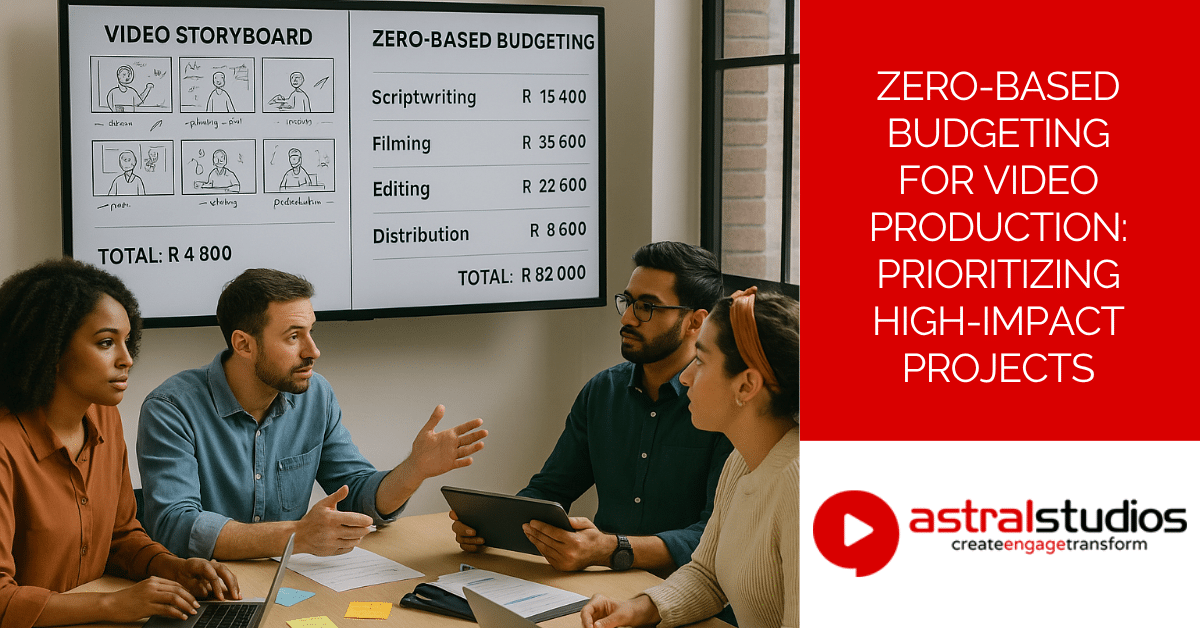
Zero-Based Budgeting for Video Production: Prioritizing High-Impact Projects
Last Updated: 6 months ago by Astral Studios Staff
Zero based budgeting is a powerful financial strategy that helps organisations rethink how they spend money by starting from scratch and justifying every expense.
Staying ahead in business means dealing with constant shifts. In South Africa, companies are always looking for smart ways to use their money. Creating videos is a major expense for many organisations. Whether it’s for marketing, training, sales enablement or internal communication, videos play a key role in how companies share messages and connect with people.
But making videos can be expensive. That’s why many companies are turning to a budgeting method called Zero Based Budgeting (ZBB). This helps them make sure every dollar they spend on video goes toward something important and useful.
What Is Zero-Based Budgeting?
Zero-Based Budgeting, or ZBB, is a way to plan your budget from scratch every time. Unlike regular budgeting, which just changes last year’s numbers, ZBB starts at zero. Every expense has to be explained and shown to be useful.
This idea was created in the 1970s by Peter Pyhrr at Texas Instruments. It helps companies think carefully about where to spend money, instead of just copying what they did before.
Why ZBB Matters:
- It helps avoid spending on old habits.
- It makes sure every cost has a reason.
- It keeps budgets focused on current goals.
ZBB is not just for big companies. It works well for creative teams too, like those who make videos.
How Does Zero-Based Budgeting Work?
Here’s how ZBB works step by step:
1. Start at Zero
Every new budget begins with no automatic spending. You must re-check all costs.
For example, if you made a training video last year, that doesn’t mean you need one this year. You should ask: “Do we still need this? Will it help our team?”
2. Justify Every Expense
You must show shy every expense is needed and how it helps the company.
If you want to hire a voice actor for a corporate video, you should explain how that will improve the message and reach more people.
3. Plan Carefully
Managers must plan in detail and prove that each cost adds value.
This means thinking ahead: Do we need a full film crew? Can we use existing footage or do some editing ourselves?
4. Spend Based on Need
Money goes to the most important projects first.
A high-impact video that trains hundreds of employees might get priority over a short social media clip with fewer viewers.
5. Keep Checking
The budget is not fixed. You review it often to make sure everything still makes sense.
If a project isn’t performing as expected, ZBB lets you stop it early and move funds to better options.
ZBB vs. Traditional Budgeting
| Feature | Zero-Based Budgeting (ZBB) | Traditional Budgeting |
|---|---|---|
| Starts at Zero | Yes | No |
| Justifies Costs | Every cost | Only some costs |
| Time Required | More | Less |
| Flexibility | High | Low |
| Cost Control | Strong | Weaker |
Traditional budgeting uses past spending as a base. ZBB looks at current needs and only spends money on what matters now.
Benefits of ZBB for Video Production
Using zero based budgeting for video production budgeting gives many advantages:
Better Spending Decisions
ZBB makes sure money goes to the most important goals. For example, a training video should help employees learn faster and better.
Less Waste
Unneeded costs get cut. Maybe you don’t need a fancy drone shot if a simple camera can tell the same story.
More Control
Everyone knows where the money is going. Teams understand why certain choices are made and how they support the bigger picture.
Adaptability
Companies can change plans when needed. If a marketing campaign isn’t working, zero based budgeting helps shift focus quickly.
Challenges of ZBB
Even though ZBB is powerful, it has some challenges:
Takes More Time
Explaining every cost takes effort. Teams must write reports, track data, and meet often.
People May Resist Change
Some may find it hard to adjust to new rules. Managers used to getting a set budget might feel limited.
Focus on Short-Term Gains
Sometimes, long-term investments get ignored. For example, building a strong brand through storytelling might take years, but ZBB could push for quick results instead.
Needs Good Data
Accurate information is very important. Without good tracking tools, it’s hard to know what’s working.
Applying ZBB to Video Production
Video production is expensive, but it’s also important. With zero based budgeting, companies ask:
Why do we need this video?
Is it going to customers understand our product? Will it train staff better?
Will it have a real impact?
Instead of making lots of low-quality videos, focus on high-impact video projects that deliver measurable results.
Can we use old footage or materials to save money?
Reusing content saves time and money. Maybe a part of last year’s annual report video can be reused for this year.
Are we working efficiently without wasting time or resources?
Use Agile budgeting for creatives. Break the project into small steps and finish each one before moving on.
Is this video more valuable than others we could make?
Compare options. A sales pitch video might bring in more money than a behind-the-scenes look.
Real Examples of Zero Based Budgeting Success
Several big companies have saved money using ZBB:
- Unilever: Saved money by focusing on high-value marketing.
- Kraft Heinz: Cut costs after merging two companies.
- Guess: Reduced expenses during the pandemic.
- Walgreens: Found savings by closing unneeded stores.
- AB InBev: Lowered costs and improved profits.
These examples show that ZBB works in real life — even in tough economic times.
Tools to Help with ZBB
Technology makes ZBB easier. These tools help manage budget allocation in video production:
- Workday Adaptive Planning: Helps build budgets from scratch with flexible planning.
- Limelight FP&A: Tracks expenses and provides real-time analytics.
- Microsoft Excel: Great for breaking down costs and forecasting budgets.
- YNAB (You Need A Budget): Helps control spending by giving every dollar a job.
AI tools are also helping. They can look at past spending and suggest better ways to allocate money.
Tips for Using ZBB in Your Video Team
Here are some ideas to help your team start using zero-based budgeting for film and video:
Use Content Marketing ROI to Guide Choices
Ask: “Will this video bring in more customers or keep them longer?” Track views, shares, comments, and conversions.
Focus on Impact-Driven Storytelling
Make videos that solve problems or teach something useful. Don’t just make videos because everyone else is doing it.
Break Down Production Costs
Know exactly how much each part of the video costs – scriptwriting, filming, editing, music, etc.
Plan with Creative Project Management
Use timelines, checklists, and meetings to stay on track and avoid delays.
Forecast Future Budgets
Look ahead and plan for upcoming video needs. This is called budget forecasting for video teams.
Compare High-Impact vs. Low-Impact Projects
Ask: “Which video will give us the best return?” A training video for 100 employees might be better than a 15-second ad.
Transforming Video Production with Zero-Based Thinking
Zero-Based Budgeting is a powerful way to manage money. For video production, it ensures that every project is useful and necessary. While ZBB takes more work, the rewards – better spending, less waste, and smarter choices – make it worth trying.
For companies in South Africa, ZBB offers a smart way to use limited funds for high-impact results – whether in marketing, training, or storytelling.
By starting from scratch and justifying every cost, your business can create cost-effective video production that supports your goals and tells your story well.
At Astral Studios , we help organisations like yours apply Zero-Based Budgeting principles to create high-impact, cost-effective video content that aligns with your strategic goals. Whether it’s corporate training, marketing, or visual storytelling, we ensure every rand you invest delivers measurable value.
Contact us today to plan your next video project with purpose — and start from zero with confidence.
Frequently asked questions
What is Zero-Based Budgeting (ZBB)?
Zero Based Budgeting (ZBB) is a financial planning method where every expense must be justified from scratch for each new budgeting period. It effectively starts from a “zero base,” meaning no costs are assumed or carried over automatically. This approach requires a thorough re-evaluation of all expenditures to ensure they are essential and aligned with the organisation’s current goals. The ultimate aim is to optimise resources by including only necessary and strategic expenses.
How does Zero Based Budgeting differ from traditional budgeting?
Unlike traditional budgeting, which often relies on adjusting previous year’s figures, ZBB resets the budget to zero at the start of every cycle. Traditional methods can perpetuate inefficiencies as they don’t require a fresh review of every expense. ZBB, on the other hand, demands that every dollar is justified and aligned with current needs and priorities, promoting greater cost control and efficiency. This fundamental difference ensures resources are allocated based on value rather than historical patterns.
What are the main benefits of implementing Zero-Based Budgeting?
Implementing ZBB offers several benefits, including improved cost control and efficiency by scrutinising every expense to identify and eliminate unnecessary spending. It also enhances accountability, as department heads are empowered to manage their budget justifications, fostering ownership over financial decisions. ZBB ensures that all financial investments directly contribute to strategic goals, optimising resource allocation for maximum impact. This method can also make organisations more adaptable to change and drive operational excellence.
What are the key challenges or drawbacks of Zero Based Budgeting?
One significant drawback of ZBB is that it is time-consuming and resource-intensive, requiring extensive planning and detailed data tracking from multiple stakeholders. There can also be resistance to organisational change from teams accustomed to traditional budgeting, who may view the scrutiny as burdensome. Additionally, ZBB carries a potential for a short-term focus, where immediate cost savings might be prioritised over crucial long-term investments. Effective implementation requires skilled financial teams to evaluate ROI and align expenses strategically.
How can organisations make Zero-Based Budgeting more manageable?
Organisations can mitigate ZBB challenges by delegating responsibility to department heads for budget justifications, decentralising the workload. It’s also helpful to break planning into cycles, such as quarterly or biannual sessions, to spread the effort over time. A hybrid budgeting model that combines traditional methods for routine costs with ZBB for discretionary spending can reduce the overall workload. Finally, leveraging budgeting software and technology can automate data entry and provide real-time insights, making the process more efficient.
How does Artificial Intelligence (AI) help with Zero Based Budgeting?
AI significantly changes the game for ZBB by its ability to analyse and remember spending at scale, reducing the time and resources needed for justification. AI-powered autonomous sourcing and spend management platforms can effectively operationalise ZBB for newly purchased or annually repurchased items by continuously analysing deep data. These technologies streamline data collection and consolidation, making ZBB a more viable and sustainable approach by automating key tasks and providing real-time insights. This helps organisations allocate funds based on today’s strategic intent rather than historical patterns.
How is Return on Investment (ROI) measured for video production?
Reporting ROI for video production can be complex but is crucial for justifying expenditure. It involves tracking usage metrics like view counts and engagement data. More importantly, it requires impact assessment to understand if a view translates into a wider reach or specific outcomes, such as 500 students being reached. Recognising the long-tail value of content is also key, as high-quality videos can remain relevant and used for many years. Organisations may need to develop their own nuanced metrics to truly understand meaningful usage over time.
What specific services does Astral Studios offer?
Astral Studios offers a wide range of video production services to meet various business needs. Their expertise includes corporate video production, recruitment videos, training videos, social media videos, drone video production, animated videos, and event videos. They serve various sectors such as transport and automotive, construction and engineering, healthcare and medical services, property and real estate, and energy and renewables. Beyond production, they provide support services like videography, post-production and VFX.

