


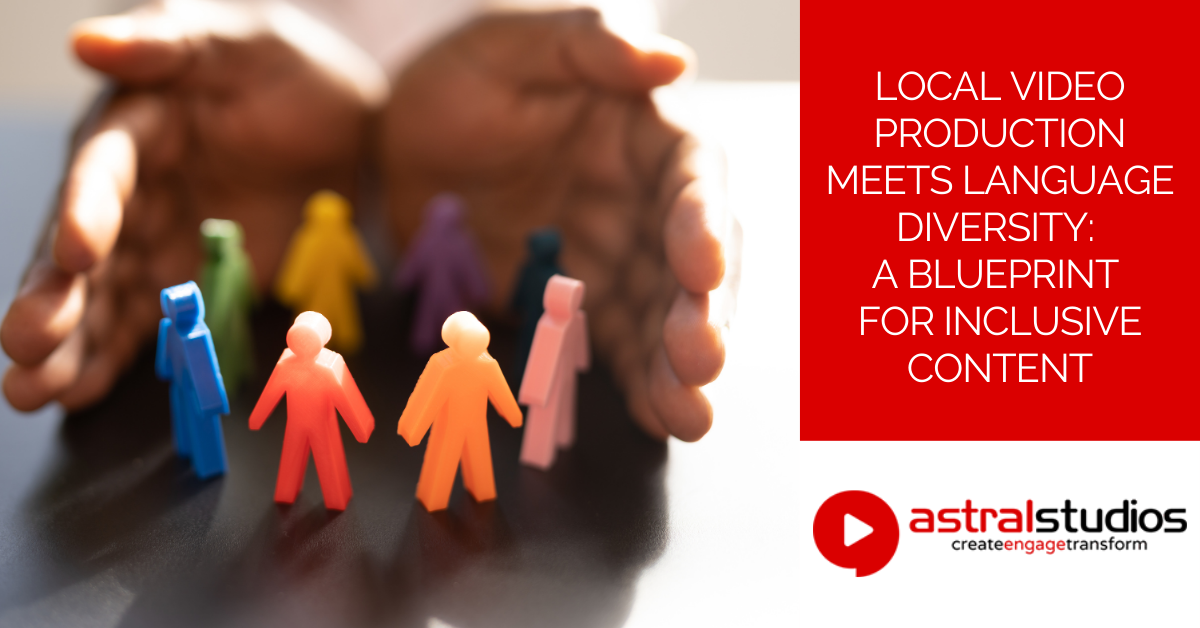
Local Video Production Meets Language Diversity: A Blueprint for Inclusive Content
Last Updated: 6 months ago by Astral Studios Staff
Learn how local video production tackles language barriers in South Africa, addressing English dominance, while boosting productivity and inclusion with training and cultural shifts.
South Africa. A nation renowned for its vibrant culture, rich history, and eleven official languages. It’s a place where diversity isn’t just a buzzword; it’s the very fabric of society. For corporate executives navigating this dynamic landscape, language is a powerful force – one that can either connect and inform or, unintentionally, exclude and alienate.
While English often serves as the common tongue in boardrooms and business communications, it’s crucial to remember it’s not the mother tongue for the majority of our workforce or customer base. This reality presents a unique challenge: how do we communicate effectively, foster inclusivity, and drive productivity in a multilingual environment? The answer lies, increasingly, in strategic local video production, embracing multilingual content creation to ensure your message resonates with everyone.
The Unseen Cost of Language Barriers
Operating predominantly in English when your audience or employees speak other languages isn’t merely an inconvenience; it has tangible consequences. Think about team members less confident in English – they might hesitate to contribute valuable ideas in meetings, miss critical details, or feel sidelined. This isn’t just a “diversity issue”; it’s a significant missed opportunity for innovation and collaboration.
These language barriers translate into real costs:
- Reduced Productivity: Miscommunication leads to mistakes, delays, and inefficiencies.
- Lower Engagement: Employees feeling excluded due to language differences often disengage from their work and teams.
- Missed Potential: Valuable insights and ideas may go unheard simply because they aren’t expressed fluently in the dominant language.
These challenges mirror those in other sectors, like education, where students struggle when taught in languages unfamiliar to them. The lesson is clear: language inclusion matters profoundly.
Speaking Their Language: A Strategic Imperative
Fortunately, there’s a powerful solution at your fingertips: corporate video localization. Adapting corporate content through multi-language videos is a strategic investment that can yield significant returns, both internally and externally. It’s about using local video production not just to tell a story, but to tell it in languages that resonate deeply.
Here’s how multilingual video production becomes a strategic advantage:
Enhanced Accessibility and Inclusivity
Creating videos in multiple languages makes your content accessible to a broader audience, including potential customers, partners, and employees who prefer their native language. This demonstrates respect and inclusivity, building trust and loyalty among diverse audiences.
Improved Engagement and Understanding
Eliminating language barriers ensures that your audience clearly understands your message, especially for complex topics or detailed explanations. Viewers engaging in their preferred language are more likely to retain information and respond positively, leading to better customer experiences and increased interest.
Greater Market Penetration
International video production, tailored locally, allows you to tailor messages to specific regions and audiences. For example, multilingual marketing videos for a new product can resonate more deeply when localised for different linguistic groups in South Africa or across the continent.
Strengthened Brand Identity
A brand communicating effectively in multiple languages showcases commitment to cultural sensitivity and global reach. This strengthens brand identity, fostering loyalty and humanising your brand by featuring people speaking their native languages.
Competitive Advantage
While many businesses stick to English content, investing in multi-language videos sets you apart as forward-thinking and inclusive. This can attract diverse talent and clients who value this approach.
Enhanced Customer Support and Training
Providing instructional or support videos in multiple languages improves customer satisfaction and ensures consistent knowledge transfer for diverse workforces. This is particularly effective for localizing training videos.
Improved SEO and Online Visibility
Add subtitles to video or provide multilingual captions and voiceovers to boost your SEO. Search engines favour content accessible to diverse audiences, increasing your chances of appearing in various language searches and driving more organic traffic.
By embracing video localization services, you’re not just translating words; you’re connecting with people on a cultural and emotional level.
Making it Happen: A Practical Approach
Producing videos in multiple languages might sound complex, but it doesn’t have to be. A simple, structured process can make it manageable. Here’s a straightforward approach to adapt corporate videos for diverse audiences:
- Initial Editing with Base Language: Start by editing your video using your primary language (e.g., English) voiceover as a guide. This ensures timing and flow are correct.
- Number the Script: Break down the original script into numbered sentences or segments. This is key for alignment later.
- Translate: Get the numbered script accurately translated into your target languages.
- Record Voiceovers: Have narrators record the translated scripts. Using the line numbers helps keep everything synchronised. This is where video dubbing and subtitling options come into play.
- Edit and Match: Integrate the translated audio into the video, matching it to the original segments using the numbering.
- Adjust Scene Durations: Different languages take different amounts of time to convey the same message. Adjust scene lengths to allow the translated audio to fit naturally.
- Final Review: Crucially, have native speakers of each language review the video for accuracy and cultural relevance.
As a bonus, once you have the numbered, translated scripts, it’s incredibly easy to create multi-language captions or subtitles, even if you only use the original audio track. This makes your content accessible even without voiceovers and aids SEO.
Choosing Your Voice: Subtitling vs. Voiceover
When deciding how to localize videos, the two primary methods are subtitling and voiceover (dubbing). Each has pros and cons depending on your goals, budget, and audience preferences.
Here’s a quick comparison:
| Feature | Subtitling | Voiceover/Dubbing |
|---|---|---|
| Cost | Generally lower | Generally higher (involves casting, recording, mixing) |
| Production Time | Faster | Slower |
| Audience Preference | Preferred for maintaining original audio and speaker’s tone/emotion. | Preferred for easier passive consumption (e.g., training videos), feels more “native”. |
| Maintains Original Audio | Yes | No (original audio is often muted or lowered) |
| SEO/Discoverability | Excellent (text is easily crawlable by search engines). | Less direct SEO benefit from audio alone, relies on metadata and page content. |
| Suitability Examples | Marketing videos, interviews, documentaries, social media content. | Training videos, e-learning modules, corporate announcements, animated content. |
| Requires Viewer Action | Viewer must read text. | Viewer can simply listen. |
| Quality Considerations | Requires high-quality translation and professional subtitling. | Requires skilled voice actors and good audio mixing. |
Your choice will depend on your specific video’s purpose and target audience, but both are effective ways to reach non-English speakers and can be facilitated by video translation services.
For corporate South Africa, local video production requires more than just technical translation; it demands cultural and linguistic sensitivity. Our eleven official languages represent not just different ways of speaking, but different ways of knowing and understanding the world.
Consider these points:
Beyond Translation
Ensure your message isn’t just translated but transcreated to fit cultural nuances. A direct translation might miss idiomatic expressions or cultural references relevant to a specific South African language group.
The final language review with native speakers is vital here.
Plain Language Matters
Even before translation, ensure your original script uses clear, plain language, free of unnecessary corporate jargon. This makes the content more accessible and relatable, improving comprehension regardless of the language used.
Training in plain language principles can help your teams create clearer source content.
Technology as an Aid, Not a Replacement
Tools like transcription software or translation apps can help bridge gaps, but be mindful of the “behemoth language bias” in AI. Much of the development in language technologies heavily favours large, influential languages like English, and may not be as accurate or nuanced for smaller, indigenous languages.
Relying solely on AI for translation without expert human review, especially for local South African languages, could lead to errors or cultural insensitivity.
Valuing Indigenous Languages
Promoting the use of South Africa’s indigenous languages through your corporate videos is more than just good business; it’s a powerful statement about inclusivity and respect.
It counters the historical marginalisation of these languages during apartheid and colonialism and contributes to preserving our rich linguistic diversity. Communicating in these languages acknowledges their importance, their status as bodies of knowledge, and supports communities in maintaining their linguistic heritage.
While some indigenous languages are endangered globally, many in South Africa are still vibrant within communities, offering a real opportunity for engagement.
By proactively addressing language diversity through thoughtful corporate video localization, you foster better teamwork, unlock innovation by tapping into diverse perspectives, and build a stronger, more inclusive employer brand.
Language as a Bridge
In South Africa’s uniquely multilingual environment, language is a critical factor for corporate success. Ignoring language barriers means missing opportunities for engagement, productivity, and market growth.
By strategically employing local video production and video localization services, companies can transform language from a potential barrier into a powerful bridge. Whether through video dubbing and subtitling, producing multilingual marketing videos, or localizing training videos, the ability to communicate effectively in multiple languages is becoming a non-negotiable aspect of doing business.
Investing in language inclusivity isn’t just about “doing good”; it’s a smart, strategic move that enhances accessibility, improves understanding, strengthens brand identity, and provides a distinct competitive advantage.
The question for corporate South Africa isn’t if English will remain a key language of business, but how companies will ensure their approach to language fosters inclusion and productivity, rather than division and exclusion. Multi-language video production offers a concrete, impactful way to make every voice heard and valued, empowering every employee and connecting with every customer in our beautifully diverse nation.
Ready to bridge language gaps and connect with every audience?
At Astral Studios, we specialize in local video production that celebrates South Africa’s linguistic diversity. Whether you need expert subtitling services , culturally nuanced translations, or multilingual corporate videos, our team ensures your message resonates authentically across all 11 official languages.
Transform language challenges into opportunities for inclusion, innovation, and growth.
Let’s create content that speaks their language—book a consultation today and unlock the power of localized storytelling.
Frequently Asked Questions
What is linguistic diversity and why is it important?
Linguistic diversity refers to the variety of languages spoken within a specific area or across the globe. It includes differences in language structures, vocabulary, and cultural contexts. Linguistic diversity is fundamentally important because it reflects the richness of human expression, cultural heritage, and identity. Language is not just a tool for communication; it carries the accumulated wisdom, values, beliefs, and experiences of the people who use it. Preserving language diversity is seen as crucial because the loss of a language means the loss of this valuable knowledge, history, and culture. It also fosters deeper understanding of different cultures, enhances cognitive development, promotes empathy, and contributes to social justice and equality.
What are the challenges of language diversity in corporate South Africa?
Corporate South Africa operates in a uniquely multilingual environment, but English is the primary medium of communication and the de facto language of business, despite not being the mother tongue for the majority of the workforce. This creates challenges where employees from different linguistic backgrounds may struggle to find a common voice. This environment can lead to unintentional exclusion, with team members less confident in English potentially avoiding contributions in meetings, missing key points, or feeling sidelined during decision-making. It’s not just a diversity issue but a missed opportunity for innovation and collaboration.
Why is English often the dominant language in business, especially in countries like South Africa?
English tends to be dominant in business globally due to historical factors like colonialism and its widespread use in international trade and communication. In former British colonies such as South Africa, English became the de facto language of business and education. Historical dominance privileges English in the workplace and often creates the incorrect perception that proficiency in English directly reflects intelligence or education This marginalizes indigenous languages.
What are the consequences of language exclusion and barriers in the corporate world?
Language exclusion in the corporate world has significant negative consequences. These include:
- Reduced Productivity: Miscommunication due to language differences can cause mistakes, delays, and inefficiencies.
- Lower Engagement: Employees who feel excluded because of language barriers often disengage from their work and teams.
- Missed Potential: People may not share valuable ideas and insights because they cannot express them fluently or confidently in English. Researchers compare these issues to challenges in education, where learners struggle when taught in languages other than their mother tongue, proving that language inclusion matters.
How can companies in South Africa address language barriers to promote inclusion?
Addressing language barriers requires more than just training; it involves a cultural shift that prioritizes inclusivity and empathy. Companies can implement various strategies:
- Training and Development Programs:
- English Proficiency Training: Offering workshops focused on workplace scenarios like presentations, email etiquette, and meeting participation, using practical tools like role-playing.
- Plain Language Training: Improving clarity in internal communications by simplifying jargon and complex language.
- Cultural and Linguistic Sensitivity Training: Teaching about cultural nuances and communication styles linked to different languages, encouraging patience and support for colleagues.
- Inclusive Leadership Development: Equipping managers with skills to navigate language diversity, ensuring all team members are heard, perhaps through structured turn-taking or encouraging written contributions.
- Cultural Shifts:
- Creating a workplace culture that values contributions over fluency.
- Using technology like live transcription or translation apps to bridge understanding gaps.
- Celebrating linguistic diversity as an asset.
What are the strategic benefits for businesses that invest in language inclusivity?
Investing in language inclusivity is considered a strategic move beyond compliance or good intentions. Companies that embrace language diversity can benefit in several ways:
- Foster better teamwork and collaboration.
- Unlock innovative solutions by drawing on the diverse perspectives of all employees.
- Build a stronger employer brand by demonstrating a commitment to inclusivity.
- Enhance accessibility and inclusivity, ensuring messages reach a wider demographic.
- Improve engagement and understanding, leading to better customer experiences and potentially higher conversion rates.
- Boost SEO and online visibility.
- Achieve greater market penetration by tailoring messages to local audiences.
- Strengthen brand identity and foster loyalty among international audiences.
- Gain a competitive advantage.
- Enhance customer support and training.
Language and culture are deeply intertwined. Language is a fundamental aspect of human culture and identity, reflecting how people understand and interact with the world. The way language is used often presupposes cultural background, and linguistic differences can underpin broader cultural differences. Preserving language is essential for preserving culture because language carries the accumulated wisdom, values, beliefs, and experiences of a community. When a language is lost, a wealth of cultural heritage, including traditions, songs, stories, and connection to history and identity, is also lost. UNESCO emphasizes promoting linguistic diversity as a way of preserving cultures and traditions.
How can linguistic diversity be encouraged in society, particularly in educational settings?
Linguistic diversity can be encouraged through various means, with educational institutions playing a critical role. Schools are crucial in shaping minds and can lend legitimacy to specific cultural practices. Strategies include:
- Actively promoting the use of mother tongues through reading and writing programs. Learning is often faster and easier when using a familiar language.
- Employing diversity and inclusivity in the hiring of teachers and staff from different linguistic and cultural backgrounds.
- Employing diverse teaching strategies that are inclusive and help students learn without sacrificing their native language. Teachers should be sensitive to language issues.
- Creating an inclusive environment that accepts diversity and promotes inclusivity, for example, by celebrating different cultures and traditions within schools.
- Educating the public about linguistic diversity and dismantling social practices that promote discrimination.
- Working with other members of society, such as parents, media personalities, and celebrities, to promote linguistic diversity. Ultimately, everyone has a part to play in preserving and celebrating different languages.
How does the dominance of certain languages affect AI development?
The dominance of a few “behemoth” languages, particularly English, in scientific and technical fields leads to a significant bias in AI development.
English and other dominant languages—mostly Western European—monopolize over 80% of developments in language technologies.
The main predictor of development in language technologies is not the number of potential users but the economic power and totality associated with the language. This bias means that when developments native to these behemoth languages are applied to smaller or different languages, the quality of those techniques and findings can be impoverished, sometimes drastically.
This can lead to less accurate medical diagnoses, lower scores in testing, and poor access to high-quality information in other languages. There is a concern that comparing AI systems to the behavior of speakers of only behemoth languages (referred to as “humans asterisk”) overlooks variations in cognition and language processing in other linguistic communities.
How can multi-language media content, such as corporate videos, be produced effectively?
Producing multi-language media, like corporate videos, for a diverse audience involves addressing challenges related to translation, voiceovers, and captioning. An effective process involves several steps:
- Initial Video Editing: Edit the video with an English voiceover as a baseline.
- Numbering the Original Script: Break down the original English script into numbered sentences or segments.
- Translation: Translate the numbered script into the desired languages. Ensure that the essence of the message is captured accurately.
- Voiceover Recording: Narrators read out the line number in English before delivering their translated lines.
- Video Editing and Matching: Match each translated sentence to the original, cutting out the line numbers.
- Adjusting Scene Durations: Adjust scene timing to accommodate the natural pacing of each language, as some languages may require longer durations.
- Final Language Review: Native speakers review the video to ensure accuracy and cultural relevance of translations and voiceovers. An additional benefit of this numbered script method is the ease of creating multi-language captions by matching translated captions to the original timed script. This multi-language approach enhances accessibility, inclusivity, and allows content to reach a broader audience, potentially leading to greater market penetration and strengthened brand identity.


