


Event Live Streaming in South Africa: A Complete Guide for Businesses
Last Updated: 4 months ago by Astral Studios Staff
Event live streaming in South Africa has moved from a pandemic workaround to a core part of how businesses communicate. This guide covers everything you need to know — from what it costs and how it works, to choosing the right platform and the right production partner.
Why South African Businesses Can’t Ignore Live Streaming Anymore
A training manager at a large mining company once described a problem that probably sounds familiar. She had 400 employees spread across three provinces. Every time there was a safety briefing or a policy update, flying everyone to Johannesburg cost a fortune. So they tried a basic video call. The audio kept cutting out. Someone’s connection dropped every ten minutes. By the end, half the team had given up and gone back to their desks.
That’s the gap that professional event live streaming fills. Not just broadcasting a signal, but creating a real experience for people who can’t be in the room.
South Africa now has over 45 million Internet users. Mobile data traffic grew by 36.4% in 2025. Fibre is rolling out beyond the metros into secondary towns. The infrastructure is there. The question is whether your events are using it well.
What Is Event Live Streaming in South Africa?
Event live streaming means broadcasting a live event over the Internet, in real time, to viewers anywhere in the world. It’s different from a recorded video in one important way: it happens now, and your audience knows it.
That shared moment matters. Think about why people watch live sport instead of a highlights reel. The stakes feel real. The same thing applies to a company AGM, a product launch, or a government briefing. Live streaming keeps that energy intact, even for the person watching from a hotel room in Durban or a home office in Cape Town.
After the event, the recording stays on. So anyone who missed it can still watch. That one event becomes a piece of content that keeps delivering.
What Makes a Live Stream Look Professional?
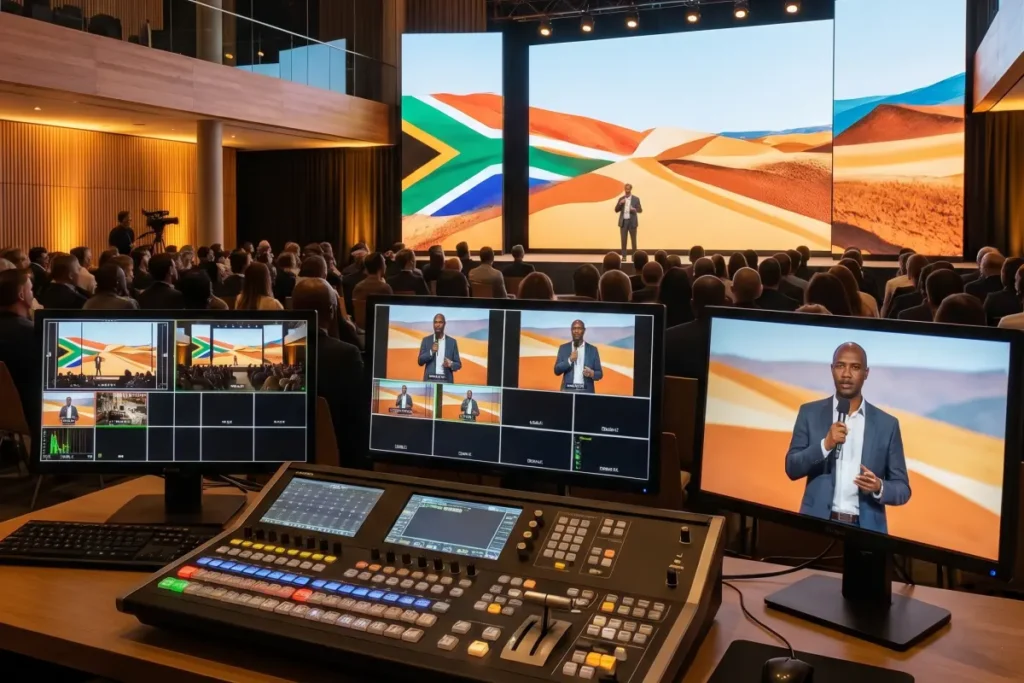
The basics are a camera, a stable Internet connection, and a platform to broadcast on. But a professional event live stream goes further. It uses multiple camera angles — wide shots of the room, close-ups of the speaker, cutaways to presentation slides. There are branded lower thirds (the text banners that identify speakers). It has a proper audio setup, because nothing kills a remote audience faster than bad sound.
Visual storytelling is the part most people underestimate. A live stream isn’t just a record of what happened. It’s a produced experience. The best ones feel like watching a well-made TV programme, not a security camera feed.
Types of Events That Work Well With Event Live Streaming in South Africa
Most corporate event types work well as live streams. Some work better than others.
| Event Type | Typical Audience | Key Streaming Need |
|---|---|---|
| AGMs and shareholder meetings | Shareholders, board members | Security, recording, live Q&A |
| Product launches | Press, public, staff | Multi-camera, branded visuals |
| Corporate conferences | Staff, delegates, global partners | Reliable connectivity, interactivity |
| Training and staff inductions | Employees nationwide | On-demand replay, Zoom/Teams integration |
| Government briefings | Public, media | High-quality audio, large audience capacity |
| Webinars and panel discussions | Industry professionals | Screen sharing, live Q&A |
| Weddings and memorials | Family and friends abroad | Private stream link, sensitivity |
Corporate and government events make up the bulk of professional streaming demand in South Africa. But the same infrastructure serves weddings, church services, and memorial events equally well — especially when family members are scattered across the globe.
Event Live Streaming in South Africa: Virtual vs Hybrid
These two terms get used interchangeably, but they mean different things.
A virtual event happens entirely online. There’s no physical venue. Everyone connects remotely. This works well for webinars, training sessions, and internal announcements.
A hybrid event has both an in-person audience and a live online audience at the same time. The presenter is on stage in front of real people, and also being watched by hundreds of remote viewers. This is the format that most South African businesses now default to.
According to Remo.co‘s 2025 event statistics, 74.5% of event planners have adopted hybrid formats. It’s no longer an experiment. It’s the standard.
The challenge with hybrid is that you’re running two events at once. The in-room experience and the online experience both need to be managed. That’s why hybrid events demand proper production support — not just someone with a laptop and a webcam.
How Event Live Streaming Works — From Planning to Broadcast
Before the Event
Good live streaming starts well before the day. The production team does a technical recce of the venue, checking Internet speed and whether bonded connectivity is needed. The run of show gets mapped out — who’s speaking when, what slides are going up, whether there’s a video insert or a panel discussion.
Branding gets built into the stream from the start. Lower thirds with speaker names and titles. An intro sequence. Branded backgrounds for the virtual attendees. This is where visual storytelling begins, not on the day.
On the Day
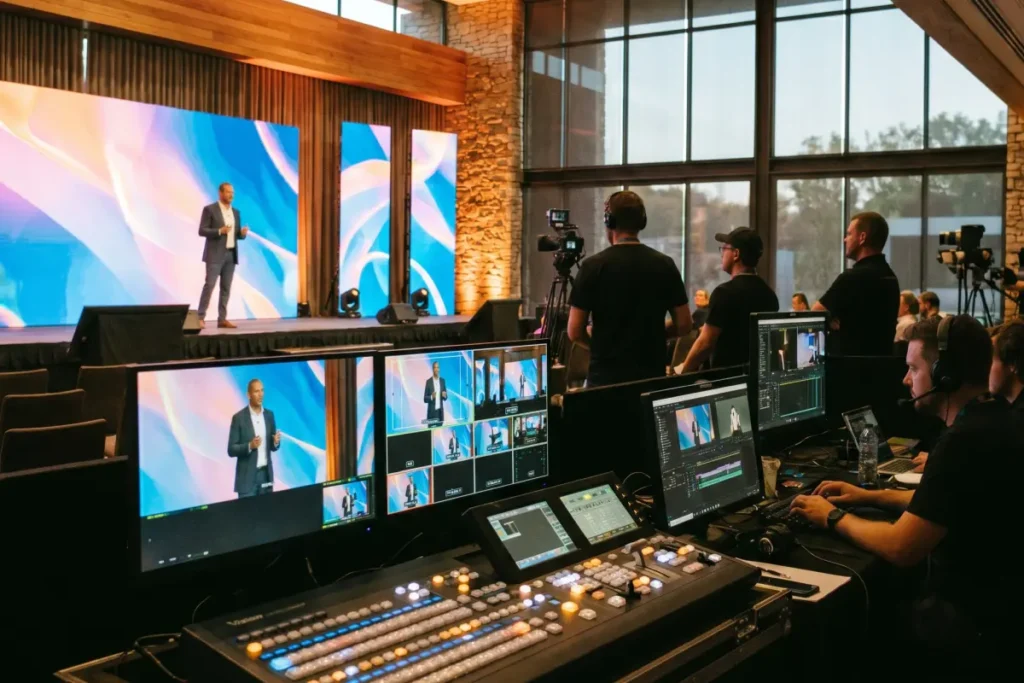
Multi-camera setups are standard for anything beyond a basic webinar. One camera on the speaker, one wide on the room, one on the screen — a vision mixer cuts between them in real time, just like a live TV broadcast.
Audio gets its own dedicated setup. A wireless lapel mic on the speaker, a room mic for audience questions, a separate audio feed into the streaming encoder. Remote viewers can’t lean in to hear better. If the audio is unclear, they leave.
A live moderator manages the online audience — monitoring the chat, fielding questions, keeping the digital side of the room engaged. This role gets overlooked constantly, and it’s one of the main reasons remote audiences disengage.
After the Event
The recording gets edited and delivered, usually within 24–48 hours for a basic cut. From there it can be broken into clips for social media, kept as a full archive for staff who missed it, or used as training material.
One conference organiser told us they got more views of the recorded stream in the two weeks after the event than they had live viewers on the day. The on-demand replay is often more valuable than people expect.
Event Live Streaming in South Africa: The Connectivity Question
South Africa’s Internet infrastructure is in better shape than it’s been in years. The country recorded a median download speed of 65.7 Mbps in Q4 2025, according to Ookla Speedtest data — the fastest fixed broadband on the African continent. Vodacom’s 5G network covers about 52% of the population. MTN is at around 45%. Fibre is growing at over 30% annually, with providers like Openserve, Vumatel, and Frogfoot expanding well beyond Gauteng and the Western Cape.
For most Joburg or Cape Town venues, a stable fibre connection is available. For venues outside the metros — a game lodge in Limpopo, a conference centre in Mpumalanga — you need a different plan.
The professional answer is bonded Internet. This means combining multiple connections (fibre plus 4G plus LTE backup) into one resilient pipe. If one connection drops, the others carry the stream. Done properly, your viewers never know anything happened.
On load shedding: it’s no longer the daily headache it was two years ago. Outages largely stopped from March 2024 onwards. That said, Eskom’s own Medium-Term System Adequacy Outlook flags a real supply risk from 2029 as coal stations retire. Professional streaming companies carry backup power as standard — it’s worth confirming this with any provider you consider.
Choosing a Platform for Your Live Stream
The platform question is one of the first decisions to make, and it depends on your audience and your event type.
YouTube Live suits public events with no access restrictions. It’s free, it reaches a wide audience, and the replay is automatic. The downside is that ads may run — including ads from your competitors.
Facebook Live works well if your audience is already on Facebook. Reach is high for public events. Less appropriate for formal corporate use.
Zoom and Microsoft Teams are the default for internal corporate events. Most employees already have accounts. Interactive features like polls and breakout rooms work well. The quality is good enough for most use cases.
Private streaming platforms are the right choice for AGMs, shareholder meetings, government briefings, or any event where access needs to be controlled. No ads, no public access, a branded experience from start to finish.
A note on data costs: South Africa still has a significant mobile-only audience. Streaming at 1080p is ideal for viewers on fibre, but a 720p option matters for people watching on mobile data. A good production team will set up adaptive bitrate streaming that adjusts automatically.
What Does Event Live Streaming Cost in South Africa?
This is the question almost every SA business has, and almost no local website answers clearly. Prices are usually quoted in USD online, which isn’t helpful.
The honest answer is that cost depends on several factors:
- Number of cameras
- Crew size and their experience level
- Duration of the event
- On-location vs studio-based production
- Platform and any licensing fees
- Post-event recording, editing, and delivery
- Travel costs for events outside major metros
A basic single-camera webinar from a studio can cost a few thousand rand. A full multi-camera hybrid conference with a live graphics package, a green screen studio backdrop, and same-day clip delivery is a different budget entirely.
What’s worth knowing is that even a professionally produced stream is substantially cheaper than flying 200 people to a central venue. Most companies that run the numbers find that live streaming pays for itself within the first event.
Green Screen Studios and Visual Storytelling
One option that’s worth knowing about is studio-based live streaming. Instead of broadcasting from a physical venue, the presenter stands in a green screen studio. Any background — a branded set, a virtual conference room, an animated backdrop — gets added in real time.
This gives companies complete control over the visual experience. No venue logistics, no background distractions, no sound bleed from the hotel corridor outside. The presenter can be joined by remote guests who appear on screen alongside them, just like a TV news panel.
It’s a good fit for product launches, internal announcements, training series, and any event where the message matters more than the setting. The production looks polished. The branding is consistent. And the whole thing can be done from a studio in Johannesburg, regardless of where the audience is.
What to Look for in an Event Live Streaming Company in South Africa
Not all live streaming companies are the same. Some operate on a shoestring with a couple of cameras and a laptop. Others bring broadcast-grade equipment, experienced crew, and production quality that matches what your brand deserves.
Here’s what to ask before you sign anything:
- Do they have experience with your type of event?
- Can they handle on-location and studio-based production?
- What’s their connectivity backup plan?
- What does the post-event recording and delivery process look like?
- Do they offer branded graphics, lower thirds, and intro/outro sequences?
- Can they show you a showreel or recent examples?
- Will someone be on-site on the day, or are they managing it remotely?
The GL Events South Africa team noted in their 2026 event infrastructure trends report that hybrid event setups now require “high-speed connectivity, integrated audio-visual systems and flexible venue setups.” That’s a useful checklist for evaluating any provider.
Event Live Streaming in South Africa: What’s Happening in 2026
The live streaming market was valued at USD 2.02 billion in 2023 and is projected to reach USD 7.8 billion by 2030, growing at 21% annually. South Africa is part of that growth, driven by broader broadband access, enterprise digital investment, and the normalisation of hybrid working.
Locally, events like the Marketing Indaba and various government-led stakeholder briefings now routinely include live streaming as part of their production plan. The National Arts Festival streamed 240 programme items in 2025. The 2Africa undersea cable completed its landings along both African coasts in 2025, which means international bandwidth for South African streams has improved and costs have come down.
For businesses, this means the audience for your next event is genuinely global — if you choose to make it so.
Frequently Asked Questions About Event Live Streaming in South Africa
How much notice do I need to give a live streaming company?
For a standard corporate event, two to four weeks gives a production team enough time to plan properly. Larger productions — multi-day conferences, AGMs, government briefings — need more lead time. Don’t leave it to the last week.
Can I stream from any venue in South Africa?
Yes, with the right setup. A professional team will assess the venue’s Internet connectivity in advance and bring bonded backup connections if needed. Off-metro locations need more planning, but they’re not a barrier.
What happens if the Internet drops during the stream?
A bonded connection setup minimises this risk considerably. If one connection drops, others keep the stream going. Ask any provider you’re considering to walk you through their specific backup plan.
Can international viewers watch my event?
Yes. Live streaming removes geography entirely. A viewer in London, Sydney, or São Paulo can join as easily as someone in Sandton. This is one of the biggest practical benefits for SA companies with international shareholders, partners, or staff.
Will the event be recorded?
Recording should be standard, not an add-on. Always confirm the format, turnaround time, and whether editing is included. Some providers deliver a raw file; others will cut a highlights reel. Know what you’re getting before the event.
Yes, with the right platform. Private streaming platforms offer password-protected access, no public indexing, and full recording for compliance purposes. This is a non-negotiable for listed companies. Confirm platform security with your provider at the outset.
Ready to Stream Your Next Event?
Whether you’re planning a conference, a product launch, an AGM, or a training series, Astral Studios offers end-to-end virtual event live streaming from our Johannesburg studio — and on location across South Africa.
Contact us to discuss your next event.
Glossary of Technical Terms
Adaptive bitrate streaming: A method that automatically adjusts video quality based on the viewer’s Internet speed, reducing buffering.
Bonded Internet: Combining multiple Internet connections (fibre, 4G, LTE) into one stable connection, used as a backup and reliability measure for live events.
Encoder: Hardware or software that converts camera footage into a digital signal that can be broadcast over the Internet.
Green screen (chroma key): A production technique where a presenter stands in front of a green background, which is replaced with any image or video in real time.
Hybrid event: An event that runs simultaneously for an in-person audience and a live online audience.
Lower third: The text overlay at the bottom of a video frame, typically showing a speaker’s name and title.
Latency: The delay between what happens at the event and what the viewer sees on screen. Low latency is important for live Q&A and interactive events.
Multi-camera production: Using two or more cameras, with a vision mixer cutting between angles in real time.
On-demand replay: A recorded version of the live stream that viewers can watch after the event has ended.
Private streaming platform: A streaming service where access is restricted to invited viewers only, as opposed to public platforms like YouTube.
Vision mixer: The equipment (and the person operating it) that switches between camera feeds and other video sources during a live broadcast.
Virtual event: An event that takes place entirely online, with no physical venue or in-person audience.


