


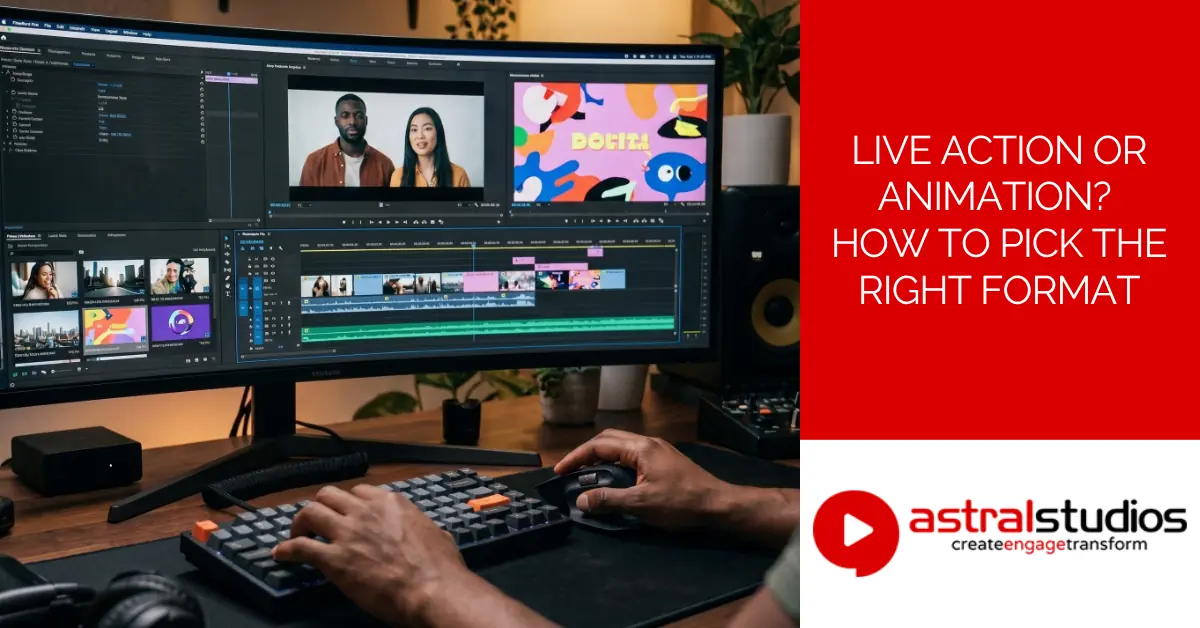
Live Action or Animation? How To Pick The Right Format
Last Updated: 2 months ago by Astral Studios Staff
Live action vs animation is the question every business asks before booking a video shoot, and the honest answer is that it depends on what you’re trying to say. This guide walks through the real differences, real costs, and how to choose without guessing.
A production manager at a logistics company once described her first animation brief like ordering food in a language she didn’t speak. She knew she wanted something, but had no idea what to ask for. Her instinct was to book a film crew, because that’s what she’d always done. Halfway through the call, she realised her actual problem was explaining a software integration process nobody could film. That’s the moment this decision usually gets made, not upfront, but partway through a conversation once the real goal becomes clear.
What’s The Real Difference Between Live Action and Animation?
The two formats aren’t just different styles. They solve different problems.
What live action actually involves
Live action means real people, real locations, and a camera. It needs a crew, often actors or presenters, and a physical place to film. Interviews, testimonials, and site walkthroughs all fall into this category.
What animation actually involves
Animation builds everything from scratch. Illustrators and animators create the visuals, whether that’s simple motion graphics, 2D characters, or full 3D environments. Nothing needs to physically exist before you can show it.
Why the format matters more than the budget
Choosing a format isn’t really about which one costs less. It’s about which one can actually show what you need to show. A software product has no physical form. A factory floor already exists. That difference alone often settles the question before cost even comes up.
Live Action vs Animation: Cost Compared
Cost comparisons get thrown around a lot, and most of them miss the point. Both formats have wide price ranges, and the ranges overlap more than people expect.
What drives live action cost
Crew size matters most. A single videographer with a camera costs far less than a full crew with a director, sound recordist, and lighting technician. Location count, shoot days, and whether you need professional talent all add up fast.
What drives animation cost
Style is the biggest factor here. Simple motion graphics, animated text and shapes over a script, cost less and move faster. Character-based 2D animation takes more time. Photorealistic 3D animation takes the most time and the most skill, and the price reflects that.
Where the ranges overlap
A basic live action interview can cost less than a complex 3D animation. A simple motion graphics piece can cost less than a multi-location live action shoot. Neither format is automatically the cheaper option. It depends entirely on scope.
| Format | Typical cost driver | Worth paying more for |
|---|---|---|
| Motion graphics | Script length, revision rounds | Fast turnaround, simple messaging |
| 2D character animation | Character design, animation complexity | Brand-specific visual style, mascots |
| 3D animation | Modelling, rendering time | Product visualisation, technical accuracy |
| Live action, small crew | Shoot days, location access | Authenticity, real testimonials |
| Live action, full crew | Multiple locations, talent, logistics | High-production commercials, brand films |
When Live Action Is The Better Choice
Some stories only work with real people in real places.
Testimonials, interviews, and authenticity
A genuine customer talking about a genuine experience carries weight animation can’t fake. Viewers pick up on eye contact and tone in ways that build trust quickly.
Company culture and behind-the-scenes content
Showing your actual team, your actual office, and your actual day-to-day work tells a more convincing story than any illustrated version of the same thing.
Events, site tours, and real environments
A live groundbreaking, a real factory floor, a real conference. These moments exist once, and only a camera can capture them as they happened.
Where live action struggles
Anything invisible is hard to film. Software interfaces, internal processes, or a hypothetical future scenario all push live action into awkward workarounds, stock footage, screen recordings, or clunky metaphors that don’t quite land.
When Animation Is The Better Choice
Animation earns its keep when the subject doesn’t physically exist, or shouldn’t be filmed the way it happened.
Explaining invisible or abstract concepts
A financial product, a software platform, an internal workflow. None of these have a physical form a camera can capture. Animation builds the visual from nothing, which is exactly what these topics need.
Content that needs regular updates
A well-built animation project keeps its source files editable. Update a statistic, a product name, or a pricing detail without booking a new shoot. Confirm this with your production partner before signing off, since not every contract includes source file access by default.
Multilingual rollouts
One animated asset can be re-voiced in isiZulu, Sesotho, Afrikaans, or any other language without reshooting a single frame. For government and large corporate clients working across multiple provinces, that’s a genuine advantage.
Sensitive topics
Restructuring announcements, compliance training, HR policy changes. Animation keeps the tone consistent and takes the pressure off putting a specific person on camera for a difficult message.
Live Action and Animation for Government and NGO Work
This is where the choice gets interesting, because the goals shift from marketing to communication and accountability.
Training and compliance videos
Consistency matters more than polish here. Animation delivers the same message, the same way, every time, across every department or region.
Public information and awareness campaigns
A government department running a health or safety campaign often needs content that works across multiple languages and literacy levels. Animation handles that flexibility well.
Monitoring and evaluation reporting
NGOs tracking project outcomes often need to show data, progress, and impact over time. Animated graphs and visual data storytelling turn a spreadsheet into something a funder or stakeholder actually wants to watch.
Multilingual requirements
South Africa’s language diversity means government and development content rarely gets away with a single-language video. Animation’s re-voicing flexibility solves a real, recurring headache here.
Can You Combine Live Action and Animation In One Video?
Yes, and it’s more common than most people realise.
How hybrid videos work
A hybrid video might use real interview footage combined with animated graphics that explain a process or visualise data. Product shots filmed on location can sit alongside an animated diagram showing how the product works internally.
Why hybrid is often the smart choice
Hybrid isn’t a compromise. It’s a way to spend your budget where each format earns its place, live footage for authenticity, animation for clarity, without paying for either format to do a job it’s bad at.
Where hybrid makes sense
A live testimonial paired with an animated statistic overlay. A filmed site tour paired with an animated map showing project scope. A CEO interview paired with animated data visualisation showing company growth. These combinations show up constantly in well-planned corporate videos.
Practical Factors Beyond Style
Style isn’t the only thing that should drive this decision.
Turnaround time
Animation production timelines depend on style and length, but they don’t depend on weather, actor availability, or location bookings. Live action needs all of those to line up before filming even starts.
Update-ability
Swapping a statistic in an animated video usually means editing a source file. Swapping a statistic in a live action video usually means a reshoot, or an awkward on-screen graphic bolted onto footage that wasn’t built for it.
Location and logistics risk
Live action carries more moving parts. Travel, weather, site access, and permissions can all shift a shoot date. Animation happens in a studio, with far fewer variables outside anyone’s control.
A quick word on power reliability
Load shedding isn’t the disruption it was a couple of years ago, so it rarely affects production schedules today. Worth flagging though: Eskom’s own 2026-2030 system adequacy outlook points to a real risk of renewed load shedding from 2029, once older coal capacity retires. It’s not an immediate concern, but studio-based animation work depends on stable power for rendering, so it’s worth keeping an eye on for longer projects further down the line.
Does Animation Look Less Credible Than Live Action?
This comes up a lot, and the honest answer is that it depends entirely on execution.
Addressing the perception gap
A cartoonish animation style can feel out of place for a serious financial or legal message. That’s a real risk, but it’s a style problem, not a format problem.
How style choice affects credibility
Clean motion graphics with a professional voiceover can feel just as credible as a filmed video for corporate content. A playful 2D character style suits a consumer brand far better than a bank.
Matching style to brand
The mistake isn’t choosing animation. It’s choosing the wrong animation style for the audience. A good production partner should steer this conversation before any illustration work begins.
How To Decide: A Simple Framework
Start with the message, not the medium
Work out what you’re actually trying to explain before deciding how to show it. The format should follow the message, not the other way round.
Match the format to the audience and platform
A LinkedIn audience of finance professionals responds differently to a TikTok audience scrolling for entertainment. Consider where the video will actually be watched.
Use budget as a filter, not a starting point
Budget narrows your options. It shouldn’t be the first question. Decide what needs to be shown, then work out which format delivers that within your budget.
Ask what needs to feel human versus what needs to feel clear
If the goal is trust and connection, lean toward live action. If the goal is clarity around something complex or invisible, lean toward animation. Most projects need a bit of both.
Frequently Asked Questions
Is animation cheaper than live action?
Not always. Simple animation can cost less than a complex live action shoot, but detailed 3D animation can cost more than a basic live action interview. Cost depends on scope, not format.
Can you mix live action and animation in one video?
Yes. Hybrid videos combine filmed footage with animated graphics or sequences, often giving you the strengths of both formats without the weaknesses of either.
Which format is better for training videos?
Animation usually works better for training and compliance content, since it stays consistent across audiences and can be updated without a reshoot.
How long does an animated video take to produce compared to a filmed one?
It depends on complexity. Simple motion graphics can move faster than a live action shoot requiring locations and talent. Detailed 3D animation can take longer than a straightforward filmed interview.
Does animation work for government or NGO communications?
Yes. Animation suits multilingual public information campaigns, training content, and monitoring and evaluation reporting particularly well, since it can be updated and re-voiced without reshooting.
Ready To Choose The Right Format For Your Video?
Picking between live action and animation gets a lot easier once you know what you’re actually trying to say. Contact us to talk through your project and find the format that fits it.
Glossary
Motion graphics: Animated text, shapes, and simple visual elements, often used to explain a message quickly without characters or complex illustration.
2D animation: Flat, illustrated animation, commonly used for character-driven explainer videos.
3D animation: Animation built in three-dimensional space, often used for product visualisation or technical detail.
Whiteboard animation: A style where a hand appears to draw the illustration in real time on a plain background.
Hybrid video: A video combining live action footage with animated elements, such as data visualisation or motion graphics overlays.
M&E (monitoring and evaluation): The process NGOs and development organisations use to track and report on project outcomes and impact.


