


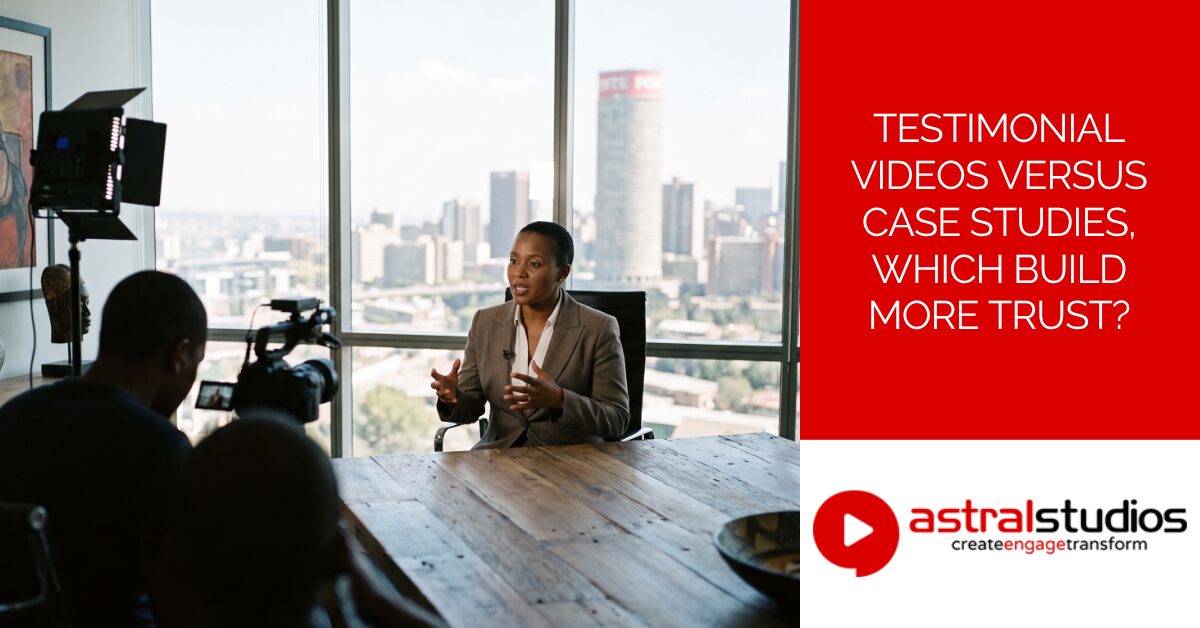
Testimonial Videos Versus Case Studies, Which Build More Trust?
Last Updated: 2 months ago by Astral Studios Staff
Testimonial videos vs case studies is a question that comes up almost every time a marketing team plans their next round of client content, and the honest answer isn’t as simple as picking a winner. Both are built to earn trust, but they do it in different ways, at different moments, for different people.
A sales manager I once spoke to at a mining supply company put it well. She said her prospects didn’t want to hear her company describe itself as reliable. They wanted proof, and proof looked different depending on who was reading it. A site manager wanted a quick, human clip showing another site manager nodding along. A procurement committee wanted the full story, with numbers, timelines, and more than one voice backing it up. She wasn’t choosing between formats. She needed both, just not for the same job.
That’s really what this article is about. By the end, you’ll know exactly where each format earns its keep in the buyer’s journey, and why the “which one is better” question is the wrong one to be asking.
What’s The Real Difference Between A Testimonial Video And A Case Study?
Before getting into trust and strategy, it helps to be clear on what each format actually is.
What A Testimonial Video Actually Is
A testimonial video is one person, giving their honest impression. It’s short, quick to watch, and built around a feeling rather than a full argument. Think of it as a snapshot rather than a story.
What A Case Study Video Actually Is
A case study video follows a proper arc: the challenge someone faced, what they did about it, and what changed as a result. It often includes more than one voice, some supporting footage, and sometimes real numbers. It’s built for someone who needs to understand the full picture, not just get a good feeling about it.
Does A Case Study Have To Be Video?
Not at all, and it’s worth saying clearly. A well-written case study with strong photography still does a solid job for plenty of businesses, particularly where the reader wants to skim and come back later. Video adds something text alone can’t, a real voice and real face, but it isn’t the only valid format. This article focuses on the video version specifically, since that’s where the bigger trust question sits.
Why Trust Is The Real Currency Here
Why People Trust A Stranger’s Opinion More Than A Brand’s Own Claims
Nobody expects a business to say bad things about itself, so a business praising its own work carries little weight. A customer saying the same thing carries far more, simply because they have nothing to gain by lying.
Social Proof And Why It Works On Screen
Seeing and hearing a real person is harder to fake, or at least harder to imagine faking, than reading a quote next to a stock photo. That’s the entire reason social proof works better on video than on a page of text testimonials.
The Line Between Polished And Believable
Here’s an opinion worth stating plainly: a testimonial that’s too polished can actually undermine itself. If someone sounds like they’re reading from a script, viewers notice, and the whole point of the format falls apart. A little rough around the edges is often more convincing than perfectly lit and perfectly worded.
Testimonial Videos Vs Case Studies, Which Builds Trust Faster?
Testimonial Videos And The Emotional Yes
Testimonial videos work fast because they don’t ask much of the viewer. Thirty seconds, one honest voice, and a viewer has what they need to feel a little more confident about a decision they were already leaning toward.
Case Studies And The Logical Case
Case studies take longer to land, but they carry more weight for bigger decisions. A buyer who needs to justify a choice to someone else, a boss, a board, a funder, needs more than a good feeling. They need a story with substance behind it.
Why This Isn’t Really A Competition
Comparing these two formats head to head is a bit like comparing a handshake to a signed contract. Both matter. They just don’t do the same job, and that’s the whole argument this article is building toward.
Where Each Format Fits In The Buyer’s Journey
This is the part that actually answers the question properly.
Early Stage: Building Initial Trust
At the top of the funnel, a visitor landing on a homepage or scrolling past a social post doesn’t want a five-minute story. A short testimonial video does the job here, quick, human, and low commitment to watch.
Middle Stage: Weighing Up The Decision
Once someone is seriously considering a purchase, they start looking for depth. This is where case study videos on service pages, or shared directly by a sales rep, earn their place. The challenge-solution-result structure gives a buyer something to measure their own situation against.
Late Stage: Justifying The Decision To Others
Big decisions rarely get made by one person alone. A buyer often needs to bring a case study video into a meeting to convince other stakeholders. This lines up with wider B2B video research, where a large majority of B2B buyers say video content plays an important role in their purchasing decisions, precisely because it gives them something concrete to point to.
After The Sale: Retention And Advocacy
Both formats have a life after the sale too. A quick testimonial keeps a happy client’s voice active in your marketing, while a case study can turn into a reference point for renewals, upsells, or referrals down the line.
How Sales And Marketing Teams Use Each Format Differently
Marketing’s Use Case: Awareness And Website Trust
Marketing teams tend to lean on testimonials for broad reach, homepages, paid social, and quick brand trust signals.
Sales’ Use Case: Follow-Ups, Decks, And Live Conversations
Sales teams get more mileage out of case studies, dropping them into proposals, pulling them up mid-call, or attaching them to a follow-up email after a meeting goes well.
The Role Of Visual Storytelling In Building Trust
Why A Real Face Says More Than A Quote On A Page
A written quote can be edited, shortened, or quietly reworded. A face on screen, saying something in their own words, is much harder to doubt. That gap in perceived honesty is exactly why video outperforms text for this kind of content.
How Structure Shapes Belief
A testimonial’s strength is its brevity. A case study’s strength is its structure. The challenge-solution-result arc mirrors how people naturally process an argument, which is part of why it does heavier lifting for bigger decisions.
The Role Of B-Roll, Setting, And Environment
Filming on location, at a client’s actual site rather than a studio backdrop, adds a layer of credibility that’s hard to manufacture. A warehouse floor, a hospital ward, or an NGO’s field site tells its own part of the story before anyone says a word.
Pacing And Editing As Trust Signals
Fast cuts and dramatic music can work against a testimonial or case study rather than for it. Restraint tends to serve trust better than polish. A viewer should feel like they’re watching something real, not something sold to them.
Local Context: Testimonials And Case Studies In South African B2B, NGO, And Government Work
Why B2B Buyers Want Proof, Not Promises
South African procurement decisions, particularly government and corporate tenders, usually involve multiple stakeholders and longer sales cycles. Local video marketing research points out that <a href=”https://audiovisuallab.co.za/journal/video-marketing-south-africa-business/”>authentic, credible content tends to outperform polished corporate messaging in South African B2B contexts</a>, which lines up neatly with everything covered above about believability over polish.
There’s also a wider trust shift worth noting. A 2025 Accenture survey, referenced in a South African media industry publication, found that a majority of consumers questioned the authenticity of online content, while a similar majority said trust is an important factor in how they engage with a brand. That’s exactly the gap real customer voices are meant to close.
How NGOs Use These Formats To Build Donor Trust
South African NGOs face a genuinely tough funding environment right now, with international donor priorities shifting and local corporate social investment budgets under pressure. In that climate, a strong donor case study, showing a specific programme’s challenge, intervention, and outcome, does more to secure renewed funding than a lengthy written report ever seems to. A short testimonial from a beneficiary or a field coordinator, paired with a fuller case study video for funder presentations, gives an NGO both the quick emotional hook and the detailed evidence a funding committee needs to sign off.
Case Studies As Evidence For Government Programme Impact
Government departments reporting on programme outcomes face a similar challenge to NGOs. A written report demonstrates that a programme ran. A case study video, showing real beneficiaries and a clear before-and-after, demonstrates that it actually worked. That distinction matters more than it might seem, especially when programme funding renewal depends on proving genuine impact rather than just activity.
A Quick Word On Production Practicalities
Filming on location across South Africa is far more predictable than it was a couple of years back, now that load shedding isn’t the daily production headache it used to be. Worth flagging though, Eskom’s own medium-term system adequacy outlook has raised a real risk of load shedding returning by around 2029 as older coal capacity retires. Not something to plan a shoot around today, but worth knowing about if you’re mapping out a longer content strategy.
Can You Get Both From One Shoot?
Often, yes. A single shoot day at a client’s site can capture a longer, structured case study interview alongside a handful of short, punchy testimonial soundbites. It’s an efficient way to walk away with content for both ends of the buyer’s journey without running two separate productions.
So, Which One Actually Builds More Trust?
The Honest Answer
Neither format wins outright, because they’re not competing for the same job. A testimonial builds a quick, emotional yes. A case study builds a considered, logical case. Trust isn’t one single thing, it shows up differently depending on how big the decision is and who else needs convincing.
A Simple Way To Decide Which One You Need First
If you need broad, fast trust at scale, a handful of testimonial videos, gathered relatively quickly, gets you there. If you’re chasing a bigger, slower decision, a government tender, a large corporate contract, a major donor renewal, a case study video earns its longer production time.
Why Most Businesses Eventually Need Both
Most organisations end up needing both formats, just deployed at different points. Testimonials open the door. Case studies help close it. Trying to make one format do both jobs usually means it does neither particularly well.
Testimonial Videos Vs Case Studies Comparison
| Format | Best Buyer Journey Stage | Typical Use | Trust Style | Typical Length |
|---|---|---|---|---|
| Testimonial video | Early stage, awareness | Homepage, social, paid ads | Emotional | 15 – 60 seconds |
| Case study video | Middle to late stage | Service pages, proposals, sales decks | Logical | 2 – 5 minutes |
| Written case study | Middle to late stage | Downloadable PDF, email nurture | Logical, skimmable | 1 – 3 pages |
Frequently Asked Questions
Is a testimonial video more trustworthy than a written testimonial?
Generally yes. Seeing and hearing a real person is harder to doubt than reading a quote on a page.
How long should a case study video be?
Most work well between two and five minutes, enough to cover challenge, solution, and result without losing the viewer.
Can a testimonial video be repurposed into a full case study later?
Sometimes, though it depends how much footage was captured. It’s easier to plan for both formats from the start of a shoot.
Do case study videos need hard numbers and data to be convincing?
Numbers help, especially for logical, considered decisions, but a clear before-and-after story can carry weight even without heavy data.
How many people should be interviewed for a case study video?
One strong voice can work, though two or three perspectives, from different roles, usually build a fuller, more credible picture.
Which format works best for NGOs seeking donor trust?
Often both together. A short testimonial opens a funder’s attention, while a fuller case study video gives them the detail needed to approve renewed funding.
Glossary
Social proof – The tendency for people to trust something more when they see others already trust it.
Buyer’s journey – The path someone takes from first hearing about a business to making a final decision.
Challenge-solution-result structure – A storytelling framework showing a problem, what was done about it, and what changed.
B-roll – Supporting footage filmed around the main interview, used to add context and visual interest.
Customer success story – Another term for a case study, focused on a client’s outcome after using a product or service.
Sales enablement – Content and tools built to help a sales team close deals more effectively.
Authenticity – The quality of feeling genuine and unscripted, a key factor in whether a viewer trusts what they’re watching.
Conversion – The point where a viewer takes a desired action, such as requesting a quote or signing a contract.
Ready To Put Your Clients’ Voices On Screen?
Contact us to talk through whether a testimonial, a case study, or both make sense for where your business is right now.


