


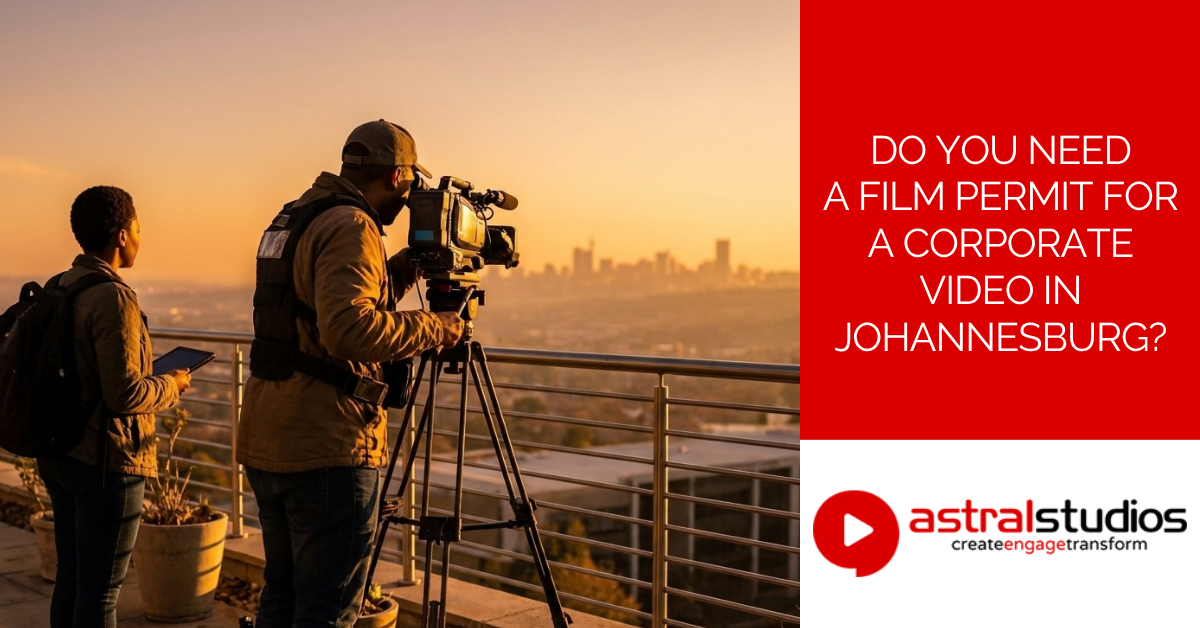
Do You Need a Film Permit for a Corporate Video in Johannesburg?
Last Updated: 3 hours ago by Astral Studios Staff
Do you need a film permit to shoot a corporate video in Johannesburg? Usually not, if you film on private premises. Public ground is different, and this guide shows where the line sits.
Say a comms manager books a crew for Monday. The plan looks simple. Film the CEO in the boardroom. Then grab a skyline shot outside. Suddenly someone asks about a permit, and the pavement shot feels risky. This scenario is invented, but it will feel familiar. In my opinion, this question can stall a shoot faster than any camera problem.
Good news first. Many corporate shoots happen indoors. Many never need a film permit. The trouble starts when the camera crosses the property line.
Do You Need a Film Permit for a Corporate Video in Johannesburg?
Here is the short version. Private premises, with the owner’s permission, rarely need a film permit. Public roads, pavements, parks and squares usually do.
When you don’t need a film permit
Think of a client’s office, factory floor or warehouse. The Gauteng Film Commission (GFC) says private sites need the owner’s permission. A managing agent can give it too. That is permission, not a permit. The difference matters, and a later section explains it.
A lot of corporate work fits here. Think CEO interviews, training demos, product close-ups and shop-floor B-roll. A written go-ahead from the client usually covers the lot.
When you do need one
A film permit covers public ground. The GFC lists roads, streets, sidewalks, squares, walkways, parks and cemeteries. Most government-owned structures also need approval first.
The GFC does not make the rules itself. The relevant authority does. A road shoot, for example, lands with the traffic authority. Only that authority can approve a road closure.
Main roads add another limit. The GFC says filming on arterials stays in off-peak hours.
Where the grey areas sit
Shopping centres, office parks and the pavement outside your door cause the most confusion. A mall feels public, yet it is private. The managing agent decides. The pavement often feels like yours. In many cases it belongs to the city.
In my view, treat anything outside your boundary wall as public. Assume it needs a permit until someone confirms otherwise. A smaller camera does not change the location rules either.
How a Film Permit Works in Johannesburg
Who issues the permit
The GFC does not issue permits. It has no permit unit either. The relevant city, provincial or national authority issues them. Some departments route applications through the GFC. The GFC points you to the right office and submits your application for free.
That help is worth using. Several authorities may be involved. Picking the wrong one costs time. The Gauteng Film Commission permit page explains the process.
What the application asks for
The GFC’s online form asks for a budget breakdown and the shoot locations. It wants a short description of each scene. It also asks for a road sketch and the number of officers required.
The form targets film crews, so a small corporate shoot may feel like overkill. Still, it shows what authorities care about. Traffic, safety and insurance seem to top the list.
Keep your letter of permission on set. Officials can ask to see it at any time. They can also ask for proof of public liability and political unrest cover.
How far ahead to apply
The GFC recommends applying at least 14 working days before filming. That is nearly three weeks. Treat it as a minimum, not a target. Build it into your production schedule from day one.
Film Permit Cheat Sheet by Location Type
Use this table as a starting point. Rules vary, so confirm with the GFC or the property owner.
| Location | Usually needed | Who to ask |
|---|---|---|
| Client office, factory or warehouse | Owner’s or managing agent’s permission | The client or site manager |
| Mine, hospital or campus | Site permission and safety rules | Site management |
| Shopping centre or office park | Managing agent’s permission | Centre or park manager |
| Public pavement or street | Public filming permit | Relevant authority, via the GFC |
| Main road or road closure | Traffic authority approval | Traffic authority, via the GFC |
| Joburg City Parks | Booking and tariff | Johannesburg City Parks and Zoo |
| City improvement district (CID) streets | Request through the GFC | CID managing authority |
| Government building | Permission, with the GFC notified | The department concerned |
| O.R. Tambo International | Authorisation letter, one week’s notice | ACSA |
| Heritage or conservation site | Special conditions likely | Relevant authority, via the GFC |
Local Rules in Sandton, Rosebank and Joburg Parks
City improvement districts
Sandton, Rosebank, Illovo, Braamfontein, Randburg and Newtown all sit inside city improvement districts (CIDs). The GFC guidelines list these and more. CIDs can restrict filming and set fees. Requests go through the GFC to the managing authority.
Many corporate shoots happen on these exact streets. That skyline shot you want probably sits inside a CID. When the GFC wrote the guidelines, Newtown, Main Street Mall and Gandhi Square charged fees. Check what applies today.
Johannesburg City Parks
Johannesburg City Parks and Zoo publishes tariffs for filming in its parks. The 2024/25 list shows R10,224 for a half day. A full day costs R19,016. Those rates sit under corporate advertising companies.
Treat these figures as indicative only. That tariff year has ended. Ask for the current rate in writing before you commit. The Johannesburg City Parks and Zoo tariff page lists the latest published rates.
Government buildings, National Key Points and heritage sites
Some sites need extra approval. The GFC names National Key Points, which include some airports. O.R. Tambo needs an authorisation letter from ACSA, with a week’s notice. Filming in non-restricted terminal and landside areas carries no fee.
Heritage can catch you out too. The GFC guidelines say a structure older than 60 years can count as heritage. Joburg has plenty of older buildings. The Cradle of Humankind also needs applications sent to the relevant authority. The South African Heritage Resources Agency is a good starting point.
For government buildings, tell the GFC first. It can help secure permission from the right department.
Film Permit vs Permission vs Consent
People mix up these three. They are different things, and a shoot may need all three.
The film permit
A permit comes from a public authority. It covers public ground, such as streets and parks.
Written permission from the property owner
Permission comes from the owner or managing agent. Get it in writing. State what you will film, where and when. Mention the crew size and any lights or generators.
POPIA consent and release forms
Consent comes from the people on camera. Legal template providers say POPIA treats video of an identifiable person as personal information. So get a signed release from employees, customers and recognisable passers-by. Minors need a guardian’s consent.
Employees may also withdraw consent later. Plan your edit so a face can come out. Ask a lawyer to check your wording. The Information Regulator publishes POPIA guidance.
Branding, signage and fire exits
Watch the background too. Third-party logos and artwork may carry their own rights. Never cover a fire exit sign unless the building manager and fire safety agree. Uncover it before you leave.
Drones and Aerial Shots for Corporate Video
Aerial footage can make Sandton look like a postcard. It also comes with its own rulebook.
Paid drone filming needs a Remote Pilot Licence for the pilot. The operating business needs a Remote Operating Certificate. Both fall under the South African Civil Aviation Authority (SACAA). Flying over a crowd needs extra permission on top.
The GFC guidelines cover aircraft in general. They add that urban flights need municipal Disaster Management approval. Ask the relevant department how it treats drones.
Local news adds a twist. In 2025, Johannesburg passed a CCTV by-law that covered drones. Property groups and civil society organisations challenged it in court. The city later said it would repeal the by-law. Check the current status before you fly.
My view? Hire a licensed drone team. A mate with a drone can cost you more in the end. Some licensed operators warn that insurers may refuse claims after an unlicensed flight. The corporate drone video cost guide covers budgets.
Insurance, Safety and Who Does the Paperwork
Public liability insurance comes up in every source. The GFC code of conduct expects the producer to hold it. Some authorities ask for proof.
So who applies, the client or the studio? A sensible split is that the studio handles public-ground admin. The client handles its own building. Agree this in writing before the shoot. A good brief names who handles permits, permissions and release forms. The video production brief template helps.
Neighbours matter too. Send a letter drop if you call or wrap outside business hours. Keep parking, loading and disabled bays clear. Use quiet generators near homes. Take your rubbish with you.
Goodwill pays off. The GFC can suspend permit rights for repeat offenders. A polite crew makes the next shoot easier for everyone.
How Location Rules Shape Your Video’s Visual Storytelling
Permits sound like paperwork. They also shape your story. Location rules decide what the viewer sees.
Think of the permit process as a map. It shows which roads are open before you start driving.
Build your shot list around location rules
Write the shot list early. Mark each shot as private, public or unsure. Scout every site before the shoot day. Then build the call sheet from that list.
A storyboard helps too. It shows the crew which frames need a permit. It also shows which frames do not.
Capture the Johannesburg skyline without a street shoot
You want that glass-tower opener. You have options. Shoot from the client’s rooftop or a high-floor window, with the building’s permission. Hire a licensed drone team. Use licensed stock for wide establishing shots. Or build the skyline with motion graphics.
A wide establishing shot sets the scene in seconds. Then the story moves indoors, where you control the light.
Shoot interviews and testimonials on private ground
Interviews work best indoors anyway. You control sound, light and background. A boardroom, a quiet shop-floor corner or a branded wall all work well. Get the release form signed before the camera rolls. The guide on testimonial videos versus case studies covers structure.
Use a studio, green screen or animation when access is limited
Sometimes a location says no. Sometimes the weather turns. A studio solves both. Green screen can drop your speaker into any setting, even a Sandton street. Animation can show a process no camera can reach. Compare live action and animation before you lock the plan. The green screen video cost guide helps with budgets.
Plan B-roll that stays on private ground
B-roll carries the story between talking heads. Think lobby details, hands on equipment, product close-ups and staff at work. All of it lives inside your property line. Shoot more than you need. Your editor will thank you.
Plan light, sound and crew size
A small crew draws less attention and may need less admin. Compact lights and one good microphone often do the job. Generators bring noise rules, so use battery lighting where you can.
Time the shoot
Golden hour makes Sandton glow. It can also clash with peak traffic. Arterial roads limit filming to off-peak hours. Plan outdoor shots for mid-morning or early afternoon. Then move indoors for the rest of the day.
A simple decision flow
A one-page graphic helps your team decide fast. Ask these five questions in order:
- Does any shot touch public ground?
- Do you have written permission from every property owner?
- Will recognisable people appear on camera?
- Does the shoot include a drone?
- Is any site sensitive, such as a heritage, government or National Key Point site?
Answer “yes” to question 1 and you start a film permit enquiry. Question 2 should always get a “yes”. Recognisable people mean release forms. Drones need a licensed operator. Sensitive sites need extra approval.
Common Mistakes to Avoid
- Assuming the pavement outside the building is private.
- Assuming a smartphone shoot skips the rules.
- Applying too late for a public location.
- Skipping release forms for staff and passers-by.
- Hiring an unlicensed drone operator.
- Forgetting public liability insurance.
Pre-Shoot Checklist
- List every location and mark it private or public.
- Find the issuing authority, or ask the GFC.
- Apply at least 14 working days ahead.
- Get written permission from each property owner.
- Confirm public liability insurance.
- Collect signed release forms.
- Brief the crew on rules, parking and noise.
- Carry every permit and letter on set.
Plan Your Johannesburg Shoot Before You Book the Crew
Permits and permissions should not slow a shoot. A clear plan keeps the crew moving and the story on track.
Contact us for corporate video production in Johannesburg from Astral Studios.
Glossary
Film permit: Written approval from a public authority to film on public ground.
Permission to film: Consent from a property owner or managing agent to film on private premises.
Gauteng Film Commission (GFC): A provincial agency that supports filming and helps with permit applications.
City improvement district (CID): An area where property owners fund extra services. It can set its own filming rules.
National Key Point: A site declared strategically sensitive, which may restrict filming.
Public liability insurance: Cover for injury or damage to other people or their property.
Release form: A signed document giving permission to use a person’s image and voice.
POPIA: South Africa’s Protection of Personal Information Act.
SACAA: The South African Civil Aviation Authority, which regulates drones.
Remote Pilot Licence (RPL): The licence a drone pilot needs for paid work.
Remote Operating Certificate (ROC): The certificate a business needs to operate drones commercially.
Location scouting: Visiting a site before the shoot to check access, light and rules.
Call sheet: A daily schedule listing crew, times, locations and contacts.
Shot list: A planned list of every shot a video needs.
B-roll: Supporting footage that covers the main interview or narration.
Establishing shot: A wide shot that sets the scene and location.
Letter drop: A written notice delivered to neighbours before a shoot.
Frequently Asked Questions
Do I need a film permit to film in my own office?
No. A film permit covers public ground, not private premises. If you rent, you still need the owner’s permission. Get it in writing.
Do I need a film permit to film on a public street in Johannesburg?
Yes, in most cases. The GFC says roads, streets and sidewalks need a public filming permit. The relevant authority issues it. The GFC can point you to that office.
Who applies for the film permit, the client or the studio?
Either can. A common split is that the studio handles public-ground applications. The client handles permission for its own buildings. Agree the split in writing before the shoot.
How far ahead should I apply?
The GFC recommends at least 14 working days before filming. Apply earlier if the shoot involves roads, parks or a CID.
Do I need permission to film inside a shopping centre?
Yes. A shopping centre is private property. Ask the managing agent first and get written approval.
Do I need a licence to use a drone in a corporate video?
Yes, for paid work. The pilot needs a Remote Pilot Licence. The operating business needs a Remote Operating Certificate from SACAA.
Do I need consent from employees who appear on camera?
Yes. Under POPIA, an identifiable person on video counts as personal information. Get a signed release form. A lawyer can check your wording.


