


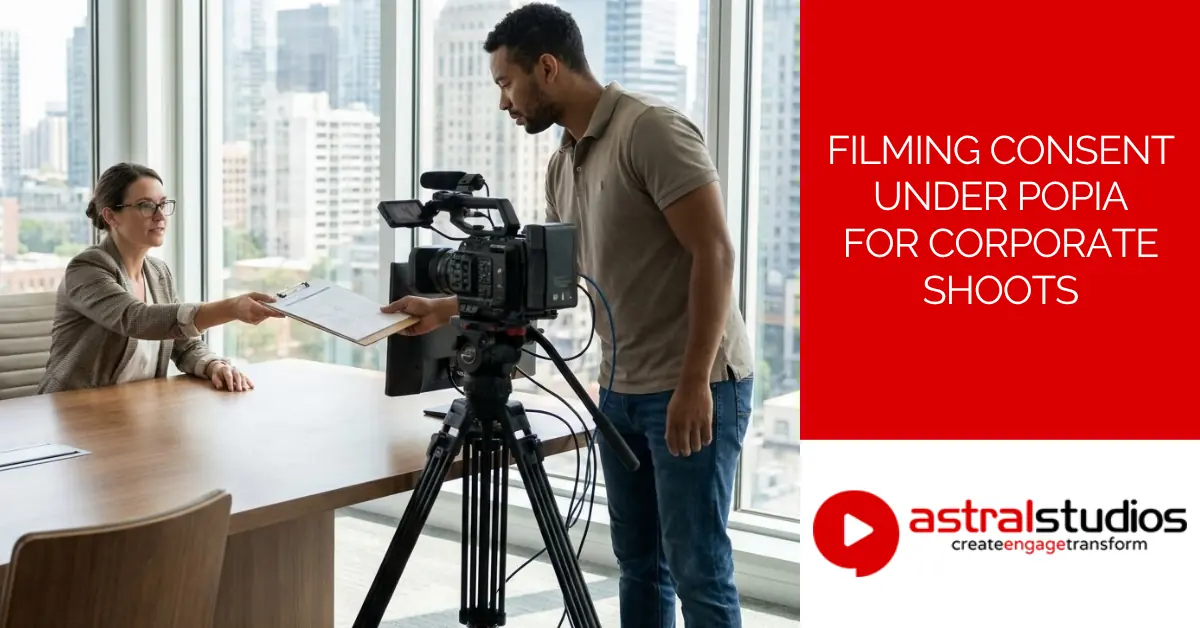
Filming Consent Under POPIA For Corporate Shoots
Last Updated: 2 months ago by Astral Studios Staff
Filming consent under POPIA is the paperwork step every corporate shoot needs first. This guide covers who must consent, and how that shapes the shoot.
A friend who runs a small production house shared a story. A client booked a private game lodge for the day. A helicopter pass captured guests below at golden hour. One guest, a well-known executive, never signed a release. Legal pulled that exact shot, days before launch. No budget could reshoot golden hour, or that guest list.
That kind of scramble is avoidable. Filming consent under POPIA isn’t complicated, once you know the shape of it. This article walks through exactly that.
What POPIA Actually Means for a Camera Crew
POPIA stands for the Protection of Personal Information Act. It came into full effect in 2021. The Act covers personal information. That includes images and voices, not just names and ID numbers. If someone can be identified on screen, POPIA applies to that footage.
Consent is one lawful reason to film someone. It isn’t the only one. A company can sometimes rely on legitimate interest or a contract instead. For most corporate shoots though, consent is still the simplest route.
Filming Permits and POPIA Consent Are Not the Same Thing
Plenty of people mix these up. A filming permit and POPIA consent solve different problems entirely.
Cape Town’s filming by-law needs a permit for most public shoots. Gauteng runs its own permit system too. Both cover property, noise, and traffic impact. Neither one mentions consent from the people on camera.
A friend who arranges location permits mentioned this mix-up often. Clients assume the permit covers everything, consent included. It doesn’t, and that surprises people.
So a shoot can hold a valid permit and still miss POPIA consent. The reverse is true too. You need both pieces sorted, not just one.
Who Needs to Consent on a Corporate Shoot
A corporate shoot usually has several kinds of people in frame. Each one needs a slightly different answer. Here’s a quick way to break it down.
| Who’s in frame | What they typically need |
|---|---|
| Employees on camera | Written consent, ideally on the call sheet |
| Executives and spokespeople | Written consent, plus sign-off on final use |
| Background staff | Consent, or reframe the shot to avoid them |
| Members of the public | Consent, or blur, or avoid identifiable framing |
| Minors | Parental or guardian consent, always written |
| Remote presenters | Consent for the call itself, and for reuse |
Minors on a Shoot
NGO and CSR shoots sometimes involve children. Always get a parent or guardian to sign, not the school alone. Keep that form separate from the general staff release.
Background Staff and Bystanders
A busy office has people walking through shots constantly. You can’t realistically get everyone’s signature. Reframe the shot, or plan for blurring later. More on that shortly.
When and How to Collect Consent
Consent works best when it’s part of the plan. Build it into the call sheet, not a scramble on the day.
Before the Shoot
Send release forms out with the shoot schedule. Give people time to read them properly. A rushed signature isn’t informed consent, not really.
On the Day
Walk each person through what they’re signing. Ask, don’t assume silence means yes. If someone declines, respect that and reframe around them.
What a Release Form Needs to Say
State exactly how the footage will be used. Name the platforms, and roughly how long you’ll keep it. Include a way to withdraw consent later.
How Consent Shapes Your Visual Storytelling Choices
This is where consent meets craft. A shoot without full consent isn’t a dead end.
Shooting Around a Declined Face
Film from behind, or in silhouette. It often looks more cinematic anyway, in my opinion. A wide shot with backs to camera tells its own story.
Blurring Faces in the Edit
Blurring works, but it reads as an afterthought. Better to plan the shot so blurring isn’t needed. Save it for genuine bystanders, not main subjects.
Reenactment and Stock Footage
Sensitive scenes sometimes suit a reenactment instead. An actor stands in for a real employee’s story. It protects the person, and the production schedule.
What Enforcement Actually Looks Like in 2026
POPIA does carry heavy maximum fines. That number gets thrown around a lot. In practice, the Information Regulator’s own enforcement record tells a calmer story.
Most 2026 enforcement action has targeted data breaches and security lapses. Government bodies feature heavily in that list. Video-specific consent cases haven’t shown up yet, from what I can see.
The Regulator generally investigates first, and orders a fix. Fines follow when that fix doesn’t happen. In my view, that’s the right order of operations.
Do it properly because it’s the right way to work. Not because a fine is landing tomorrow.
Storage, Reuse, and the Right to Be Forgotten
Signed consent isn’t the end of the story. What happens to the footage afterward matters too.
How Long to Keep Raw Footage
POPIA says don’t keep data longer than needed. Raw footage counts as data. Archive what you might reuse, and delete the rest.
Reusing Old Footage
A testimonial from two years ago isn’t automatically fair game. Check what the original consent actually covered. When in doubt, ask again.
Handling a Deletion Request
Someone can ask to be removed later. Take that request seriously, and act on it. Update the published video, not just your files.
Filming in Public and Semi-Public Spaces
Public streets are one thing. An office lobby or retail floor is another.
Both count as spaces where bystanders can end up on camera. Mary-Jane Mphahlele Attorneys covers the general rules around filming strangers well. For a corporate shoot, plan your angles to avoid identifiable strangers where you can.
Briefing Your Production Company on Consent
Put this in the brief, not a follow-up email. Ask for these things upfront.
- Signed release forms for every named participant.
- A plan for background staff and bystanders.
- Written notes on how footage will be reused.
- Someone responsible for holding the signed paperwork.
A studio that’s done this before will already have answers.
Frequently Asked Questions
Does POPIA apply to video, not just written data?
Yes. An identifiable image or voice counts as personal information. POPIA applies the moment someone can be recognised on screen.
Do I need written consent, or is verbal enough?
Written is safer, and easier to prove later. Verbal consent can work for a quick, low-stakes shot. For anything published widely, get it in writing.
Is a filming permit the same as POPIA consent?
No, they’re separate requirements. A permit covers where and how you film. Consent covers the people appearing in your footage.
Do background people in a wide shot need to consent?
Ideally, yes, if they’re identifiable. In practice, reframe the shot or blur faces later. Full consent from every bystander often isn’t realistic.
What happens if someone refuses on the day?
Respect the decision immediately. Reframe the shot, or film around them. Pushing back afterward causes more trouble than the reshoot.
Can I reuse old footage in a new campaign?
Check what the original consent actually covered first. If it’s unclear or narrow, ask the person again. Don’t assume old footage is free to reuse.
How long can I keep raw footage?
Only as long as you genuinely need it. POPIA discourages holding data indefinitely. Archive what’s useful, and delete what isn’t.
Is POPIA the same as GDPR?
They’re similar, but not identical. Both require lawful grounds for processing personal data. Michalsons has a clear comparison if you need the detail.
Do I need special consent to film children?
Yes, always get a parent or guardian’s signature. Never rely on a school or venue alone. Keep that consent separate from adult release forms.
What actually happens if a business gets this wrong?
Realistically, the Regulator tends to investigate and request a fix first. Serious fines have mostly hit government bodies and security breaches. That’s still a reason to get it right, not an excuse to skip it.
Get Your Next Shoot’s Consent Sorted Early
Contact us for corporate video planning that builds consent in from day one. Bring your shoot list, and we’ll talk through who needs to sign what.
Glossary
POPIA – Protection of Personal Information Act, South Africa’s data privacy law.
Personal information – Any data that identifies a person, including images and voice.
Data subject – The person whose personal information is being processed.
Responsible party – The organisation that decides how personal information is used.
Consent – Permission that’s freely given, specific, and informed.
Legitimate interest – A lawful reason to process data without consent, when justified.
Release form – A signed document recording someone’s consent to be filmed.
Information Regulator – The body that oversees POPIA compliance in South Africa.
Filming permit – Municipal permission to film in a public space.
Retention – How long an organisation keeps personal information, including footage.
Right to erasure – A person’s right to ask for their data to be deleted.


