


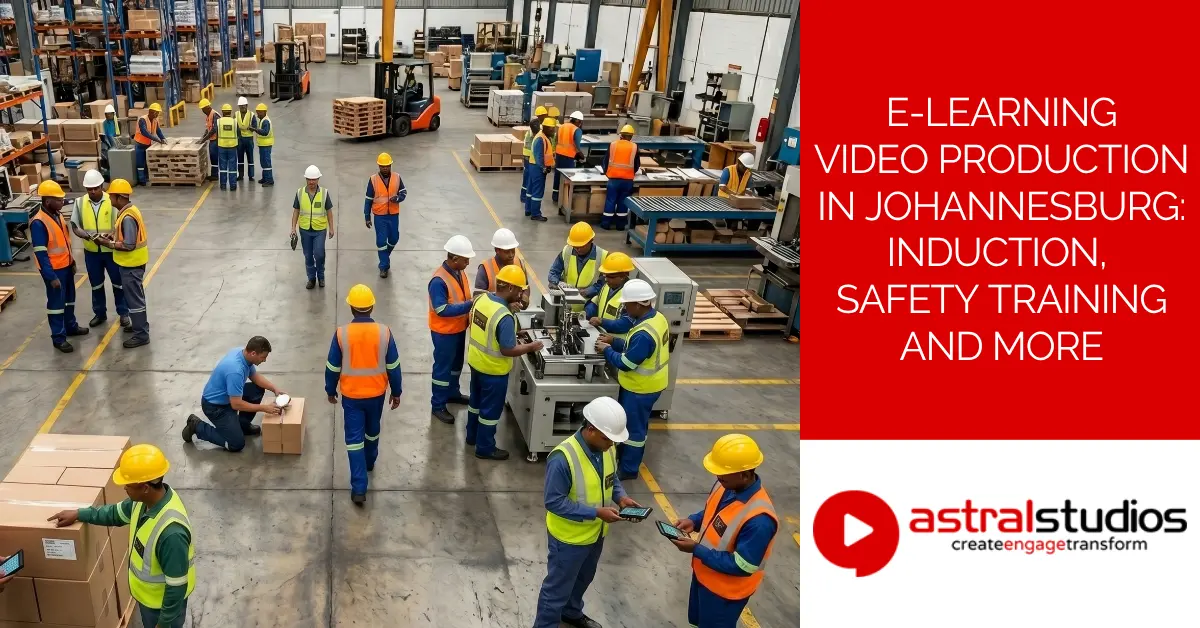
E-Learning Video Production in Johannesburg: Induction, Safety Training and More
Last Updated: 4 months ago by Astral Studios Staff
If you’re an HR manager or L&D professional searching for e-learning video production in Johannesburg, you’ve probably already figured out that classroom training doesn’t scale. This article covers what video-based training actually looks like, what it costs, and what to look for in a Johannesburg production partner.
Here’s a scenario that comes up regularly. A large organisation has new employees starting across three provinces every month. HR flies a trainer to each site, books a venue, prints manuals, and blocks out a full day. Then half the new starters miss the session because of shift changes. The trainer comes back. The costs keep climbing. Meanwhile, nobody is sure if the content is landing or not.
Video-based induction and training solves most of that in one go. You produce the content once, deploy it everywhere, and track who has watched what. That’s the core appeal – and it’s why e-learning video production has become a serious line item in SA corporate and government training budgets.
What E-Learning Video Production Actually Covers
The term covers more ground than most people realise. It’s not just a presenter talking to a camera. Depending on your training needs, e-learning video production in Johannesburg can include:
Induction videos – introducing new employees to the organisation, its culture, policies, and procedures. These work well as a series of short modules rather than one long video.
Safety training videos – particularly relevant for mining, manufacturing, construction, and logistics. A well-produced safety video can demonstrate hazardous procedures in a controlled way that would be impossible or dangerous to replicate live. Animation works especially well here for showing what happens inside machinery or in scenarios too risky to film.
Compliance training – POPIA, BBBEE policies, anti-corruption, harassment protocols. These need to be clear, documented, and completable on any device. Video combined with a short assessment is the standard approach.
Process and skills training – showing employees exactly how to do a specific task, step by step. Live action for physical procedures, screen recording for software, animation for anything abstract or technical.
Soft skills and leadership development – scenario-based videos using actors to demonstrate real workplace situations. These are more involved to produce but drive better retention than a slide deck ever will.
Why Johannesburg Organisations Are Moving to Video Training
The geography argument is the most compelling one for South African companies. Getting everyone into a training room when your workforce is spread across Gauteng, Limpopo, KZN, and the Western Cape is genuinely expensive. Travel costs, accommodation, trainer fees, and lost productivity add up fast.
One mining operation cited in Astral Studios’ e-learning ROI guide was spending R80,000 per quarter flying trainers to Free State operations. After moving to video-based training, they cut that budget by 70% – and safety test scores actually improved.
The multilingual argument is equally strong. South Africa has 11 official languages. A training video can be produced with subtitles or voiceovers in multiple languages from a single production, giving every employee access to content in a language they’re comfortable with. That’s not something a single live trainer can replicate.
What Format Works for Which Training Need?
Not every training topic needs the same treatment. Here’s a practical breakdown:
| Training Type | Best Format | Why |
|---|---|---|
| Induction and onboarding | Live action presenter + motion graphics | Warm, human, easy to update |
| Health and safety procedures | Animation or live action on location | Shows hazards clearly and safely |
| Compliance and policy | Presenter + screen graphics | Clear, auditable, easy to track |
| Software and systems | Screen recording with voiceover | Exact and repeatable |
| Process and technical skills | Live action on location | Shows the real environment |
| Scenario-based soft skills | Scripted live action with actors | Drives behaviour change |
Animation deserves a special mention for safety training specifically. When a client needed to train workers on the internal mechanics of heavy equipment, live action couldn’t show what was needed. A 3D animated sequence showed exactly what happens inside the machine during a malfunction – the kind of visual that sticks.
What Does E-Learning Video Production Cost in Johannesburg?
Pricing varies based on format, length, and complexity. Based on current SA market rates:
- Simple talking-head presenter video (5 minutes, basic graphics): R20,000 – R50,000
- Standard training module (scripted, professionally shot, motion graphics, voiceover): R40,000 – R120,000
- Animation-based training video (2D or 3D, 3–5 minutes): R60,000 – R200,000+
- Full induction programme (series of 6–10 modules): R150,000 – R500,000+
- SCORM-packaged e-learning course (interactive, LMS-ready): add R15,000 – R60,000 to base production cost
The cost-per-learner maths is worth doing before you baulk at those numbers. A R80,000 training module watched by 400 employees costs R200 per learner. That same training delivered in-person – with trainer fees, travel, venue, and lost productivity – routinely costs ten times that per head. You can find a broader breakdown of video production costs in South Africa for additional context.
What to Look for in a Johannesburg E-Learning Production Partner
This is where the question “who in Johannesburg does this?” becomes practical. A few things worth checking:
Do they understand training, not just video? There’s a difference between a team that shoots corporate promos and one that understands learning objectives, knowledge retention, and how to structure content for comprehension. Ask to see examples of actual training work, not just showreels.
Can they handle animation as well as live action? Some training topics need animation. A production partner that only does live action will steer every brief toward live action, whether it’s the right choice or not.
Do they have LMS and SCORM experience? If you need your content to live inside a learning management system – tracking completion, assessments, and pass rates – the production company needs to understand that workflow. Not all of them do.
Can they work across multiple sites and locations? For induction programmes covering different facilities, a Johannesburg-based team with experience shooting on location around South Africa matters.
Do they understand your industry? Safety training for a mine looks different from compliance training for a financial services firm. A production partner with relevant sector experience will ask better questions and produce more accurate content.
Frequently Asked Questions
What is the difference between a training video and an e-learning course?
A training video is a video file. An e-learning course wraps video content with interactive elements – quizzes, branching scenarios, completion tracking – and packages it in a format (usually SCORM or xAPI) that works inside a learning management system. Many organisations start with video and add the interactive layer later.
Can training videos be produced in multiple South African languages?
Yes. A single production can be delivered with voiceovers or subtitles in multiple languages without reshooting. This is one of the strongest practical arguments for video training in the South African context.
How long does it take to produce a training video in Johannesburg?
A standard training module typically takes four to eight weeks from briefing to delivery, depending on complexity. Animation takes longer than live action. A full induction programme with multiple modules should be planned over three to six months.
Do I need a learning management system to use training videos?
Not necessarily. Basic training videos can be hosted on a private YouTube channel, internal intranet, or shared drive. However, if you need to track completion, administer assessments, and maintain compliance records, an LMS is the right tool – and your video content needs to be packaged accordingly.
What industries in Johannesburg use e-learning video production most?
Mining, financial services, manufacturing, logistics, healthcare, and government departments are the most active sectors. Safety-critical industries tend to have the strongest need, but any organisation with a large or geographically dispersed workforce benefits from the format.
How do I convert existing classroom training into video?
The starting point is your existing training material – manuals, slide decks, trainer notes. A good production partner will work with your subject matter experts to adapt that content for video, breaking it into logical modules and identifying which topics suit live action versus animation versus screen recording.
Let’s Talk About Your Training Requirements
Whether you need a single induction video or a full multi-module e-learning programme, a Johannesburg-based production team with experience across live action, animation, and LMS-ready content can handle the brief from script to delivery.
Contact us to discuss your training project.


