


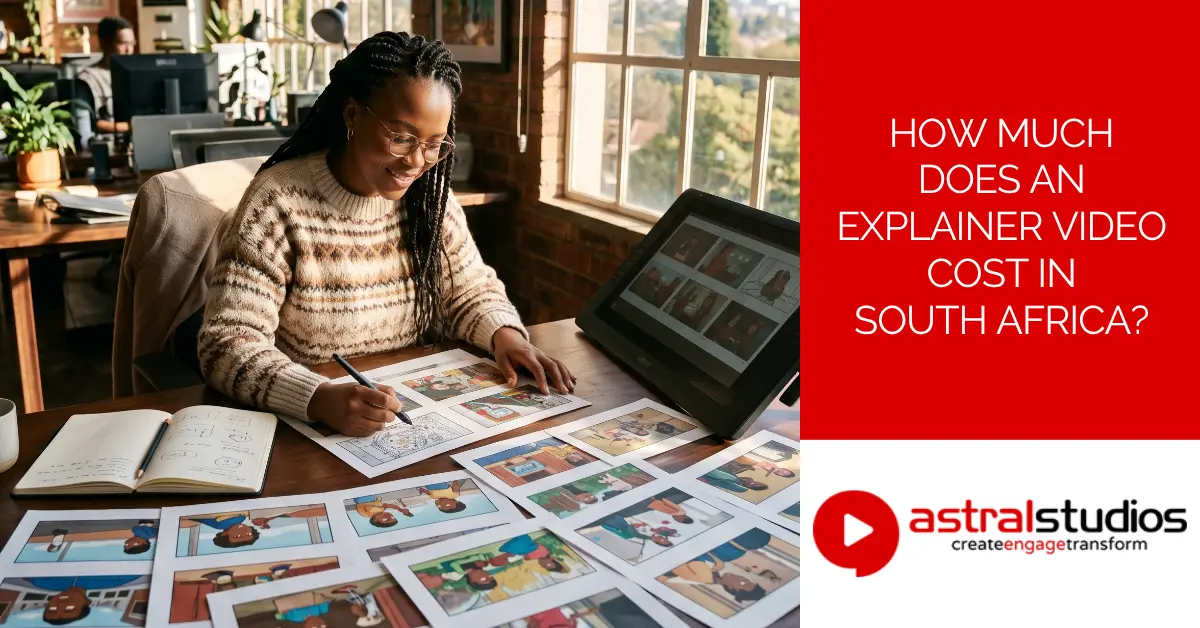
How Much Does an Explainer Video Cost in South Africa?
Last Updated: 4 months ago by Astral Studios Staff
Explainer video cost is one of the first things businesses ask about when they start planning a video project — and it’s also one of the hardest questions to answer without more context. This article breaks down what you’ll actually pay in South Africa in 2026, what drives the price up or down, and how to make sure you get good value for your money.
Here’s a story you’ll probably recognise. A marketing manager at a Joburg fintech company needs a short animated video for their website. She gets three quotes. One comes in at R18,000. Another at R55,000. The third at R140,000. All three are for a 60-second animated explainer. She has no idea why the prices are so different, or which one to trust. She picks the middle one, crosses her fingers, and hopes for the best.
That kind of confusion is completely normal — and totally avoidable. Let’s sort it out.

What is an Explainer Video?
Before we get into numbers, let’s make sure we’re talking about the same thing.
An explainer video is a short video that explains what your business does, how your product works, or what problem your service solves. It’s usually between 60 and 90 seconds long. It can be animated or live-action, and it’s built to be watched on a website, in an email, on social media, or in a sales presentation.
It’s not the same as a corporate video (which tends to be more about brand and culture). It’s not a training video (which usually runs longer and goes deeper into process). And it’s not a TV commercial, which has very different production requirements.
The explainer video is really a conversion tool. According to Wyzowl’s 2026 State of Video Marketing report, 96% of people have watched an explainer video to learn more about a product or service, and 85% say a video has convinced them to buy. That’s a pretty good argument for making one.
What Does an Explainer Video Cost in South Africa?
Let’s get straight to what most people really want to know.
In South Africa, explainer video cost varies a lot depending on who makes it, how it’s made, and what’s included. Based on what studios across the country are charging in 2026, a professionally animated video from a seasoned local studio typically falls somewhere between R30,000 and R250,000. That’s a wide range — and for good reason.
Here’s a practical breakdown by budget tier:
| Budget tier | What you typically get | Rough SA price range |
|---|---|---|
| Entry level / freelancer | Template-based animation, basic script, standard voiceover | R5,000 – R20,000 |
| Mid-range studio | Custom 2D animation or live-action, professional script and VO | R30,000 – R80,000 |
| High-end studio | Complex animation, character design, premium VO, full production | R80,000 – R250,000+ |
A word on the low end. Yes, you can find people on Fiverr or Upwork who’ll make something for R5,000 or less. You’ll almost certainly get a template-based video with stock characters and a generic feel. For internal use or a quick social media clip, that might be fine. For your website homepage or a client-facing pitch? Probably not.
Why Does the Explainer Video Cost Vary So Much?
This is the question behind the question. If you’ve ever gotten two wildly different quotes for what seems like the same job, here’s what’s actually going on.
Animation style is the biggest driver of explainer video cost
The biggest single factor is how the video is made visually. There are several main styles, and they come with very different price tags.
Motion graphics use shapes, icons, and text in motion. They’re clean, relatively quick to produce, and they age well. This is usually the most affordable animated style.
2D character animation involves illustrated characters that move. Think of the kind of animation you see in explainer videos for apps or financial services. It looks great, but it takes longer — characters need to be designed, rigged, and animated frame by frame.
Whiteboard animation mimics a hand drawing on a white board. It works well for education and process explanation. But it can look dated if it’s not done well, and cheap whiteboard videos are very easy to spot.
3D animation is the most expensive option by a wide margin. It involves 3D modelling, lighting, and rendering. It’s worth it for certain types of content — product visualisations, architectural walkthroughs, medical or engineering simulations — but overkill for most basic explainer briefs.
Live-action replaces animation with real footage of people, products, or environments. The cost depends heavily on crew size, location, and cast. For some briefs, a well-shot live-action explainer can actually be cheaper than complex animation.
Here’s a quick comparison:
| Animation style | Relative cost | Best for |
|---|---|---|
| Motion graphics | Lower | Tech, finance, process explanation |
| 2D character animation | Mid to high | Apps, services, consumer brands |
| Whiteboard animation | Lower to mid | Training, education, B2B |
| 3D animation | High | Products, engineering, medical |
| Live-action | Mid to high | Human-centred stories, testimonials |
Video length pushes the explainer video cost up
Most pricing in the industry uses 60 seconds as the base unit. Each additional 30 seconds typically adds 25–40% to the total cost, because more script, more animation, more voiceover, and more editing are needed.
The good news is that 60–90 seconds is actually the sweet spot for this format. Longer videos don’t perform better. Attention drops off fast, and most of what you want to say can fit into 90 seconds if the script is tight.
If a studio tells you your explainer video needs to be three minutes long, push back. It probably doesn’t.
The script is where the real work happens
A good script is not just writing. It’s strategy. It has to explain a product or service clearly, in plain language, in under 150 words, while still sounding like a human being rather than a brochure.
Most studios include scriptwriting in their quotes, but not all do — especially at the lower end. Always check. A badly written script leads to expensive revision rounds in production, because once the animation starts, changes get costly fast.
One thing we hear often: a client comes in with a script they wrote themselves, convinced it’s almost done. It’s usually much longer than it needs to be, and it explains the product from the inside out rather than from the customer’s point of view. That’s not a criticism — it’s just a different kind of writing, and it’s worth letting someone who does it every day take a pass at it.
Voiceover adds more than most people expect
The voiceover is not just someone reading the script. The right voice sets the tone for the whole video. And in South Africa, there are some decisions that don’t come up in other markets.
English is the default for most corporate explainer videos, but some clients want Afrikaans or Zulu or Sotho versions as well. Multilingual voiceover adds cost, but it also adds real reach — especially for government or NGO content targeting communities where English is not the first language.
Human voiceover still wins for brand-facing content. AI-generated voiceover has improved a lot in 2025 and 2026, and it’s a legitimate option for internal training or social media content. But for a video that’s going to represent your brand on your website for the next three years, the human voice matters.
Most studios include two to three rounds of revisions in their quotes. Extra rounds cost more — sometimes a lot more — and they also add time.
The way to avoid runaway revisions is simple: approve the script before animation starts. Approve the storyboard before motion begins. Changes at the script stage cost almost nothing. Changes at the animation stage cost a great deal. This is the one thing producers across the industry agree on, and it’s the one thing clients consistently underestimate.
Always ask upfront: how many revisions are included, and what does an extra round cost?
Rush fees and turnaround time
A standard 60-second animated explainer typically takes three to six weeks from brief to delivery. If you need it faster, expect a premium — sometimes 25–50% on top of the normal rate.
Plan ahead. If you have a product launch or an event coming up, brief your studio at least six weeks before the deadline. The rush fee is entirely avoidable.
What’s Actually Included in an Explainer Video Quote?
This is where a lot of buyers get caught out. Two quotes at the same price can include very different things. Here’s what to check:
| Line item | Often included | Sometimes extra |
|---|---|---|
| Script | ✓ at most studios | ✗ at some budget studios |
| Storyboard | ✓ | ✗ |
| Voiceover | ✓ | ✗ |
| Music licensing | ✓ | ✗ |
| Revisions | 2–3 rounds usually | Extra rounds billed separately |
| Multiple formats (16:9, 9:16, square) | ✗ | Usually extra |
| Subtitles/captions | ✗ | Usually extra |
| Source files | ✗ | Often extra |
Two questions worth asking every studio, every time: Who owns the final files? And can I get the source assets if I want to make changes later?

The Three Stages of Explainer Video Production
Understanding where your money goes makes the whole pricing conversation easier.
Pre-production
This is the planning phase. It covers the brief, the script, the storyboard, and the style frames. It also includes the voiceover recording.
Pre-production is where the most important decisions get made. It’s also where the project is most vulnerable to scope creep. A vague brief leads to a vague script, which leads to a vague video and a lot of expensive back-and-forth. The studios that ask a lot of questions upfront are usually the ones worth paying for.
Production
This is where the actual animation or filming happens. For an animated explainer, it includes character design, scene illustration, motion graphics, and animation. This phase takes the most time and uses the most skilled people. It’s also where most of your budget goes.
For live-action explainers, this is the shooting phase: crew, cameras, lighting, location, and talent.
Post-production
Post is where everything comes together: editing, sound design, music, colour correction, and final rendering. It’s easy to underestimate this phase, but a badly mixed audio track can undermine a beautifully animated video. Poor sound is one of the things audiences notice immediately, even if they can’t explain why.
Ask for all formats at delivery: at minimum, a 16:9 version for websites and a square or 9:16 version for social media. Getting these cut later from an edited master is cheaper than going back to the source files.
Local SA Studio vs Offshore: What Should You Choose?
The rand makes offshore options look tempting. A Fiverr animation studio in Eastern Europe or Southeast Asia might quote you a fraction of what a Joburg studio charges. It’s worth thinking through what you’re actually buying, though.
Briefing an overseas studio on a South African product, a South African audience, or South African compliance context is genuinely harder than it sounds. You’ll spend more time explaining things that a local studio already understands. Time zone differences slow down approvals. And if you need Afrikaans or Zulu voiceover, finding and directing that talent remotely is a real challenge.
South African production rates are also competitive by global standards. According to research across studios worldwide, US studios charge considerably more than European studios for the same deliverable — and SA studios sit below both in most cases. You get local knowledge and global quality at a rate that makes sense.
For one-off tasks — a voiceover, a quick edit, a few motion graphics assets — offshore freelancers can absolutely work. For end-to-end production of a brand-facing video? The local option usually works out better in practice, even if it looks pricier on paper.
Is the Explainer Video Cost Actually Worth It?
Fair question. Let’s be direct about it.
A well-made explainer video is not a once-off expense. It lives on your website, runs in email campaigns, plays at events, and sits in sales decks for years. When you divide the cost by the number of times it gets used, the cost per impression is low.
The numbers from the industry back this up. Research shows that explainer videos can increase conversion rates by between 20% and 80%, making them one of the better-performing tools in a marketing budget. Landing pages with explainer videos convert at 86% higher rates than those without. Emails that include explainer videos see around 300% better click-through rates.
For a business spending R50,000 on an explainer video that drives even a modest increase in conversions over two years, the maths tends to work out well.
The caveat is that a cheap video that doesn’t work is not a bargain. A R10,000 video that confuses people or looks shoddy can actually hurt your brand. Think of it like a new team member: the right investment upfront saves a lot of pain later.
One other thing worth mentioning. A smart studio will build your explainer video in a way that allows you to repurpose it. The same core animation can be cut into 15-second social media clips, reformatted for different platforms, or re-voiced in different languages. That flexibility multiplies the value of the original production considerably.
A Note on AI and Explainer Video Cost in 2026
AI-assisted video production has changed the pricing conversation in 2025 and 2026. Professional studios using AI-powered workflows can now deliver studio-quality animated videos for significantly less than traditional production — sometimes half the cost. This isn’t because quality has dropped; it’s because AI handles some of the repetitive production work, freeing up the creative team for what actually matters.
The honest position is this: AI-assisted production makes sense for training content, social media clips, and rapid-turnaround projects where volume matters. For a flagship brand video on your homepage — the one that shapes how a potential client sees you in the first 90 seconds — human creative direction still has the edge. The two approaches aren’t in competition; they serve different needs.
FAQ: Explainer Video Cost in South Africa
How much does a 60-second animated explainer video cost in South Africa?
Roughly R30,000 to R80,000 from a mid-range professional studio, depending on animation style and complexity. High-end productions with complex animation can reach R250,000 or more.
What’s the cheapest way to get an explainer video in SA?
Freelancers or template-based tools can bring costs down to R5,000–R20,000, but customisation is limited. For brand-facing content, this tier usually shows.
How long does it take to produce an explainer video?
Typically three to six weeks for a 60–90 second animated video, from brief to delivery. Rush projects cost more.
Does video length affect the cost a lot?
Yes. Each additional 30 seconds typically adds 25–40% to the total production cost, because more script, animation, voiceover, and editing are needed.
Can I use AI to make a cheaper explainer video?
Yes, and AI-assisted production is a legitimate option in 2026 — especially for internal content or social media. Brand-facing videos still benefit from human creative direction.
Is a local SA studio better than going offshore?
For content aimed at a South African audience, yes. Local studios understand the market, the language context, and the compliance requirements without needing lengthy explanations.
Ready to Talk About Your Explainer Video?
We work with businesses, corporates, NGOs, and government agencies across South Africa to produce explainer videos that actually do their job. Get in touch and let’s talk about what yours needs to do.
You can also read our full guide to video production costs in South Africa for a broader picture of what different types of video production cost.
Glossary
2D animation — Animation that works in two dimensions: height and width. Characters and scenes are illustrated and moved across the screen. The most common style for explainer videos.
3D animation — Animation built in three dimensions, involving modelling, lighting, and rendering. More expensive and time-consuming than 2D, but creates a realistic, three-dimensional look.
Motion graphics — Animated text, shapes, and icons that move to tell a story or explain a concept. Often used in corporate and financial explainer videos.
Whiteboard animation — A style that mimics drawing on a whiteboard. Used mainly for education and training content.
Live-action — Video that uses real cameras, real people, and real locations rather than animation.
Pre-production — Everything that happens before filming or animation begins: brief, script, storyboard, voiceover recording, style frames.
Post-production — Everything that happens after the main filming or animation: editing, sound design, music, colour correction, final rendering.
Storyboard — A visual plan for the video, showing each scene as a sketch before animation begins.
Voiceover (VO) — A recorded narration that runs over the video. Can be human or AI-generated.
Revision rounds — Structured opportunities to request changes during production. Most studios include two to three rounds in their standard quote.
Rush fee — A premium charged for faster-than-standard turnaround time.
Source files — The original project files created during production. Useful if you want to make changes later. Not always included in a standard quote.
AI-assisted production — A production workflow that uses artificial intelligence tools to speed up parts of the animation or video production process, reducing cost without necessarily reducing quality.


