


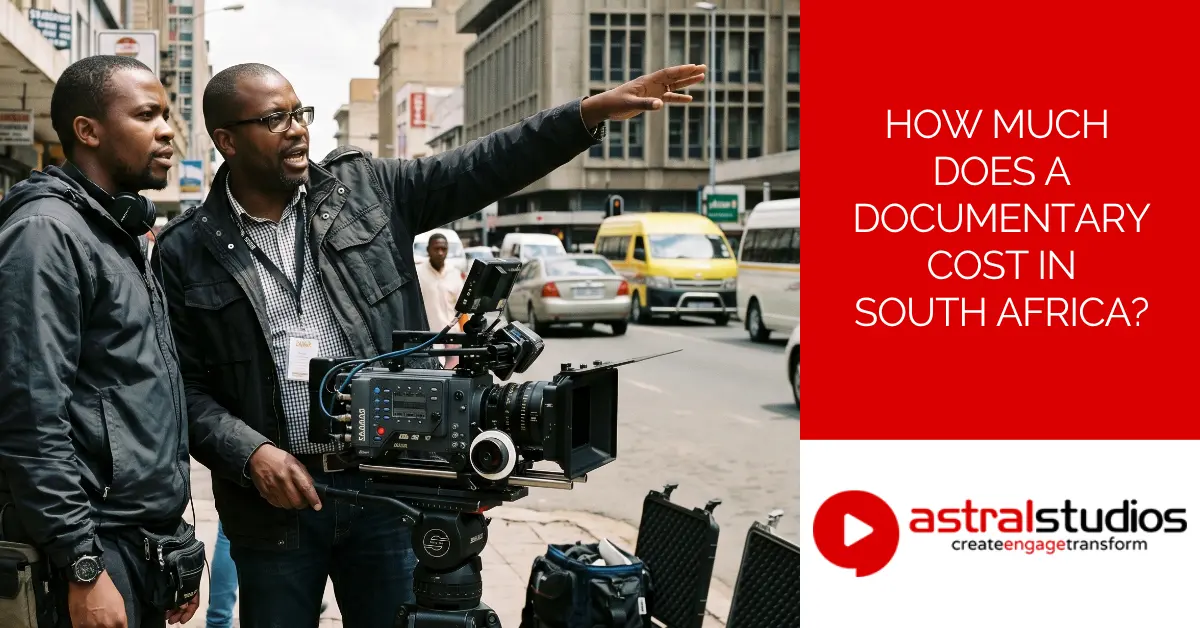
How Much Does a Documentary Cost in South Africa?
Last Updated: 4 months ago by Astral Studios Staff
Documentary cost in South Africa ranges from R25,000 for a short docustyle video to well over R500,000 for a full branded production. This article breaks down what you can expect to pay in South Africa in 2026, and what drives the price up or down.
A marketing manager at a Joburg company once put it this way: “I thought a documentary would cost the same as the corporate video we did last year.” It didn’t. And that gap between expectation and reality is something worth talking about honestly.
So let’s get into it.
What Kind of Documentary Are You Thinking About?
Before any numbers make sense, you need to know what category your project falls into. There are basically three types.
The Branded or Corporate Documentary
This is the one most businesses, NGOs and government departments are after. It runs between 5 and 30 minutes. It tells a real story about your organisation, your people, or your impact. You use it on your website, at events, in boardroom presentations, or on social media.
This is also the format this article focuses on. Documentary cost for this category runs from about R40,000 to well over R500,000. The range is wide because the scope varies enormously.
The Independent or Broadcast Documentary
This is what you see on DStv, SABC, or streaming platforms. It’s usually 45 minutes or longer. It often runs as a series. Funding usually comes from the NFVF, a broadcaster, or both. The minimum spend to qualify for the DTIC’s film production rebate is R500,000 for documentaries. Budgets go up from there, often well past R2 million.
This isn’t the typical commissioned documentary for a business. But it’s good to know the difference.
The Short Docustyle Video
This sits between a standard corporate video and a full documentary. It runs 3 to 8 minutes. It uses documentary-style interview footage and real locations instead of a scripted presenter. It’s the most accessible format for smaller budgets. You can start from around R25,000 to R60,000 for a well-produced short.
Documentary Cost at a Glance
Here’s a rough guide to documentary cost in South Africa for 2026. All figures exclude VAT at 15%.
| Format | Typical Length | Estimated Cost (excl. VAT) | Best suited for |
|---|---|---|---|
| Short docustyle video | 3-8 min | R25,000-R60,000 | Social media, website content, events |
| Short branded documentary | 10-20 min | R80,000-R250,000 | Corporate storytelling, NGO impact reporting |
| Mid-range branded documentary | 20-45 min | R250,000-R600,000 | Brand heritage, broadcast-quality productions |
| Independent / broadcast documentary | 45-90+ min | R500,000-R5M+ | TV, streaming platforms, NFVF-funded projects |
These are indicative ranges, not fixed quotes. Every production is different. A 15-minute documentary shot entirely at one Joburg location costs less than the same length shot across three provinces.
Why Documentary Cost is Higher Than a Corporate Video
This is the question clients ask most often. So here’s the honest answer.
Research and Pre-Production Take More Time
A standard corporate video follows a script you’ve already written. A documentary starts with a story you still need to find. That takes research, conversations, location visits, and treatment development. All of that time costs money before a camera even rolls.
Pre-production on a mid-range branded documentary can run R20,000 to R50,000 on its own. It’s not glamorous, but it’s what stops a documentary from going off the rails during production.
Shoot Days Are Less Predictable
You can’t script a documentary the same way you script an ad. Interview subjects cancel. Weather changes. A story takes an unexpected turn. Real productions often need more shoot days than originally planned. Each extra day adds crew, equipment, and transport costs.
A client once commissioned a documentary about a community development project. The team planned four shoot days. By the time the story was properly captured, they’d used seven. That kind of thing happens. Good planning helps, but you can’t plan everything in a documentary.
Documentary Post-Production Is a Different Beast
Editing a corporate video means cutting a pre-written script together. Editing a documentary means finding the story inside the footage. That’s a different skill, and it takes longer.
A 20-minute branded documentary might generate 20 to 40 hours of raw footage. Someone needs to watch all of it, log it, build an assembly cut, refine it, and cut it down to something tight and watchable. After that, add colour grading, sound design, music, and narration. Post-production alone can account for 30 to 40% of your total documentary cost.
What Drives the Documentary Cost Up
Locations
Shooting in one Joburg office is straightforward. Shooting in five different cities is a logistical operation. Travel, accommodation, and transport for a full crew adds real money. If your story can be told locally, it will cost less. Simple.
Archival Footage and Photography
A lot of documentaries use archive footage for historical context. Licencing footage from South African broadcasters or international libraries is a legitimate cost that surprises many clients. Rights fees vary widely depending on the source and how you plan to use the material.
Music Licencing
Music does a lot of heavy lifting in a documentary. It sets pace, tone, and emotion. Licencing a commercial track can cost anywhere from R5,000 to R50,000 per song, depending on where you’ll show the film and for how long. Original composition costs more upfront but gives you full ownership. Stock music libraries are the most budget-friendly option, and they’ve improved a lot over the past few years.
Animation and Motion Graphics
Some documentaries use animation to explain data or recreate events. Even basic titles and lower thirds take time to design and build. Expect to pay R8,000 to R25,000 for simple motion graphics work, more for anything complex.
Crew Rates and Equipment
A Director of Photography in South Africa typically charges between R6,500 and R20,000 per day, depending on the production. Add a director, sound recordist, camera assistant, and production manager, and a single professional shoot day can run R25,000 to R45,000 before you’ve touched equipment or location fees.
The NFVF maintains useful resources on the South African film and television industry if you want to understand crew structures in more detail.
Narration and Voice-Over
A professional voice-over artist for a 20-minute documentary typically costs R3,000 to R10,000, depending on the talent and usage rights. Broadcast-quality narration also needs professional studio recording, which is a separate line item.
What Can Bring the Documentary Cost Down
The good news is that smart planning can make a real difference to your budget.
Shoot close to home. Keeping all shoot days in one city removes travel costs entirely. For most corporate or NGO documentaries, this is completely achievable.
Use stock footage for context shots. You don’t need to send a crew out at dawn to get an aerial shot of Joburg. A well-chosen stock clip costs a fraction of a shoot day and can be just as effective.
Come in with a clear brief. The single biggest cause of budget overruns in documentary production isn’t the crew or the equipment. It’s a brief that changes after filming starts. A clear, signed-off brief before the camera rolls saves money at every stage.
Plan for content repurposing. If the footage will also feed shorter social cuts, a 60-second trailer, or a behind-the-scenes reel, your cost-per-asset drops considerably. Get more out of the same shoot days.
Mix structured and observational elements. A fully observational documentary needs more shoot days than one with structured interview segments. A hybrid approach gives you the richness of real documentary storytelling without the unpredictability of a fully fly-on-the-wall shoot.
How Long Does a Documentary Take to Produce?
Clients ask this one almost as often as they ask about documentary cost. Here’s a general guide.
| Stage | Typical Duration |
|---|---|
| Brief and concept development | 1-2 weeks |
| Pre-production (research, treatment, scheduling) | 2-6 weeks |
| Production (shoot days) | 2-15 days over 2-8 weeks |
| Post-production (edit, grade, mix, narration) | 4-12 weeks |
| Revisions and final delivery | 1-3 weeks |
| Total | 2-6 months |
A short branded documentary at a lower budget can move faster. An independent broadcast documentary often takes 12 to 24 months from development to delivery.
Is There Funding Available for Documentary Production?
The NFVF
The National Film and Video Foundation funds South African documentary productions. They cover feature documentaries, 2-3 part documentaries, and short films. Applications are competitive and require a production company with a proven track record. This route isn’t open to most commissioned corporate or branded documentary clients, but it’s worth knowing about.
The DTIC Rebate
The DTIC Film and Television Production Incentive offers up to 35% of Qualifying South African Production Expenditure (QSAPE) back to qualifying productions. Documentaries need a minimum QSAPE of R500,000. Delays in rebate payments were a real issue for the industry in 2025, with independent producers raising formal concerns about DTIC processing times. If you’re planning a production that might qualify, factor the payment timeline into your cash flow planning.
Brand or Client Funding
For most branded and corporate documentaries, the commissioning organisation funds the production directly. NGOs often use donor or grant funding. Some social impact documentaries secure co-funding from multiple sources.
Documentary Cost: Frequently Asked Questions
How much does a short documentary cost in South Africa?
A short branded documentary of 10 to 20 minutes typically costs between R80,000 and R250,000, depending on locations, crew, and post-production. A simpler docustyle video can start from R25,000. See our guide to video production costs in South Africa for a broader breakdown.
What’s the difference between a documentary and a corporate video?
A corporate video follows a pre-written script in a controlled environment. A documentary follows a real story with real people, real locations, and real events. The research, shoot time, and editing involved are all more intensive. That’s the main reason documentary cost runs higher.
Can a small business afford a documentary?
Yes, if the scope matches the budget. A short docustyle video shot locally, with structured interviews and a clear brief, sits within reach for many businesses. The key is matching the format to the budget rather than trying to shrink a feature-length concept into a small one.
Does the DTIC rebate apply to branded documentaries?
The DTIC rebate is designed for productions intended for public broadcast or distribution. Most branded or internal documentaries don’t qualify. A production company can advise you on whether your project meets the criteria.
How many shoot days does a documentary need?
A short branded documentary typically needs 2 to 5 shoot days. A mid-range documentary with multiple locations might need 6 to 15 days. Each additional day adds crew, equipment, and logistics costs.
Who owns the footage after production?
This depends on your contract. In most commissioned documentary productions, the client owns the final deliverables. Rights to raw footage, music, and any licenced material should be clearly set out before the project starts. Ask for a clear IP and usage rights clause in your production agreement.
What is documentary cost influenced by most?
The number of shoot days and the complexity of post-production are the two biggest cost drivers in a documentary. Location travel is the third. Getting those three things right at the brief stage gives you the most control over your budget.
Ready to Talk Documentary?
If you’re thinking about a documentary for your organisation, we’d love to hear about it. Come with a sense of the story you want to tell, who the audience is, and what you want them to feel or do after watching it. We’ll take it from there.
Contact us for a conversation about your project.
Glossary
Archival footage: Pre-existing video material, such as news clips or historical footage, licenced for use in a new production.
Colour grading: The process of adjusting the colour and tone of footage in post-production to create a consistent visual style.
DOP (Director of Photography): The crew member responsible for the visual look of a production. They operate or oversee the camera and lighting.
DTIC: Department of Trade, Industry and Competition. The South African government body that administers film production incentives.
Motion graphics: Animated visual elements used in video production, such as titles, lower thirds, charts, and illustrative animations.
NFVF: National Film and Video Foundation. The South African government body that funds and develops the local film and television industry.
Post-production: Everything that happens after filming: editing, colour grading, sound design, music, narration, and visual effects.
Pre-production: Everything that happens before filming: research, scripting, location scouting, casting, and scheduling.
QSAPE: Qualifying South African Production Expenditure. The portion of a production budget spent on South African goods, services, and personnel that qualifies for the DTIC rebate.
Sound design: The process of recording, editing, and mixing audio elements in post-production, including dialogue, ambient sound, and music.
Voice-over: A narration track recorded by a professional artist and added to a video in post-production.


