


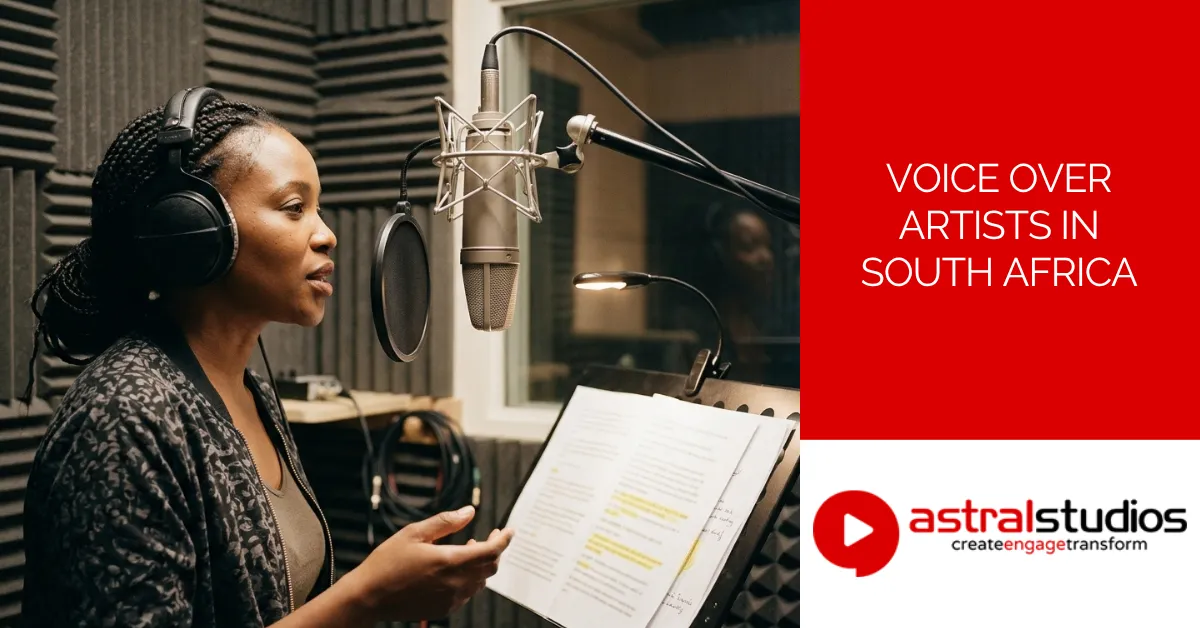
Voice Over Artists in South Africa
People judge a corporate video by its voice within seconds. A flat or mismatched voice makes even great visuals feel cheap. And once the video is edited, the voice is the hardest thing to change.
Yet many buyers pick a voice from a demo reel in five minutes. This guide is for anyone commissioning a video. It covers choosing a voice, briefing the artist and budgeting for the job.
Key takeaways
- Match the voice to your audience, not just to what sounds “professional”.
- Usage rights affect the price as much as the recording does.
- A locked script and a pronunciation guide save costly re-records.
- AI voices suit some jobs. But never clone a real person’s voice without consent.
What does a voice over artist do in a corporate video?
A voice over artist records the spoken narration you hear but don’t see. They might also voice characters in an animation, or record phone system messages.
A voice over artist isn’t an on-camera presenter. It also isn’t quite the same as dubbing. Dubbing replaces all the speech in another language. It often matches lip movements too. Our guide to choosing languages for corporate video covers dubbing in more detail.
Types of corporate voice over work
Corporate and brand videos
Company profiles and brand films need a voice that sounds confident and trustworthy. The pace is usually calm, with room for the visuals to breathe.
Best suited to: a warm, assured voice that feels like a senior person speaking.
Explainer and animated videos
Explainers move fast and often use humour. So the voice needs energy, clear diction and good timing.
Best suited to: a friendly, upbeat voice that can keep up with the animation. See our explainer video cost guide for budgets.
E-learning and training modules
Learners may listen to the same voice for hours. A voice that grates will lose them quickly. Clarity and a steady pace matter more than drama here.
Best suited to: a clear, patient voice that one artist can hold across a whole series.
TV and radio adverts
Adverts squeeze a message into 15 to 60 seconds. The voice must land every word, often to a strict time limit.
Best suited to: experienced commercial voices who can hit exact timings.
Phone systems and internal announcements
On-hold messages and phone menus are often the first thing a customer hears. They’re cheap to record well, and they show.
Best suited to: a clear, neutral voice with a friendly tone.
How to choose voice over artists in South Africa
Accent and audience
A neutral South African English accent works well for most national audiences. For a regional campaign, though, a local accent can feel more real. Think about who’s listening, not who’s paying.
Local language voices
Many South Africans prefer content in their home language. Good first-language voices exist for isiZulu, isiXhosa, Afrikaans, Sesotho, Setswana and more. Always use a first-language speaker, rather than an English voice reading a translation.
Tone of voice
Decide on two or three words for the feel you want. Examples include warm, authoritative, energetic or calm. Then share those words with everyone choosing the voice.
Gender and age
Many buyers default to a deep male voice for corporate work. That’s a habit, not a rule. Pick the voice that suits your message and your audience best.
Listening to demo reels the right way
Demo reels show an artist at their best, on scripts they chose. So shortlist two or three voices. Then ask each for a short sample, using a paragraph of your script.
Agency, freelancer or production company?
You can book a voice in three main ways. Each has trade-offs.
- Voice agency: offers a wide choice of voices and handles contracts and rights. However, you still manage the recording session yourself.
- Freelance artist: usually cheaper and quicker to book. On the other hand, you handle the rights, the direction and the quality checks.
- Production company: casts the voice, directs the session and mixes it into the video. It costs more, so it’s overkill for a simple one-off recording.
For a directory of local professionals, the South African Voice Over Association is a good place to start.
Voice over rates in South Africa
Few South African rate guides are public, and every job is different. So treat these figures as indicative only. Always get a written quote that includes usage rights.
| Type of job | Typical length | Usage | Indicative cost |
|---|---|---|---|
| Training or e-learning narration | Per finished minute | Internal | R1,500 to R4,000 per minute |
| Corporate or explainer video | Up to 3 minutes | Online | R2,500 to R7,000 |
| Local language voice | Up to 3 minutes, per language | Online or internal | R2,500 to R7,000 |
| Phone system or on-hold messages | One set of messages | Phone line | R1,000 to R3,000 |
| TV or radio advert | 15 to 60 seconds | Broadcast | From R8,000, plus usage fees |
| Studio time with a director | Per hour | Any | R1,000 to R2,500 per hour |
Note that full dubbing costs far more than a voice over. Dubbing replaces every line of speech and often matches lip movements. For training video budgets, see our training video cost guide.
Usage rights: what you’re really paying for
When you book a voice, you pay for two things. One is the recording session. The other is the right to use the recording.
Usage rights depend on three things:
- Where it plays: internal, online, radio or TV.
- How long it runs: a few months, a year or forever.
- Where in the world: South Africa only, Africa, or worldwide.
A voice bought for an internal video can’t simply go on TV later. So agree the usage in writing before you record. If plans might grow, ask what an upgrade would cost upfront.
How to brief a voice over artist
Lock the script before recording
Get every sign-off before the session. Changing a script afterwards means paying for pickups, or a whole new session. Our video production brief template helps you lock things down early.
Add a pronunciation guide
List every name, brand, place and acronym that might trip someone up. Spell them out phonetically, or record yourself saying them. This matters a lot for South African names and places.
Send one or two examples of voices or videos you like. Also give the target length, so the artist knows how fast to read.
Decide who directs the session
Someone should listen live and give feedback. That might be you, your agency or the production company. Many sessions now run remotely, with the director joining online.
Ask for the right files
Agree on the file format. Ask for clean audio with no music or effects. Request a few alternate takes of key lines, too. They give your editor options later.
AI voices: when they work and when to avoid them
AI voices have improved fast. They work well for drafts, quick internal updates and fast-changing training content. They’re also cheap and instant.
However, they’re weaker for brand films and emotional stories. Many local languages also lack good AI voices so far. Listeners often notice, and it can make your brand feel less human.
Cloning a real person’s voice is a different matter. South Africa has no single law on AI voice cloning. Still, a July 2025 SchoemanLaw article on Polity points out that a voice may count as biometric information under POPIA. Using it without consent could be unlawful.
So never clone a staff member’s or CEO’s voice without explicit written consent. Our guides to AI in video production and filming consent under POPIA cover this in more detail.
Which voice over option fits your project?
- Quick internal update: a freelance artist, or an AI voice for a first draft.
- E-learning course with many modules: one consistent artist, booked for the whole series.
- Brand film or TV advert: an agency or production company, with full usage agreed upfront.
- Multilingual training: first-language artists for each language, directed together for consistency.
- Accessible video: a clear voice over, plus captions. See our guide to closed captions and SASL.
Common voice over mistakes
- Changing the script after the recording
- Skipping the pronunciation guide
- Choosing a voice your audience can’t relate to
- Forgetting to agree usage rights in writing
- Using different voices across one training series
- Recording in a room with echo or background noise
Need the right voice for your video?
The right voice makes your message easier to trust and remember. Getting the casting, brief and rights right from the start saves money later. Contact us for corporate voice over production from Astral Studios.
Frequently asked questions
How much does a voice over cost in South Africa?
An online corporate video of up to three minutes might cost R2,500 to R7,000. These are indicative figures. TV and radio work costs more, because of usage fees.
How long does a voice over recording take?
A three-minute corporate script usually takes about an hour to record, including retakes. Longer e-learning courses can take several sessions. Delivery of edited files often takes a day or two.
What’s the difference between a voice over and dubbing?
A voice over adds narration on top of the visuals. Dubbing replaces all the speech in a video, often in another language. Dubbing usually matches lip movements, so it costs more.
Can I use a voice over from my online video in a TV advert?
Not without paying for broadcast usage. Voice rights depend on the channel, the time period and the territory. Agree any upgrade in writing first.
Should I use an AI voice for my corporate video?
AI voices can work for drafts and quick internal updates. For brand films and emotional stories, a human voice usually connects better. Never clone a real person’s voice without their written consent.
Can a voice over artist record remotely?
Yes. Many professional artists have their own sound-treated home studios. A director can join the session online and give feedback live.
How do I make sure names are pronounced correctly?
Send a pronunciation guide with the script. Spell tricky words phonetically, or attach a short voice note saying them. Then ask the director to check each one during the session.
Glossary
- AI voice cloning: using software to copy a real person’s voice from recordings.
- Buyout: a one-off fee that covers wide or unlimited use of a recording.
- Demo reel: a short recording that shows off an artist’s range of voices.
- Directed session: a recording where someone listens live and gives the artist feedback.
- Dry audio: a clean voice recording with no music, effects or processing.
- Dubbing: replacing all speech in a video, often in another language.
- Pickups: short re-recordings of a few lines to fix mistakes or script changes.
- Pronunciation guide: a list of tricky words with notes on how to say them.
- Usage rights: the agreed terms for where, how long and in which countries a recording plays.
- Voice over: narration recorded separately and added on top of a video.


