


Healthcare Video in SA: Training, Education, and the NHI
Last Updated: 3 months ago by Astral Studios Staff
Healthcare video in South Africa is having a moment – and not just because the technology has improved. The National Health Insurance Act was signed into law in May 2024. Phase 2 of implementation begins in 2026. That means one of the biggest communication and training challenges in SA history is now underway. This article covers what healthcare video actually involves, who uses it, and why the demand for it is growing fast.
South Africa runs two health systems at the same time. The public sector serves around 80% of the population. The private sector serves roughly 20%. Yet both sectors spend almost equal amounts on healthcare overall. That gap – between who gets served and who gets quality care – is exactly what the NHI is trying to close. And closing it requires a lot of communication. A department head at a provincial health authority once put it plainly: “We can write a hundred policy documents. But if a community health worker in a rural clinic doesn’t understand what to do, nothing changes.” Video changes that.
Let’s map out what healthcare video looks like in South Africa right now.
What is healthcare video, and who uses it in SA?
Healthcare video covers a wide range of content. Each type serves a different audience and does a different job. Understanding the categories helps you figure out which one you actually need.
The main types of healthcare video
- Patient education video: explains diagnoses, treatments, and aftercare in plain language
- Clinical training video: teaches healthcare professionals new techniques, protocols, or equipment
- Medical animation: shows processes, mechanisms, or anatomy that can’t be filmed
- Staff onboarding and compliance video: orients new clinical and administrative staff
- Public health communication: government and NGO campaigns on TB, HIV, maternal health, NHI
- Pharmaceutical and medical device marketing: product demonstrations for professionals and consumers
- Community health worker training: scalable, offline-capable training for frontline workers
Who commissions healthcare video in South Africa?
The four major private hospital groups – Netcare, Life Healthcare, Mediclinic, and the National Hospital Network – all have internal training, patient communication, and brand needs. Government health departments at national and provincial level have public health communication demands that have grown considerably since the NHI Act was signed. Pharmaceutical companies, medical device companies, NGOs, and medical aid schemes all commission healthcare video regularly.
The NHI adds a new commissioning layer: public awareness campaigns, staff readiness training, and system registration communications all need video content at scale.
Patient education video – making healthcare accessible
What patient education video actually does
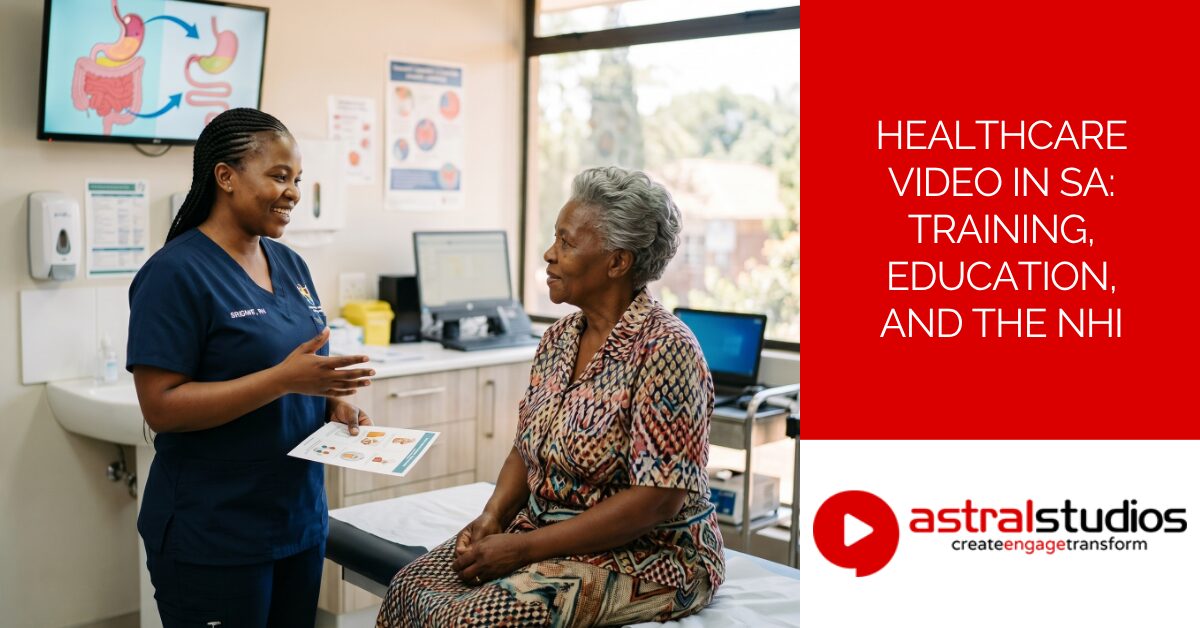
Patient education video translates complex medical information into plain, watchable content. Hospitals use it in waiting rooms. Clinics play it on wall screens. Patient portals host it online. The videos explain what a diagnosis means, what a procedure involves, and what to do after treatment.
Research backs this up. A systematic review of video-based health education across African contexts found that 86.6% of eligible studies reported positive effects on knowledge, awareness, or self-efficacy among patients and health workers. Video works particularly well where literacy levels vary. That’s a direct SA consideration.
The multilingual challenge in SA patient education
A patient education video in English doesn’t help a Zulu-speaking patient in KwaZulu-Natal. It doesn’t help a Sotho speaker in the Free State either. South Africa’s 11 official languages make healthcare video production more complex here than in almost any other country.
Producing truly accessible patient education means choosing between multiple narration tracks, subtitle options, or separate language versions. Each approach has different costs. A full additional narration track adds roughly 30 to 50% of the base narration cost per language. AI-assisted dubbing tools can help bring that cost down, but medical content needs native speaker review before it goes anywhere near a patient. Precision matters here in a way it doesn’t for a product marketing video.
Visual storytelling in patient education healthcare video
Animation is often the right tool for patient-facing content. Showing how a medication works in the body, what happens during a procedure, or how a chronic condition progresses over time – these are things animation explains better than live footage or text alone. Live action works for interpersonal content: a nurse explaining wound care, a doctor describing what to expect after surgery. The format should follow the message.
Clinical training video for South African healthcare professionals
Why video works for clinical training
A 2025 study in the Journal of Nursing Education found that video-based clinical training achieved 22% higher knowledge retention than traditional lecture formats, while cutting training time by 40%. Healthcare systems using structured video training programmes report 65% faster onboarding for new clinical staff.
For a health system under staffing pressure, those numbers matter. South Africa’s public health facilities deal with staff turnover and training backlogs continuously. Video-based clinical training scales in a way that classroom instruction simply doesn’t.
What clinical training healthcare video covers
Clinical training content typically includes new equipment and device operation, clinical procedures and technique demonstrations, protocol and guideline updates, infection prevention and control, emergency response procedures, and patient communication skills for clinical staff.
Accuracy and accountability matter more in clinical healthcare video
Clinical training videos carry unique risks. Inaccurate clinical information can lead to patient harm, regulatory penalties, and legal liability. A professional clinical training video workflow includes subject matter expert review, clinical accuracy checking, and version control. Outdated content gets updated, not left to circulate. This is different from a standard corporate training video, and any production company working in this space needs to treat it that way.
Medical animation – showing what can’t be filmed
When animation is the right choice for healthcare video
Some healthcare content can’t be filmed. The mechanism of action of a pharmaceutical drug. A surgical procedure from inside the body. How a medical device works at a cellular level. How a virus replicates in tissue. These are natural territory for 2D or 3D medical animation.
Animation also ages better than live action. A clinical procedure demonstration filmed in 2020 may show outdated technique or equipment. An animated equivalent can be updated scene by scene without a full reshoot.
2D vs 3D medical animation in healthcare video
| Animation type | Best for | Relative cost |
|---|---|---|
| 2D animation | Patient education, process flows, public health comms | Moderate |
| 3D animation | Surgical procedures, device demos, anatomical detail | Higher |
| Live action | Clinical demonstrations with real practitioners | Moderate to high |
| Blended (animation + live) | Complex training combining real and visual content | Varies |
Visual storytelling in medical animation
The best medical animation doesn’t just show the mechanism – it tells a story. A video showing how a drug targets cancer cells lands better when it follows a patient through diagnosis, treatment, and recovery than when it simply shows a molecule binding to a receptor. Visual storytelling principles apply in healthcare video just as they do in documentary or corporate production. The science is the substance. The story is what makes it stick.
Healthcare video and the NHI – South Africa’s biggest communication challenge
What the NHI means for healthcare video demand
The NHI is South Africa’s strategy to achieve universal health coverage – a centralised national insurance fund that will buy healthcare services from both public and private sector providers. Every eligible South African will need to register as a user with the NHI Fund at an accredited provider. That registration process, and the rights and services it unlocks, needs to be explained clearly to a population that spans urban professionals and rural communities with limited formal education.
That’s a healthcare video brief on a national scale. Public communication needs to cover what NHI is, how to register, what services are covered, and how to access care. It needs to do this in multiple languages, at accessible literacy levels, and in formats that reach people who may not have reliable Internet access.
NHI staff training – a production need that’s already here
Beyond public communication, the NHI creates substantial internal training demands. Healthcare workers across public and private facilities need to understand new accreditation requirements, contracting processes, referral pathways, and administrative systems. Research on Gauteng hospitals’ NHI readiness found that challenges in healthcare facilities include inadequate infrastructure, lack of personnel, and lack of equipment – all of which create training needs at scale.
Video-based training is one of the most practical ways to address these across a geographically dispersed workforce. A well-produced module on NHI accreditation requirements can reach a clinic in Limpopo and a hospital in Durban at the same time, at no additional distribution cost.
The honest picture on NHI timing
It’s worth being clear about where the NHI actually stands. The minister has indicated that full rollout may take up to 15 years. Multiple legal challenges are ongoing. The Board of Healthcare Funders, the Hospital Association of South Africa, and others have raised constitutional and financial concerns about the Act as signed. The South African Medical Journal published a critical analysis in March 2026 noting fundamental deployment challenges.
None of that changes the communication and training demand. Staff preparation, public awareness, and system readiness all require investment regardless of the legal timeline. The healthcare video production need exists independent of the constitutional questions.
Community health worker training video in South Africa
Who community health workers are and why their training matters
Community health workers are frontline health workers who are trusted members of the community. They serve as a liaison between health services and the community. South Africa’s Ward-Based Primary Healthcare Outreach Teams deploy community health workers across rural and peri-urban areas where clinic access is limited.
The National Department of Health released updated CHW training materials in 2024, including participant manuals, facilitator guides, and screening tools. The training scope covers HIV, TB, maternal health, mental health, and chronic disease – a broad curriculum that requires ongoing refreshment as guidelines change.
Training these workers at scale is a real challenge. Classroom-based training requires travel, accommodation, and dedicated facilitator time. Video-based training – particularly offline-capable content on tablets or smartphones – offers a practical alternative.
What CHW training healthcare video looks like in practice
Community health worker training content needs to be accessible at lower literacy levels, available in local languages, usable offline in areas with limited connectivity, and practically focused on real community health scenarios.
Scenario-based video works particularly well for this audience. A short video showing a CHW conducting a home visit, identifying a health risk, and making the right referral teaches in a way that a manual simply can’t. Animation and live-action drama both work. The key is authenticity – the settings, faces, and language need to reflect the communities the CHWs actually serve.
Africa CDC is scaling CHW programmes across the continent
The Africa CDC endorsed Community Health Strategic Priorities for 2023 to 2027, setting a clear roadmap for scaling up integrated community health worker programmes to achieve universal health coverage across Africa. South Africa is part of that continental push. The demand for scalable CHW training content is going to grow, not shrink.
Regulatory and ethical considerations in healthcare video production
SAHPRA and pharmaceutical marketing healthcare video
All healthcare products in South Africa must be registered with the South African Health Products Regulatory Authority (SAHPRA). Video marketing for pharmaceutical products and medical devices sits within that regulated environment. Claims made in video need to align with registered product indications – the same requirement that applies to any other marketing material. A production team working in this space needs SAHPRA familiarity, or needs to work alongside a regulatory affairs team that has it.
Patient consent and dignity on camera
Filming in clinical environments means filming near patients. Patient consent is non-negotiable. POPIA applies to any filming where identifiable individuals appear. Informed consent needs to be documented before any patient-facing filming begins. This is standard in professional healthcare video production. It should be a topic of discussion at briefing stage – not something figured out on the day.
Clinical accuracy and version control
Healthcare content dates in a way that corporate content doesn’t. Treatment protocols change. Guidelines get updated. Drug indications shift. A professional healthcare video production workflow includes planned review dates and version control – so that outdated content gets updated rather than continuing to circulate in a clinic waiting room from 2023.
Healthcare Video: Frequently Asked Questions
What types of video does the healthcare sector use?
Healthcare organisations use patient education video, clinical training video, medical animation, staff onboarding content, public health communication, pharmaceutical and device marketing, and community health worker training content. Each type serves a different audience and has different production requirements.
Can you show medical procedures on video?
Yes, with appropriate consent and clinical oversight. Live-action procedure video requires consent from anyone filmed and is typically produced with clinical staff demonstrating technique rather than actual patients undergoing treatment. For procedures that can’t be filmed – surgical views inside the body, cellular mechanisms, device operation at a microscopic level – 2D or 3D medical animation is the standard solution.
What is medical animation and when does healthcare video use it?
Medical animation uses 2D or 3D computer-generated visuals to show biological processes, anatomical structures, pharmaceutical mechanisms, or medical device operation. Healthcare video uses it when live footage can’t capture what needs to be shown – inside the body, at a microscopic scale, or where filming the actual procedure isn’t practical or appropriate.
How do you produce healthcare video in multiple South African languages?
Options include separate narration tracks over the same visuals, subtitle tracks in multiple languages, or fully localised versions for each language. Each approach has different costs. AI-assisted dubbing and translation tools can help reduce cost, but medical content needs native speaker review before distribution. Budget for roughly 30 to 50% of the base narration cost per additional language.
What does the NHI mean for healthcare video production demand?
The NHI creates two immediate demands: public communication explaining how the system works and how to register, and internal training for healthcare workers on new processes and requirements. Both need scalable video content in multiple formats and languages. Phase 2 of implementation begins in 2026, making this an active demand rather than a future one.
What compliance considerations apply to pharmaceutical marketing healthcare video in SA?
All pharmaceutical marketing claims must align with SAHPRA-registered product indications. Video is subject to the same regulatory requirements as other marketing materials. Work with a production team experienced in healthcare content, or ensure your regulatory affairs team reviews scripts before production begins.
What’s the difference between patient education and clinical training healthcare video?
Patient education video targets patients and the general public. It explains health conditions, treatments, and procedures in plain, accessible language. Clinical training video targets healthcare professionals. It teaches technique, protocol, equipment use, or clinical decision-making at a professional level. The two types have different production requirements, different accuracy standards, and different distribution channels.
Ready to produce your healthcare video?
Healthcare video production in South Africa is more specialised than standard corporate video. It involves clinical accuracy, consent management, multilingual production, regulatory awareness, and often animation capability – all in one project. A production partner with experience across these requirements makes a real difference to the outcome.
Contact us to talk through your healthcare video project.
Glossary
Healthcare video
A broad category covering all video content produced for the healthcare sector, including patient education, clinical training, medical animation, public health communication, and pharmaceutical marketing.
Patient education video
Video content designed to help patients understand their health conditions, diagnoses, treatments, and aftercare. Typically produced for hospital, clinic, and digital distribution.
Clinical training video
Video content designed to teach healthcare professionals new clinical techniques, protocols, equipment use, or decision-making skills. Subject to higher accuracy requirements than general corporate training content.
Medical animation
Computer-generated 2D or 3D visual content used to show biological processes, anatomical structures, pharmaceutical mechanisms, or medical device operation that cannot be captured with a standard camera.
NHI (National Health Insurance)
South Africa’s strategy to achieve universal health coverage through a centralised national insurance fund that purchases healthcare services from both public and private providers on behalf of all eligible residents.
SAHPRA
South African Health Products Regulatory Authority. The national regulatory body responsible for the registration and oversight of medicines, medical devices, and related health products in South Africa. All healthcare product marketing – including video – must align with SAHPRA-registered indications.
Community health worker (CHW)
A frontline health worker who is a trusted member of the community and serves as a liaison between health services and community members. South Africa’s CHW programme deploys workers through Ward-Based Primary Healthcare Outreach Teams.
POPIA
Protection of Personal Information Act. South Africa’s primary data privacy legislation. Applies to any filming where identifiable individuals – including patients – appear on camera.
SCORM
Sharable Content Object Reference Model. A technical standard that allows e-learning content, including clinical training video modules, to work inside an LMS and track learner progress.
LMS (Learning Management System)
A platform that hosts and delivers e-learning courses to learners, tracks completions, and manages training records. Widely used for clinical training and staff onboarding in large healthcare organisations.
Mechanism of action (MOA)
A term used in pharmaceutical and medical contexts to describe how a drug or medical intervention produces its effect. MOA videos are a common type of medical animation, showing how a drug interacts with cells, receptors, or biological pathways.
Ward-Based Primary Healthcare Outreach Team (WBOT)
South Africa’s national community health worker deployment model. WBOTs place community health workers in wards to provide primary healthcare outreach, health promotion, and referral services in communities with limited clinic access.


