


How Much Does Event Live Streaming Cost in South Africa?
Last Updated: 3 months ago by Astral Studios Staff
Event live streaming cost in South Africa is one of those questions that gets very different answers depending on who you ask. This article breaks down what you should actually budget in 2026, what drives prices up or down, and what to watch out for in a quote.
A marketing manager at a Johannesburg financial services company once described her experience getting three quotes for a conference live stream. One came in at R9,500, one at R27,000, and one at R68,000. All three said they did “professional live streaming.” None of them explained why their price was what it was. She picked the middle one, assumed it was a fair compromise, and spent the morning of the event watching the stream buffer every 90 seconds because the company had planned to use venue WiFi.
That story is more common than it should be. The variation in event live streaming cost is real and legitimate – but it’s only confusing if nobody explains what you’re actually buying. So let’s fix that.
What does event live streaming actually involve?
Before we get into numbers, it helps to know what goes into a live stream. Most first-time buyers assume it’s one person with a camera pressing record. In reality, there are several moving parts – and each one has a cost attached.
The core components of any live stream
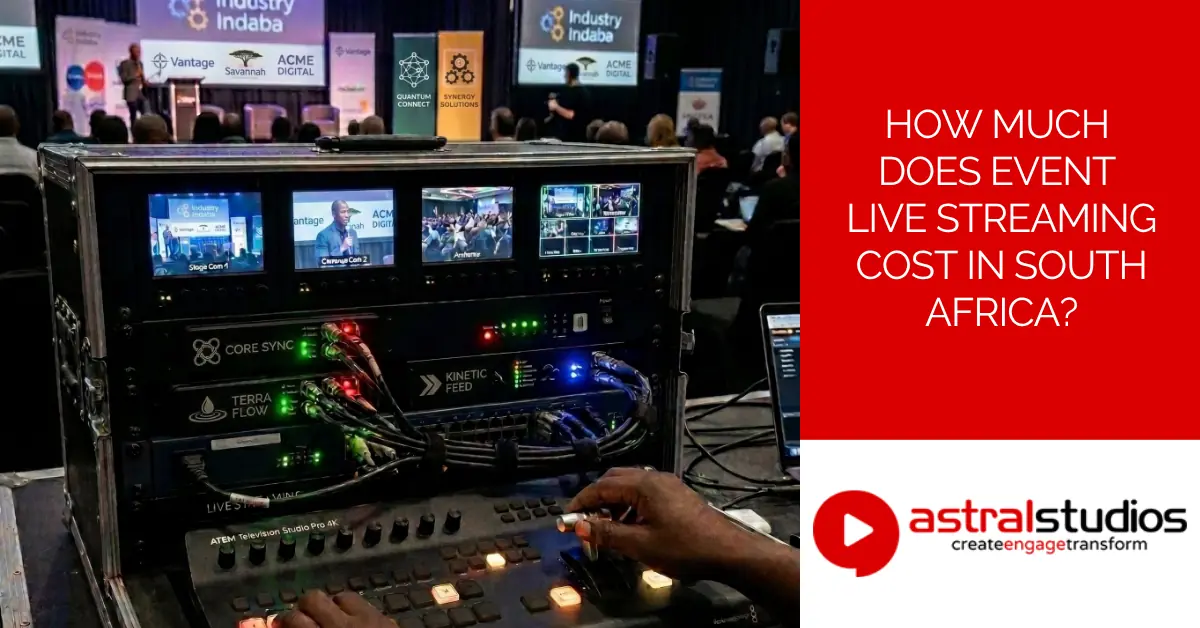
A professional live stream involves:
- Cameras capturing the event
- A vision mixer or switcher selecting between camera feeds in real time
- An encoder converting the video signal into a stream
- An Internet connection delivering that stream to a platform
- A streaming platform where your audience watches
- A crew to operate and direct all of the above
A basic setup combines several of these into one operator with one device. A full production separates them. That’s where the price range begins.
Live streaming vs recording – not the same thing
Recording captures your event for later distribution. Live streaming broadcasts it in real time. Many clients want both, but they’re separate deliverables. Not every quote includes both automatically. Always check before you sign off.
Public streams vs private streams
A public stream goes to YouTube, Facebook, or LinkedIn – free platforms your audience accesses with a link. A private stream needs a password-protected platform or a dedicated portal. AGMs, board meetings, shareholder communications, and internal town halls almost always need a private stream. Private platforms cost more. It’s worth knowing this upfront.
Event live streaming cost in South Africa – what to budget in 2026
Here’s a tier-based breakdown of what you can expect to pay. These are per-day figures for Johannesburg-based events. Multi-day conferences often attract discounted day rates, and events outside Gauteng will carry additional travel costs.
| Production level | What’s typically included | ZAR range (per day) |
|---|---|---|
| Basic single-camera stream | One camera, operator, public platform | R8,000 – R15,000 |
| Standard corporate stream | Two to three cameras, switcher, branded overlays | R15,000 – R35,000 |
| Full production stream | Multi-camera, director, graphics, dedicated Internet | R35,000 – R80,000 |
| Hybrid event production | Full stream plus two-way audience interaction | R50,000 – R150,000+ |
| Private/password-protected stream | Any tier above plus a secure platform | Add R3,000 – R10,000 |
These ranges are indicative. Your actual event live streaming cost depends on your event type, duration, location, and what the quote actually includes. Which brings us to the most misunderstood part of the whole conversation.
What pushes the cost up
A few things move a quote from the lower end to the higher end:
- Adding cameras and a live vision mixer
- Requiring dedicated Internet rather than venue WiFi
- Needing a private platform instead of YouTube
- Adding branded graphics and name straps
- Including post-event recording and file delivery
- Events outside Johannesburg or Cape Town
- Overtime or events running past the agreed hours
What keeps the cost down
On the other side, a few things keep event live streaming cost lower:
- A single camera with a single platform output
- Public YouTube or Facebook streaming
- Half-day events
- Venues with existing AV infrastructure in good condition
- Booking well in advance
This is the one that catches people out most often. It’s Internet connectivity.
Why venue WiFi doesn’t work for live streaming
Venue WiFi is shared infrastructure. Other guests, staff systems, and even the venue’s own operations compete for the same bandwidth. A professional live stream needs consistent, dedicated upload speed – typically 10 to 20 Mbps minimum for HD quality, and more for 4K output.
Shared venue WiFi can’t guarantee that. A stream that drops for 30 seconds during a keynote speech is worse than no stream at all. The story from the beginning of this article? That was a venue WiFi problem. It’s almost always a venue WiFi problem.
Bonded cellular Internet – what it is and what it costs
Most professional SA streaming companies use bonded cellular devices. These combine multiple 4G and 5G SIM cards from different networks into a single reliable connection. If one network drops, the others compensate automatically.
Bonded Internet typically adds R2,000 to R6,000 per day to a quote. It’s not a luxury – it’s what separates a reliable stream from a risky one. If a quote doesn’t mention Internet connectivity at all, ask the question directly. The answer will tell you a lot.
Dedicated fibre at the venue
Some larger venues can arrange temporary fibre connections for events. This is more reliable than bonded cellular for very high-output productions. It’s also more expensive and needs advance planning with the venue. For most corporate events, bonded cellular is the right solution. For large multi-stream productions, dedicated fibre is worth the conversation.
A note on infrastructure in 2026
South Africa’s connectivity infrastructure has improved considerably. Load shedding is far less of a daily issue than it was a few years ago, though Eskom has flagged potential risks beyond 2027 that are worth staying aware of. Most professional streaming companies carry backup power as standard. It’s still worth asking, particularly for outdoor or semi-outdoor events.
Event live streaming cost by event type
Different events have different requirements – and different price expectations.
Conference and multi-day summit streaming
Conferences typically need at least two cameras – a wide shot of the stage and a closer shot of the speaker, switched live. Branded overlays showing the speaker’s name and session are standard. Many conferences stream to multiple platforms simultaneously: YouTube for public attendees, a private portal for registered delegates.
Multi-day conferences attract better per-day rates. A three-day event quoted at R30,000 per day might come down to R25,000 per day for the full booking. Always ask about multi-day discounts.
AGMs have specific requirements. The stream almost always needs to be private and password-protected. Remote shareholder participation – questions, voting, comments – may need facilitation. Recording for post-meeting compliance is standard.
YouTube is not suitable for AGM streaming. The privacy controls are limited, and the viewing experience isn’t right for governance events. Dedicated platforms like Zoom Webinar, EventLive, or a custom portal are more appropriate. The platform cost adds to the overall event live streaming cost but is non-negotiable for this use case.
Product launches and brand events
Product launches combine public streaming to social platforms with high-quality in-room production. The visual storytelling element is more demanding – branded graphics, logo animations, and polished presentation cuts matter more here than at a standard conference. Budget at the higher end of the standard corporate tier.
Internal town halls and staff communications
Town halls are often lower-cost. The visual standard is more relaxed, and the platform is simpler – Microsoft Teams or Zoom Webinar rather than a custom portal. Single-camera setups work for most internal town halls. That said, if the executive team wants a polished look, the production requirements go up accordingly.
Awards ceremonies
Awards ceremonies are among the more demanding events to stream. Multiple camera angles, live reactions, acceptance speeches, and entertainment all need real-time switching. Branded overlays change frequently. Post-event highlight edits are often requested. Budget at the full-production tier and expect to discuss the specifics in detail.
Live streaming vs hybrid events – what’s the difference and what does each cost?
This is one of the most common points of confusion in the event live streaming cost conversation.
What a hybrid event actually means
A live stream has an audience that watches. A hybrid event has an audience that participates. Remote attendees can ask questions, vote in polls, network with other attendees, and engage with speakers in real time – alongside the in-person audience.
That distinction changes the production entirely. You’re not just broadcasting to remote viewers. You’re running two simultaneous event experiences: one for the room and one for the screen.
What hybrid adds to event live streaming cost
A genuine hybrid build typically adds 20 to 40% on top of the in-room AV budget. The additions include:
- A dedicated platform with interaction tools (Q&A, polling, networking)
- Extra crew to manage the remote audience experience
- Moderation for incoming questions and comments
- Often a separate audio mix optimised for the stream rather than the room
- Registration and access management for remote delegates
The key advice here: if hybrid is on the table, scope it from day one. Bolting it on after the rest of the production is already planned costs more and produces a worse result.
Visual storytelling in hybrid events
A hybrid event needs to serve two audiences at the same time. Camera angles that work well for a live room – wide establishing shots, audience reaction shots – often don’t translate well to a laptop screen. Speakers need to know where to direct eye contact. Graphics need to be legible on a small screen, not just a large LED wall.
A good hybrid production director briefs speakers on all of this before the event starts. It’s the kind of detail that separates professional hybrid production from an expensive streaming disappointment.
What to look for in a live streaming company in South Africa
Not all providers are the same. Here’s how to tell a good quote from a risky one.
Questions to ask before you book
- What Internet solution do you use on-site, and what’s your backup if it fails?
- How many cameras does the quote include, and what switching setup?
- Is post-event recording and file delivery included?
- What streaming platforms do you support, and can you provide a private stream?
- Do you have experience with events in our sector?
- What happens if your equipment fails mid-event?
- Is travel included for events outside Johannesburg?
Red flags in a live streaming quote
Watch out for these:
- No mention of Internet connectivity (they’re planning on venue WiFi)
- A very low price with no breakdown of what’s included
- No redundancy or backup plan mentioned anywhere
- Vague language like “one camera setup” without platform or recording details
Why sector experience matters for event live streaming
A streaming company with corporate event experience handles things differently from a wedding or funeral streaming operation. Corporate clients need lower-thirds with correct titles and spellings, branded overlays approved before the event, director communication with speakers, and professional management of unexpected moments. Ask for corporate references. Any company worth hiring will have them.
For more context on video production costs in South Africa, the full video production cost guide covers the broader picture of what professional production involves and what to budget.
Event Live Streaming Cost: Frequently Asked Questions
How much does it cost to live stream an event in South Africa?
A basic single-camera corporate live stream starts at around R8,000 to R15,000 per day. Standard multi-camera production runs R15,000 to R35,000. Full production with dedicated Internet, graphics, and a director sits between R35,000 and R80,000. Hybrid events with two-way audience participation start at R50,000 and can exceed R150,000 for large productions.
Is Internet connectivity included in a live streaming quote?
Not always. Some quotes assume venue WiFi, which is rarely adequate for professional streaming. Always ask what Internet solution your provider uses and whether it’s included. Bonded cellular Internet – the standard professional solution in South Africa – typically adds R2,000 to R6,000 per day to the quote.
Can I stream my event to YouTube for free?
YouTube Live is free as a platform. The production crew, cameras, encoder, and Internet connection are not. For public-facing events, YouTube is a reasonable platform choice. For AGMs, board meetings, or shareholder communications, YouTube is not suitable – the privacy controls are limited and the experience doesn’t meet governance requirements.
What’s the difference between live streaming and a hybrid event?
A live stream broadcasts your event to a remote audience who watches. A hybrid event lets remote attendees participate – asking questions, voting in polls, and engaging with speakers in real time. Hybrid costs more because you’re running two simultaneous event experiences. Expect to add 20 to 40% on top of your in-room production budget.
Is recording included in a live streaming quote?
Not automatically. Recording and post-event file delivery need to be explicitly confirmed in your quote. Some providers charge separately for recording, editing, or same-day turnaround. Always ask before you sign off.
How far in advance should I book a live streaming company?
Four to six weeks minimum for a standard corporate event. Larger productions, multi-day conferences, or events outside Gauteng need eight to twelve weeks lead time. September to November is the busiest conference season in South Africa – book early if your event falls in that window.
Can you live stream events outside Johannesburg?
Yes, most Johannesburg-based companies cover South Africa, but expect travel, accommodation, and transport costs for crew and equipment. Pretoria is usually covered without a travel surcharge. Events in Durban, Cape Town, or other centres will carry additional costs that should be itemised in your quote.
What happens if the Internet goes down during the stream?
A professional streaming company uses bonded cellular Internet with multiple networks as backup. If one network drops, the device switches automatically. Ask your provider what their redundancy plan is. Any company planning to rely on venue WiFi as their only connection has no satisfactory answer to this question.
Ready to talk about your event live streaming?
Choosing the right production partner makes the difference between a stream your audience actually watches and one they give up on after two minutes of buffering. A professional team brings the cameras, the connectivity, the crew, and the contingency plan – so you can focus on your event rather than your tech stack.
Contact us to discuss your event and get a clear, itemised quote.
Glossary
Bonded cellular Internet
A technology that combines multiple mobile data SIM cards from different networks into a single reliable Internet connection. Used by professional streaming companies to ensure the stream stays live even if one network drops.
Encoder
A device or software that converts a video signal into a compressed digital format suitable for streaming over the Internet. An encoder is the bridge between your cameras and your streaming platform.
Vision mixer (switcher)
A device that lets a director switch between multiple camera feeds in real time during a live production. The director selects which camera the audience sees at any given moment.
Lower thirds
Branded text overlays that appear in the lower portion of the screen, typically showing a speaker’s name and title. A standard element of professional corporate live streaming.
Hybrid event
An event that serves two simultaneous audiences – one in the room and one joining remotely via the Internet. Remote attendees can participate in Q&A, polling, and networking rather than just watching.
RTMP
Real-Time Messaging Protocol. The technical standard most streaming platforms use to receive a live video feed from an encoder. Most professional encoders and platforms support RTMP.
Bitrate
The amount of data your stream sends per second. Higher bitrate means better quality but requires more Internet bandwidth. A typical HD corporate stream runs at 5 to 10 Mbps.
Multi-camera production
A live production using two or more cameras, with a director switching between them in real time. Multi-camera production is standard for conferences, awards ceremonies, and product launches.
Outside broadcast (OB)
A fully self-contained mobile production setup, including cameras, switcher, audio equipment, encoding, and Internet connectivity. An OB van or OB kit can transform any venue into a broadcast-quality production environment.
Private stream
A live stream accessible only to viewers with a password or invitation link, rather than the general public. AGMs, board meetings, and internal events typically use private streams.
AGM (Annual General Meeting)
A legally required annual meeting of a company’s shareholders. AGM live streaming allows remote shareholders to watch and participate in proceedings. Privacy and recording requirements make AGMs a specific use case with specific platform needs.
Zoom Webinar
A platform that allows large-scale one-to-many broadcasting with controlled audience participation. Frequently used for internal corporate live streams and AGMs. Different from a standard Zoom meeting in that audience members cannot unmute or share video unless invited.


