


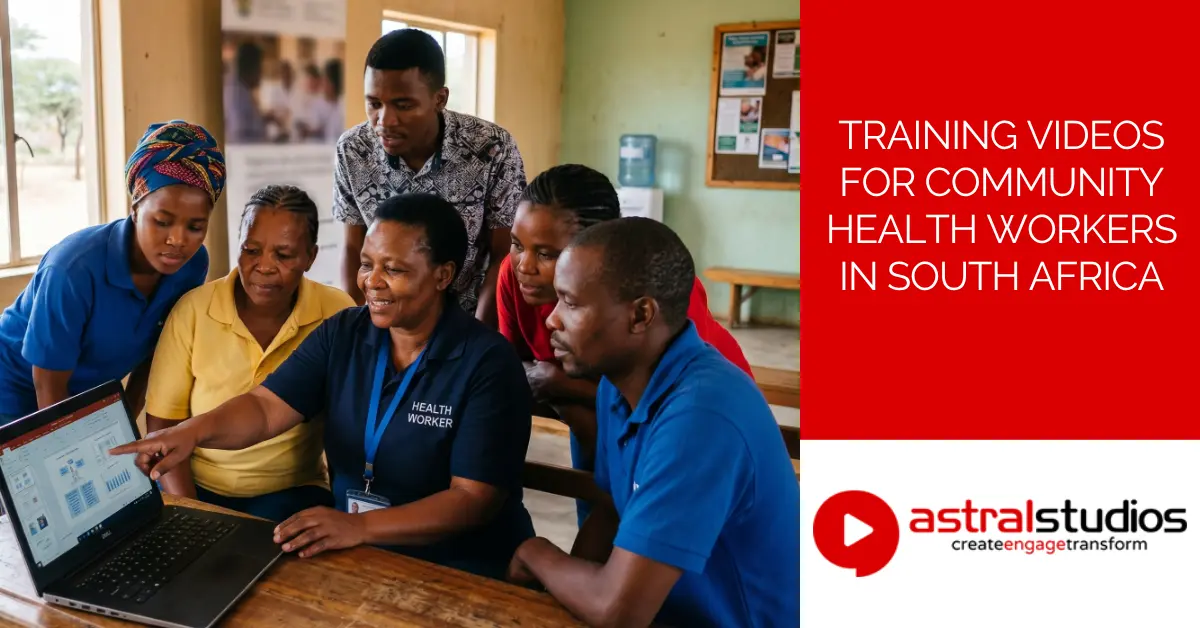
Training Videos for Community Health Workers in South Africa
Last Updated: 1 week ago by Astral Studios Staff
Most people searching for information about community health workers are dealing with the same problem: a large, dispersed workforce that’s hard to train consistently. This article is for health programme managers, NGO training coordinators, and Department of Health L&D officers who need practical guidance on using video to train community health workers at scale.
A training coordinator once described it like this: “I’ve got 200 CHWs spread across three districts. They speak four different languages. They’re out doing home visits every day. How am I supposed to get them all trained on the new TB protocol?” That question is exactly what this article is about.
Who Community Health Workers Are in South Africa
Community health workers are frontline health workers who live in the communities they serve. They’re trusted members of those communities. And they do a lot of the work that keeps the public health system functioning at ground level.
Their day-to-day tasks include door-to-door health screenings, tracing TB and HIV defaulters, educating households on disease prevention, referring patients to clinics, and collecting health data. They work in people’s homes, in taxi ranks, in community halls. Not in offices.
The WBPHCOT Model
South Africa organises CHWs into Ward-Based Primary Health Care Outreach Teams, known as WBPHCOTs. Each team has 6 to 10 CHWs led by a professional nurse. A single team serves a population of around 7,600 people. The WBPHCOT model is the main delivery mechanism for primary health care re-engineering under the National Health Insurance framework.
The Scale of the Workforce
The numbers matter here. The Department of Health’s 2025 Human Resources Plan projects a need for 60,000 additional community health workers by 2030. In March 2026, the government announced plans to permanently employ 19,000 CHWs. Private sector health schemes, including Discovery Health and Momentum Health, launched community-based care programmes in 2025 that created a third employment pathway for CHWs beyond government and NGOs.
This is a workforce that’s growing fast. Training it consistently is a genuine challenge.
Why Training Community Health Workers Is Hard
This isn’t a simple training problem. It has several overlapping difficulties that don’t apply to most other workforces.
CHWs Work in the Field, Not in Classrooms
CHWs spend their days in communities, not at desks. Pulling them off the floor for a two-day classroom session disrupts the very communities they serve. In fact, a survey of 1,950 health workers in South Africa found that only 56% had received training on key clinical protocols – despite working with those protocols daily. And that gap exists partly because in-person training is expensive and logistically difficult to scale.
The Language Problem
South Africa has 11 official languages. A CHW team in KwaZulu-Natal works in isiZulu. A team in Limpopo needs Sepedi. A team in the Western Cape may need isiXhosa or Afrikaans. English-only training materials consistently underperform in multilingual field settings. This isn’t a minor issue. It’s a significant barrier to knowledge transfer.
Protocols Change. Printed Manuals Don’t.
HIV treatment guidelines update. New non-communicable disease management approaches come in. TB screening protocols change. Printed manuals go out of date the moment you print them. And getting updated content to a dispersed field workforce costs time and money every single time something changes.
The Funding Shift
PEPFAR funded a large portion of CHW salaries, supervision, and training infrastructure across 27 high-burden health districts in South Africa. With that funding winding down in 2026, the Department of Health and NGO partners face pressure to train more people with less money. The tools that scale without scaling costs have become more relevant than they were two years ago.
Where Training Videos for Community Health Workers Fit In
Video doesn’t replace a good supervisor or a skilled nurse team leader. But it solves specific problems that in-person training can’t solve at scale.
A well-produced training video delivers the same message consistently, every time, to every CHW who watches it. A CHW in Mpumalanga sees the same content as a CHW in the Northern Cape. No trainer having an off day. No key points left out.
Research from Cape Town found that short video clips delivered via WhatsApp, alongside printed materials, produced measurable improvements in CHW knowledge and skills over six months. Recently, a study published in JMIR Medical Education confirmed that digital training approaches, including video, show positive outcomes for CHW health service delivery in low- and middle-income countries. Research from Tanzania showed that CHWs who received video-based training showed improved counselling performance and better mentorship outcomes.
Video also works on a smartphone. And most CHWs already have one.
Video Formats That Work for Community Health Worker Training
Not every video format works equally well in a CHW context. The format needs to match the training content and the conditions under which it will be watched.
| Format | Best for | Typical length | Key considerations |
|---|---|---|---|
| Scenario-based live action | Counselling skills, home visits, patient interaction | 5–12 min | Must reflect real community contexts and languages |
| Animation | Health concepts, protocols, data collection | 2–6 min | Works across literacy levels; easier to update |
| Microlearning clips | Protocol reminders, refresher content | 30 sec–3 min | Ideal for WhatsApp distribution |
| Demonstration video | Screening procedures, clinical skills | 3–8 min | Close-up detail and clear narration are critical |
| Modular e-learning video | HWSETA-aligned formal programmes | 10–20 min per module | Needs a learning management system |
Scenario-Based Video for Counselling and Communication
CHWs spend a large part of their day in conversation. Counselling a patient about HIV testing. Explaining medication adherence to a resistant family member. Discussing TB treatment with someone who’s stopped taking their pills. These are skills that are genuinely hard to teach from a manual.
Scenario-based video shows a CHW handling a real situation – including what to do when the patient pushes back or when a household is hostile. Seeing the scenario play out is more useful than reading a description of it. Research from Tanzania showed that community health workers who received video-based training in early childhood development counselling showed improved counselling performance and enhanced mentorship skills. The same principle applies to HIV and TB counselling contexts.
Animation for Health Concepts and Protocols
Animation works well when the training content is conceptual. Explaining how TB spreads through a household. Showing how a medication interacts with the body. Walking through a data collection form step by step. Animation can show things that cameras can’t, and it works across literacy levels. A well-produced animated short in isiZulu, with clear visuals and a natural voice-over, reaches a CHW who would struggle with a dense written protocol. It also reaches the community members that CHW works with, making it double-useful.
Microlearning for WhatsApp
WhatsApp is the dominant communication tool for CHW teams across South Africa. Health workers already use it to share updates, ask supervisors questions, and coordinate home visits. Short training clips of 30 seconds to 3 minutes are naturally suited to WhatsApp distribution. A supervisor can send a clip the morning before a specific community health campaign, or as a reminder before a complex home visit. A WhatsApp-based microlearning programme tested with nurses and community health workers in rural South Africa showed measurable improvements in knowledge about HIV treatment protocols.
Making Training Videos That Work in the Field
This is where production decisions matter most. A video that looks professional but misrepresents the CHW working environment won’t land. A few things to get right from the start.
Represent the Real Workforce
If your CHWs work in Soweto, the training video should look like Soweto. The people on screen should reflect the people watching. The language in the video should match the language of the team. A video filmed in a generic corporate environment with an English-only presenter can actively reduce trust and engagement among CHW audiences. This isn’t about aesthetics. It’s about whether the content transfers.
Keep It Short and Modular
CHWs don’t sit at desks watching hour-long videos. Short, focused modules of 3 to 10 minutes each get higher completion rates than long-form content. Each module should have one clear learning objective. A training programme on TB management might have five separate modules – one on screening, one on referral, one on adherence support, one on household contact tracing, and one on data recording. Each stands alone. Each can be updated independently.
Design for Mobile and Low Bandwidth
Most community health workers access content on a smartphone over mobile data. Videos need to be compressed for low-bandwidth viewing without losing clarity. A video that buffers or fails to load in a township clinic is a video that doesn’t get watched. File size is a real production decision, not an afterthought.
Pair Video With a Knowledge Check
Video alone doesn’t confirm that someone learned something. A simple follow-up assessment – even a WhatsApp poll or a short quiz – closes the loop. For HWSETA-aligned programmes, documented proof of completion and competency is a requirement, not optional.
Community Health Workers and HWSETA Alignment
CHW training in South Africa falls under the Health and Welfare SETA (HWSETA) at NQF Level 3 and Level 4. The HWSETA accredits training programmes against these qualifications.
Video can form part of an HWSETA-aligned blended learning programme. But it needs to be paired with workplace-based assessment, supervisor sign-off, and documented learning outcomes. The video is one component of a structured programme – not a standalone qualification.
The instructional design and SETA alignment need to be built into the brief from the start. A production company can produce an excellent video. But if the learning objectives haven’t been mapped to unit standards before the script is written, you’ll have a well-produced video that doesn’t qualify for anything. Get the instructional design right first.
What Training Videos for Community Health Workers Cost
Costs vary considerably depending on format, language versioning, and the number of modules. Here’s a practical guide.
A single 5 to 10 minute scenario-based training module produced in one language typically costs R40,000 to R120,000. Animation costs more to produce upfront but less to update and easier to translate. A full modular training series in two or three languages is a larger project – expect R250,000 upwards for a well-produced suite.
The per-CHW cost drops fast. A training video produced for R80,000 that reaches 5,000 community health workers via WhatsApp costs R16 per person. Compare that to the cost of a single day’s in-person training for even a fraction of that workforce.
For a full breakdown of training video costs in South Africa, see How Much Does a Training Video Cost in SA?
The National Department of Health Knowledge Hub publishes training materials and resources for CHW programme managers. It’s a useful reference when developing your training brief.
Frequently Asked Questions
What is a community health worker in South Africa?
A community health worker is a frontline health worker who lives in the community they serve. In South Africa, CHWs are organised into Ward-Based Primary Health Care Outreach Teams under the NHI framework. Their work includes door-to-door health screenings, TB and HIV defaulter tracing, community health education, patient referrals, and health data collection.
How are community health workers trained in South Africa?
CHW training falls under HWSETA accreditation at NQF Level 3 or Level 4. The National Department of Health published updated CHW Training Materials for the Foundation Phase in 2024. Training is delivered through a mix of in-person sessions, workplace-based learning, and increasingly, digital and video-based content.
Can training videos replace in-person CHW training?
No – and they shouldn’t try to. Training videos work best as part of a blended learning approach. They deliver consistent content at scale, reinforce in-person training, and are available on demand. They work alongside supervision, mentorship, and workplace-based assessment, not instead of them.
What languages should community health worker training videos be in?
This depends on where your CHWs work. isiZulu, isiXhosa, Sesotho, Sepedi, and Setswana cover the largest CHW populations by province. Producing content in English only is a common mistake that reduces both comprehension and trust. Even subtitles in a CHW’s home language improve retention considerably.
How do you distribute training videos to community health workers?
WhatsApp is the most practical distribution channel for most CHW programmes in South Africa. Short clips can be shared directly by supervisors to team groups. For formal HWSETA-aligned programmes, a learning management system with mobile access gives you better tracking and assessment capability.
How long should a CHW training video be?
Short modules of 3 to 10 minutes get the best completion rates in field settings. Microlearning clips for WhatsApp distribution should be 30 seconds to 3 minutes. Longer content should be broken into shorter modules, each with one clear learning objective.
What makes a good training video for community health workers?
The best CHW training videos reflect the real working environment of the people watching them – the right language, the right setting, realistic scenarios. They are short, modular, compressed for mobile viewing, and paired with a simple knowledge check. And they should be designed to be shared, not streamed from a centralised platform that requires reliable wifi.
How much does a community health worker training video cost in South Africa?
A single 5 to 10 minute module in one language typically costs R40,000 to R120,000. A full modular series in multiple languages starts at around R250,000. See How Much Does a Training Video Cost in SA? for a full breakdown.
Ready to Train Your CHW Team More Effectively?
If you’re managing a CHW programme and looking for a better way to deliver consistent training across languages and districts, video is worth a serious look. Come with a sense of your workforce size, the languages they work in, the topics you need to cover, and whether HWSETA alignment is a requirement. That’s enough to start a real conversation.
Contact us to discuss your community health worker training project.


