


How Much Does A Green Screen Video Cost In South Africa?
Last Updated: 2 months ago by Astral Studios Staff
Green screen video cost in South Africa can range from a few hundred rand for a DIY setup to R75,000 or more for a full corporate production, and this guide breaks down exactly where your money goes. A producer once told me about a small NGO that tried to save money by filming their annual report video against a bedsheet pinned to the office wall. The footage came back with wrinkles that looked like ripples in a pond, and shadows that made the presenter look like she was standing in a cave. They ended up paying twice, once for the failed shoot and once for the reshoot in a proper studio. That story stuck with me because it shows exactly why this question matters so much.
What Is A Green Screen Video, And Why Do Businesses Use One?
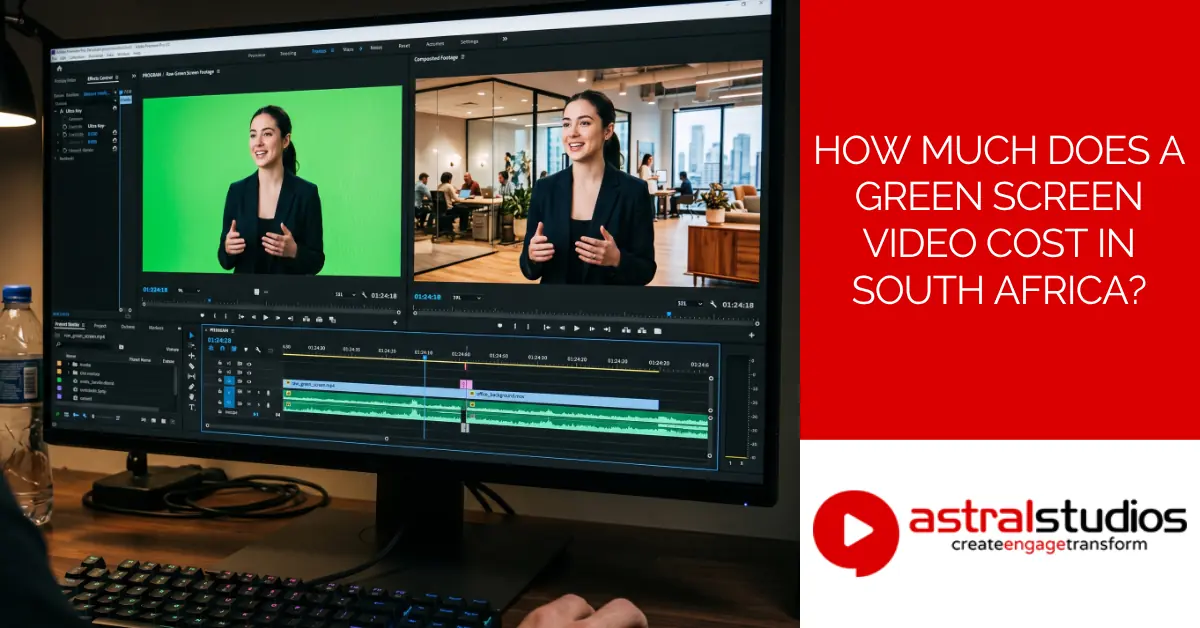
A green screen video uses a solid green backdrop that gets swapped out for a different background in editing. This process is called chroma keying. You’ve seen it on the weather report, where the presenter stands in front of a map that isn’t really there.
Businesses use this technique for a good reason. It lets you place a spokesperson anywhere, a warehouse floor, an office, even an African sunrise, without sending a crew there. For corporates, NGOs, and government departments, that saves both time and travel budget.
So, How Much Does A Green Screen Video Cost In South Africa?
Here’s the short answer. Studio hire alone can cost between R1,200 and R2,500 per day. A finished video, studio time plus crew plus editing, usually lands somewhere between R5,000 and R75,000, depending on how complex the project is.
That’s a wide range, and it should be. A one-person talking head clip for social media costs a fraction of a multi-location training series with motion graphics. The rest of this article unpacks why, so you can figure out where your project sits.
Two Routes: Hire A Studio Or Buy Your Own Screen
There are really only two paths here. You either hire a proper green screen studio with lighting and crew, or you buy a screen and film it yourself.
Both routes work. It just depends on your budget, your timeline, and how polished the final video needs to look.
| Option | Typical Cost | Best Suited For |
|---|---|---|
| Studio hire (dry, just the space) | R1,200 to R2,500 per day | Teams with their own camera gear and crew |
| Studio hire (full service, crew included) | R5,000 to R75,000+ per project | Businesses that want a finished, polished video |
| DIY screen (budget fabric or paint) | R150 to R800 once-off | Solo creators, low-stakes internal content |
| DIY screen (collapsible pro kit) | R1,500 to R6,000 once-off | Creators who film regularly |
What Pushes Green Screen Video Cost Up Or Down?
A few factors decide where your project lands on that price scale. Knowing them upfront helps you budget properly instead of guessing.
Studio Size And Location
Johannesburg has the biggest concentration of studios, and pricing there is a fair benchmark for the rest of the country. Cape Town and Durban studios can charge slightly differently, so it pays to get more than one quote if location matters to you.
Crew On The Day
A camera operator, sound operator, and autocue operator all add to the day rate. Some studios bundle crew into the hire fee. Others charge separately, so always ask what’s included before you book.
How Long You Need The Studio
Hourly rates suit quick shoots. Day rates work out cheaper if you’re filming for more than three or four hours, since most studios build in a discount once you cross that threshold.
Number Of Backgrounds Or Locations
Each new virtual background usually means extra time spent lining up footage and testing the keying. If your video needs five different virtual settings, expect the cost to climb accordingly.
How Complex The Editing Is
Basic keying is quick. Motion graphics, 3D compositing, or blending live footage with animation takes longer and costs more. We’ll cover this properly in a moment.
Green Screen Studio Hire Rates In South Africa
Published studio rates aren’t always easy to find, since many studios prefer to quote per project. Where rates are public, they tend to follow a pattern. One Johannesburg studio lists green screen backdrop hire at <cite index=”3-1″>R250 per hour or R1,200 per day for a basic setup, rising to R450 per hour or R2,500 per day for a larger studio with a 12 by 6 metre backdrop</cite>.
That’s dry hire, meaning just the space and the screen. Add a camera operator, lighting crew, and editing, and a full-service booking climbs into the thousands rather than hundreds. For a simple corporate video under five minutes, budget somewhere around R5,000 to R25,000 all in. Mid-range productions, corporate promos or short explainer videos, typically run from R25,000 to R75,000.
What It Costs To Buy Your Own Green Screen
If you’re filming regularly, owning a screen might make more financial sense than hiring one every time. Here’s roughly what each tier costs.
Budget DIY Options
Green fabric or matte paint from a hardware store can cost as little as R150 to R400. It works, but you’ll need careful lighting to avoid shadows and wrinkles ruining the shot.
Pop-Up And Collapsible Kits
A proper collapsible screen with a stand runs from about R800 to R3,000. These are the sweet spot for content creators who need something portable but reliable.
Professional-Grade Screens
If you want a screen that stretches wrinkle-free every time and holds up outside a studio, expect to pay R3,000 to R6,000 or more. This is the tier serious creators and small production teams tend to land on.
The catch with DIY is that the screen is only one part of the puzzle. Lighting, space, and a subject who isn’t wearing anything green all matter just as much.
Don’t Forget The Editing Cost
A lot of people budget for the shoot and forget the edit. Someone still has to key out the green and drop in the new background, and that takes skill.
DIY editing software can do this for free or cheap, though the learning curve is real. Professional editing and compositing, especially if it involves motion graphics or 3D elements, is usually charged per day or per hour, and can add several thousand rand to the total project cost.
Green Screen Video Cost By Use Case
Not every green screen video needs the same budget. Here’s roughly how cost tends to break down by what the video is actually for.
Corporate Messages And Leadership Videos
These are often a single presenter, one background, and minimal editing. They usually sit at the lower end of the pricing scale.
Training And Induction Videos
These take longer to plan and often need multiple takes, scripts, and sometimes several backgrounds. Costs climb with the number of modules involved.
Testimonials And Case Studies
Simple setup, but scheduling multiple interviewees across different days can add to the studio hire time.
Product Explainers With Virtual Backgrounds
These often need custom-designed backgrounds rather than stock footage, which adds a design cost on top of filming.
E-Learning Content
Similar to training videos, but often filmed in batches to cover a full course. Batching multiple lessons into one studio day is one of the best ways to bring the average cost per video down.
Green Screen vs Filming On Location: Which Is More Cost-Effective?
This depends entirely on what you need. Location filming gives you real texture and authenticity, but travel, permits, and weather all add cost and risk.
Green screen filming trades some of that authenticity for control and predictability. You can also lean on stock footage for background elements instead of sending a crew somewhere expensive. Want a shot of Table Mountain at sunrise behind your spokesperson? Stock footage gets you there without an early morning flight.
What’s Usually Included In A Studio Booking (And What Costs Extra)
Most bookings include the screen, basic lighting, and a bare-bones crew. Here’s what tends to cost extra.
Autocue or teleprompter hire is often a separate line item. So is additional crew beyond the standard camera and sound operator. Wardrobe styling advice, overtime beyond your booked hours, and rush editing turnaround are also common add-ons. Always ask for a full breakdown before you sign off on a quote, so there are no surprises on the invoice.
A Quick Note On Load Shedding
Load shedding isn’t the daily headache it was a couple of years ago, and most studios now run smoothly without interruption. Worth mentioning though, Eskom’s own outlook for 2026 to 2030 flags a real risk of it returning, as <cite index=”30-1″>a large chunk of coal capacity is due to retire around 2029 just as an existing electricity import agreement with Mozambique ends</cite>. It’s a good idea to check that your chosen studio has backup power and a stable Internet connection, just in case things shift again before the decade is out. You can read more about the outlook on News24.
Tips To Get The Best Value From Your Shoot
A few small choices can make a real difference to your final bill. Batch multiple videos into one studio booking rather than spreading them across separate days. Prepare your script and wardrobe before you arrive, since indecision on the day eats into paid studio hours. Decide on your backgrounds in advance too, so the editing team isn’t waiting on approvals after the shoot.
Why Work With A Professional Studio Instead Of DIY
DIY has its place, especially for quick social content where a bit of imperfection doesn’t matter. For business-facing video though, a wrinkled screen or a shadow across someone’s face undermines the message before a single word is spoken.
A professional studio brings even lighting, a properly tensioned screen, and an editor who knows how to key footage cleanly without leaving a green fringe around your presenter’s hair. For anything representing your organisation to clients, funders, or the public, that difference in polish is usually worth the spend. That’s my honest opinion after seeing both sides of this process play out.
If you want a broader look at video pricing beyond green screen work specifically, our video production cost guide covers the full range of project types and budgets.
Frequently Asked Questions
What Affects Green Screen Video Cost The Most?
Crew size, shoot length, and how complex the editing is are the three biggest factors. A simple one-person video with basic keying sits at the low end, while multi-location shoots with motion graphics push costs up fast.
What’s The Difference Between Dry Hire And Wet Hire?
Dry hire means you’re only paying for the studio space and screen. Wet hire includes crew and equipment, camera operator, lighting, and sometimes sound, bundled into the price.
Does The Price Include Editing And Keying?
Not always. Some studios bundle basic editing into the day rate, others charge it separately. Always confirm this before booking so it doesn’t catch you out later.
Can I Bring My Own Crew To A Hired Studio?
This varies by studio. Some allow outside crew for dry hire bookings, while others require you to use their in-house team. Worth asking upfront.
Is A DIY Green Screen Good Enough For A Business Video?
For low-stakes internal content, often yes. For anything client-facing or public, the risk of wrinkles, shadows, and poor keying usually outweighs the savings.
How Far In Advance Should I Book A Green Screen Studio?
Two to three weeks is a safe buffer for most projects, though busy studios can book out further ahead during peak corporate seasons like year-end reporting.
Can Green Screen Footage Be Combined With Animation Or 3D Elements?
Yes, and this is common for explainer videos and product demos. It does add to the post-production time and cost, so budget for it upfront rather than as an afterthought.
Ready To Plan Your Green Screen Video?
Whether you need a single corporate message or a full training series, getting the budget right from the start makes the whole process smoother. Contact us to get a proper quote based on what your organisation actually needs.
Glossary
Chroma key: The editing technique that removes a solid colour, usually green, and replaces it with a different background.
Compositing: Combining two or more pieces of footage or images into a single final shot.
Cyclorama: A curved, seamless studio backdrop, often used for green screen or white background filming, that removes visible corners or edges.
Dry hire: Renting a studio space and equipment without any crew included.
Wet hire: Renting a studio space along with crew, such as a camera operator and sound operator.
Keying: The process of digitally removing the green background from footage during editing.
Autocue: A screen-based prompting device, also called a teleprompter, that displays a script for a presenter to read while looking at the camera.
Colour spill: Unwanted green light reflecting onto a subject’s skin, hair, or clothing from the screen, which can make keying difficult.


