


How Much Does A Safety Induction Video Cost In South Africa?
Last Updated: 2 months ago by Astral Studios Staff
Safety induction video cost in South Africa varies a lot. Prices range from R15,000 for a short video to R500,000 or more for a full induction programme. This guide breaks down exactly where your project sits on that scale, and why.
I’ve sat in on more than one production briefing where a site manager pulls out their phone. They show a training video from three companies ago. It’s shaky, and the audio cuts out halfway through. Someone’s PPE is the wrong colour for their department. Everyone laughs, then someone says “and we’re still using that thing.” That’s usually the moment a business decides to budget properly. It’s time for something better.
What Is A Safety Induction Video?
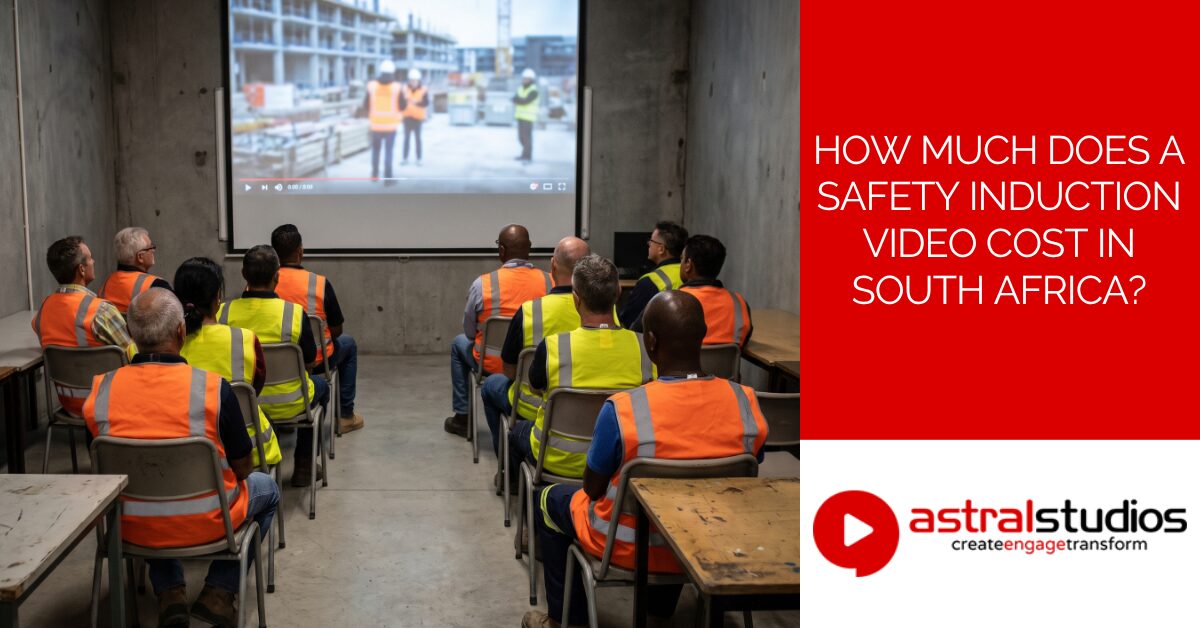
A safety induction video teaches new employees, contractors and visitors. It shows them how to stay safe on site. It’s different from a general onboarding video. That kind covers company culture, leave policy and where the bathrooms are. A safety induction video focuses on hazards, PPE, emergency procedures and incident reporting. Some businesses combine both into one longer production. Others keep them separate, especially in high-risk industries. Safety content there often needs updating more than HR content.
What Affects The Cost
Video Length And Number Of Modules
Most general inductions run 8 to 20 minutes. Safety content can run longer, since regulatory detail takes time to explain properly. A single-topic video, say working at heights, costs less. A full induction covering ten hazards across a large site costs more. Longer productions usually get broken into modules rather than one long video. This also makes future updates easier.
Number Of Site-Specific Risks
This is the biggest cost driver on most quotes. A small office with two or three basic risks costs far less to film and script. Compare that to a mine site with confined spaces, moving machinery and chemical storage. All of that, plus working at heights, in one induction adds up fast. Every extra risk means extra filming time, extra scripting, and often extra locations.
Live Action, Animation, Or A Mix
Live action feels real and site-specific. New employees recognise their actual workplace on screen. That builds trust faster than generic stock footage ever could. Animation earns its place when a hazard is too dangerous to film. Think a confined space collapse or an electrical arc flash. Many productions in South Africa use a mix. Live footage covers orientation and PPE. Animation handles the scenarios nobody wants to recreate in real life.
Drone Footage
Aerial footage gives new employees a proper sense of a large site, evacuation routes included. It’s genuinely useful for mines, big industrial plants, and multi-building campuses. For a small office induction, it’s an unnecessary cost. Ask your production company whether drone footage adds real understanding. Or whether it’s just visual polish for your specific site.
Languages And Subtitles
South Africa has 11 official languages. Most workplaces employ people across several of them. Subtitling in an extra language costs less than full re-narration. Re-narration means a new voice track and often a new edit pass. If your workforce is genuinely multilingual, budget for two or three language versions. Do this from the start rather than adding them later.
LMS And SCORM Packaging
Do you need to track who watched the video, and when? Maybe you need a comprehension check too. If so, you’ll need SCORM packaging for your learning management system. This adds cost on top of the base production. It also gives you auditable proof of compliance. That matters if an inspector ever asks.
Typical Costs In South Africa
Every project is different, and the ranges below are estimates only. They’re a starting point for budgeting conversations, not a quote. Confirm actual pricing with a production company. They’ll need to understand your specific site and risks first.
| Production Type | Typical Range (Excl VAT) |
|---|---|
| Single-topic safety video (1-5 risks) | R15,000 – R55,000 |
| Multi-risk safety video (6-10 risks) | R50,000 – R120,000 |
| High-risk site, drone footage, 4K (10-15+ risks) | R100,000 – R250,000 |
| Full multi-module induction programme (6-10 modules) | R150,000 – R500,000+ |
| SCORM/LMS packaging add-on | R15,000 – R60,000 |
| Additional language (subtitles) | Ask for a quote per language |
| Additional language (full re-narration) | Ask for a quote per language |
A Single Safety Video vs A Full Induction Programme
Here’s where a lot of the published guides get confusing. Most cost breakdowns online quote a full induction programme. That’s six to ten modules covering history, HR policy, benefits and safety together. That’s a different product from a standalone safety induction video. It also costs a lot more. If you only need the safety component, expect a smaller budget. The big headline figures cover far more than that. If you’re building a full onboarding suite, safety is one part of it. It usually sits as just one module within that larger scope.
Bespoke Production vs Off-The-Shelf Packages
Some suppliers sell tiered, templated induction video packages. These are priced by how many site risks you need covered. They’re faster and cheaper than a fully bespoke production. The trade-off is specificity. A templated package might not capture your exact site layout. It may miss your exact equipment or emergency assembly points too. For low-risk environments, that’s often fine. For a mine or construction site, that’s a different story. Generic content usually doesn’t hold up under scrutiny.
Mining And High-Risk Industries
Why MHSA Compliance Pushes Costs Up
If you run a mine, your induction video isn’t optional. It’s a legal requirement under the Mine Health and Safety Act. A generic safety video won’t satisfy an inspector. The content has to reflect actual conditions on your specific site. That means your hazards, emergency routes and PPE requirements. That specificity is why mining inductions cost more. A generic corporate safety video costs less, but covers less.
What’s Changing In 2026
The Mine Health and Safety Amendment Bill is currently before Parliament. It sits with the Portfolio Committee on Mineral and Petroleum Resources. Public comments close on 22 August 2026. The Bill aims to strengthen employer accountability and increase penalties for non-compliance. It hasn’t passed into law yet, so nothing here is final. But it’s worth knowing this is happening. You may be budgeting for mining safety content this year. Staying flexible with modular video content makes updates easier if requirements shift. You can read more on the Tabacks legal update.
General Workplaces And The OHS Act
Mining isn’t the only sector with moving regulatory goalposts. The Department of Employment and Labour has new Physical Agents Regulations. These cover noise, heat, cold stress, vibration and radiation. A compliance deadline is approaching in September 2026. If your induction touches any of these hazards, take note. This is a good year to check your content is current. More detail is available via this Lexology summary of the regulations.
Why Video Beats A Manual Or A Verbal Talk
Think about the last time someone read you a policy document out loud. Did you remember any of it three days later? Probably not much. Visual information sticks far better than written text over the same period. That’s not a marketing line, it’s how human memory actually works.
Video also solves the consistency problem. A verbal induction depends entirely on who’s giving it that day. It also depends on how tired they are. And whether they skip the boring bits. A video says the same thing, the same way, every single time. An auditor might ask: can you prove every employee got the same safety information? A completed video log answers that far better than “our supervisor usually covers it.”
Good safety storytelling isn’t about drama for its own sake. It’s about sequence. Show the hazard clearly, show the correct behaviour. Then show what happens if that behaviour isn’t followed. A short re-enacted near-miss, filmed on your actual site, teaches fast. It beats a bullet-point list every time. One HR manager I spoke to had a good line for it. She called her old paper-based induction “death by highlighter.” Her new video cut completion time in half. More importantly, people actually remembered the fire assembly point.
What A Good Safety Induction Video Should Cover
- Site orientation, including fire assembly points, first aid stations and restricted areas
- Site-specific hazards relevant to the actual work being done
- Required PPE, and how to check it’s fitted correctly
- Emergency procedures and evacuation routes
- Incident and near-miss reporting steps
- Contractor-specific rules, where relevant
Working Out Cost Per Learner
A R120,000 video watched by 300 employees works out to R400 per person. That’s the cost over its full lifespan. Compare that to repeated in-person sessions instead. Factor in a trainer’s time and travel costs. Add the productivity lost while a team sits in a briefing room instead of working. Over a year or two, the video usually wins on cost. It wins by a wider margin as your workforce grows. These figures are illustrative only. Your actual cost per learner depends on your headcount and turnover rate. It also depends on how long the video stays relevant before an update.
How Long Does Production Take?
A single-topic safety video typically takes four to eight weeks. That’s from brief to final delivery. Animation takes longer than live action. A full multi-module induction programme needs three to six months. That’s especially true if it needs site visits and multiple language versions. Sign-off from several departments also adds time.
What To Prepare Before You Request A Quote
- Existing risk assessments or OHS documentation for your site
- A clear list of the hazards you need covered
- Your workforce’s language profile
- Whether you need LMS tracking and assessments
- Site access arrangements for filming
- Any branding guidelines the video needs to follow
A tighter brief means a tighter quote. Vague briefs tend to come back with wide price ranges. The production company ends up quoting for uncertainty, not just the work.
Keeping Your Video Current
Procedures change, equipment gets replaced, and regulations get amended. You just read about two examples above, in mining and general OHS updates. A well-structured modular video lets you update one section. Say the PPE requirements change, you won’t need to reshoot everything. That’s a meaningful saving over the life of the video. Ask your production company about this upfront, not later. On the practical side, filming schedules have gotten easier lately. Load shedding has largely settled down over the past couple of years. Worth flagging though: Eskom’s own outlook points to renewed risk from 2029. Older coal capacity is set to retire around then. It’s not something to panic about for a shoot booked this year. But it’s worth watching if you’re planning a long-term content strategy.
Frequently Asked Questions
Does a safety induction video alone satisfy OHS Act or MHSA requirements?
Usually not on its own. A video is strong supporting evidence of consistent training. Most businesses still need signed acknowledgement and risk assessments too. Where relevant, add a completed assessment showing the employee understood.
How much does adding extra languages cost?
Subtitling is the cheaper option, since it doesn’t require a new voice recording. Full re-narration in another language costs more. It usually means a separate audio track and extra edit time. Get a quote per language rather than assuming a flat add-on fee.
What’s the difference between tiered induction video packages?
Tiered packages are usually priced by how many site risks they cover. For example, one to five risks versus six to ten. Higher tiers typically include extras like drone footage or 4K filming. Check exactly what’s included before comparing prices between suppliers.
Can I update my safety induction video without reshooting the whole thing?
Yes, if it was built with modular sections from the start. This is worth confirming with your production company before filming begins. Not every production allows partial updates later.
Do I need drone footage for a safety induction video?
Only if your site is large enough for aerial context to help. It should help new employees understand layout and evacuation routes. For a single-floor office, it’s not worth the extra cost.
How does cost differ between a single site and multiple branches?
One video filmed at your primary site can often be reused. Minor customisation makes it work across branches. That’s far cheaper than filming a separate video at each location. Site-specific hazards unique to a particular branch may still need extra filming.
Every safety induction video quote comes down to a few variables. How many risks, how many languages, how much filming, and how it gets tracked. None of the numbers in this piece are locked in stone. The real answer to “how much” only shows up once a production company gets involved. They’ll need to understand your site, workforce and actual risks first.
Ready to talk numbers for your site?
Contact us for a scoped quote based on your actual site, workforce and safety requirements.


