


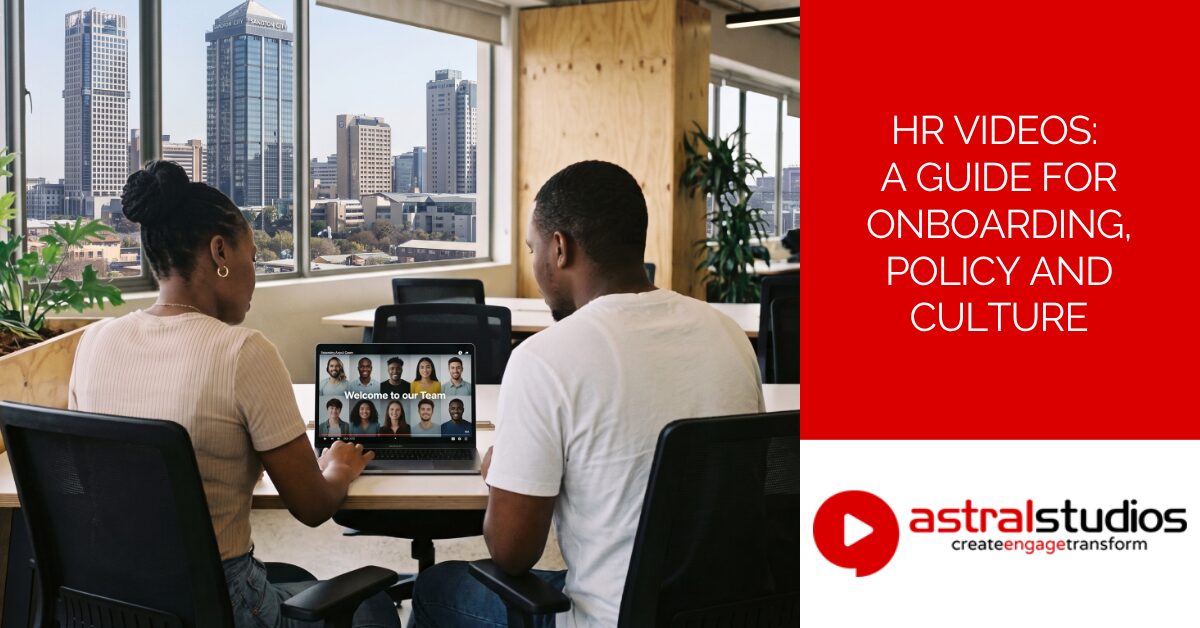
HR Videos: A Guide for Onboarding, Policy and Culture
Last Updated: 1 week ago by Astral Studios Staff
HR videos cover three very different jobs: onboarding, policy communication and culture. I once spoke to an HR manager drowning in policy PDFs. Nobody read them. Nobody remembered them either. She wasn’t the only one facing that problem.
This article covers all three uses of video for HR. You’ll find practical advice for each one.
Quick Answer: What Does “HR Videos” Actually Cover?
Video for HR isn’t one thing. It’s three separate jobs: welcoming new hires, communicating policy, and showing real culture. Each needs a different approach. This guide walks through all three.
Why HR Teams in South Africa Are Turning to Video
Text-heavy HR communication has a real problem. People skim it, or skip it altogether. Video solves that, mostly by being harder to ignore.
Text and printed manuals don’t hold attention
A 40-page handbook rarely gets read cover to cover. New hires skim the first few pages, then stop. A short video holds attention far better than dense text.
Remote and hybrid teams need consistent messaging
A remote hire in Durban should hear the same welcome as someone in Joburg. Video makes that consistent, without flying anyone anywhere.
Multi-site and multi-branch consistency
A retail chain with fifteen branches faces the same challenge. One video, watched everywhere, beats fifteen slightly different briefings.
Video works for a multilingual, multicultural workforce
South African workplaces speak many languages, sometimes on the same floor. Subtitled video reaches everyone without translating a stack of documents.
Onboarding Video: The First Thing New Hires See
What a good onboarding video actually covers
A solid onboarding video welcomes people, then orients them. Company values, a few key policies, and practical day-one details. Keep it focused, not exhaustive.
How long should an onboarding video be
Shorter is usually better here, five to ten minutes at most. Split longer content into a short series instead of one long slog.
Onboarding video vs a printed handbook
This exact question deserves its own detailed answer elsewhere. Short version: video engages people better. A written handbook still matters, for reference and compliance.
Onboarding for remote and hybrid hires
Remote hires miss the hallway conversations and casual introductions. A video can’t replace that fully, but it closes some of the gap.
Onboarding across multiple branches or sites
Filming once and distributing everywhere saves real money. It also keeps the message identical, branch to branch.
Policy Communication Video: The Most Overlooked Use Case
Nobody gets excited about a leave policy. But nobody ignores a well-made two-minute video either.
Why policy communication usually fails as a PDF or email
Policies get emailed, filed, and never opened again. It’s not that employees don’t care. It’s that a wall of text asks too much of anyone.
Which policies actually work well on video
Leave policy, code of conduct, anti-harassment, disciplinary process, health and safety. Anything with steps, consequences, or a “what if” scenario works particularly well.
Does a policy video count as proof of communication?
Pair it with a short quiz or an LMS record of completion. That combination holds up far better than a signature nobody remembers giving.
Updating a policy video when the policy changes
This is the honest downside. A video needs a proper reshoot or re-edit, not a quick text fix. Plan for that cost before you commit.
Presenter-led, animated, or text-and-voiceover, which fits which policy
A presenter builds trust for sensitive topics like harassment or discipline. Animation suits abstract or technical policies. Text-and-voiceover works well for a quick update.
Culture Video: Showing, Not Telling
The difference between a culture video and a recruitment ad
A recruitment ad sells the workplace to outsiders. A culture video speaks to people already there. Keep that audience distinction in mind.
Executive and leadership messaging on video
A CEO on camera lands differently than a company-wide email. It feels direct, and a little more human.
Employee-generated content vs professionally produced culture video
Informal phone-shot clips feel authentic, and cost almost nothing. Polished video feels intentional, but takes longer and costs more. Many businesses use both.
Representing your actual workforce authentically
A culture video should look like your actual team, not a stock photo. In my opinion, this is where a lot of culture videos fall flat.
Video for recognition and internal milestones
Long-service awards, team wins, and small daily moments all work on video. These clips age well, and get rewatched more than you’d expect.
Why Visual Storytelling Matters for HR Video Specifically
Good HR video isn’t just information with a camera pointed at it. It’s a story, even a short one.
Real workplace b-roll over stock footage
Stock footage of generic offices feels hollow fast. Real desks, real faces, and real spaces build instant trust.
Interviews and testimonials from real employees
A genuine, slightly awkward answer beats a scripted one every time. Employees trust their colleagues more than they trust HR memos.
Motion graphics for policy and compliance content
Steps, timelines, and processes often work better animated than filmed. Motion graphics simplify a complicated procedure into something watchable.
Sound, music and tone: why a policy video shouldn’t sound like a safety warning
The tone of a disciplinary policy video matters more than you’d think. Sound too stern, and people switch off immediately. Aim for calm and clear, not alarming.
Captions and subtitles for accessibility and multilingual reach
Captions help everyone, not just employees watching without sound. In South Africa, subtitles in isiZulu, Sesotho or Afrikaans widen reach further.
A South African Legal Consideration Nobody Talks About: POPIA and Consent
Here’s something most HR teams don’t think about until it’s too late. Filming an employee counts as processing personal information. That’s covered under POPIA, South Africa’s data protection law.
The Information Regulator expects informed, specific consent. Not a line buried in a stack of onboarding paperwork. Get a signed release before anyone appears on camera. It’s a small step that avoids a real headache later.
One quick scheduling note, unrelated to consent. Load shedding barely disrupts shoots in 2026. Eskom’s own outlook flags a possible return around 2029, worth a passing thought for long-term filming plans.
Should One Video Cover Onboarding, Policy and Culture All at Once?
Short answer: usually not. Each has a different tone and a different job to do.
When combining them makes sense
A small business with one video budget might combine welcome and culture. Keep policy separate even then, it ages differently.
When they need to stay separate
Larger organisations usually benefit from separating all three. Different owners, different update schedules, different audiences.
Who Owns the Budget: HR, Internal Comms, or Marketing?
This varies a lot, business to business. HR usually owns onboarding and policy. Marketing or internal comms often owns culture content. Talk to each other before briefing a producer separately.
Measuring Success Beyond View Counts
Completion rates and quiz scores
A view count tells you almost nothing useful. A completion rate, paired with a short quiz, tells you if the message landed.
Manager and new-hire feedback
Ask new hires directly what confused them. That feedback shapes the next version far better than guesswork.
Is AI Changing HR Video Production in South Africa?
A little, mostly on the policy side. AI-generated presenters can read a script and deliver a quick, low-cost update. They’re useful for minor policy changes. In my opinion, they still feel a bit stiff. That stiffness shows most in emotional content, like culture videos.
What HR Video Costs and How Long It Takes
Both questions deserve their own detailed answer, not a rushed paragraph here. A short onboarding or policy video usually takes three to six weeks. For actual figures, the cost guide and timeline guide cover this properly.
Need a Video Plan Across Your Whole HR Remit?
Every HR team juggles onboarding, policy and culture differently. Contact us for a video plan built around your priorities, from Astral Studios.
Glossary of Terms
- Onboarding video: A video welcoming and orienting new employees.
- Policy communication video: A video explaining a workplace policy or procedure.
- Culture video: A video showing what it’s actually like to work somewhere.
- LMS: Learning Management System, software that tracks who has watched or completed training.
- B-roll: Supporting footage used alongside interviews or main shots.
- Motion graphics: Animated text, icons and on-screen design elements.
- POPIA: The Protection of Personal Information Act, South Africa’s data protection law.
- Release form: A signed document giving consent to be filmed and used in video.
- Completion rate: The percentage of people who watch a video all the way through.
Frequently Asked Questions
Does a policy video replace the written policy document?
No. A video explains a policy well. A written version still matters, for legal reference.
How long should an HR video be?
Five to ten minutes for onboarding or culture. Policy videos work best even shorter, often two to three minutes.
Can one video cover onboarding, policy and culture together?
It can, for a small business on a tight budget. Larger organisations usually get better results keeping them separate.
Do employees need to sign a release form before appearing in a culture video?
Yes. POPIA treats filming someone as processing their personal information. A signed release protects both the employee and the business.
Is video onboarding suitable for remote and hybrid teams?
Yes, and it’s arguably more useful there. Remote hires miss the informal introductions everyone else gets.
How often should a policy video be updated?
Whenever the underlying policy changes, not on a fixed schedule. Outdated policy content creates more risk than no video at all.


