


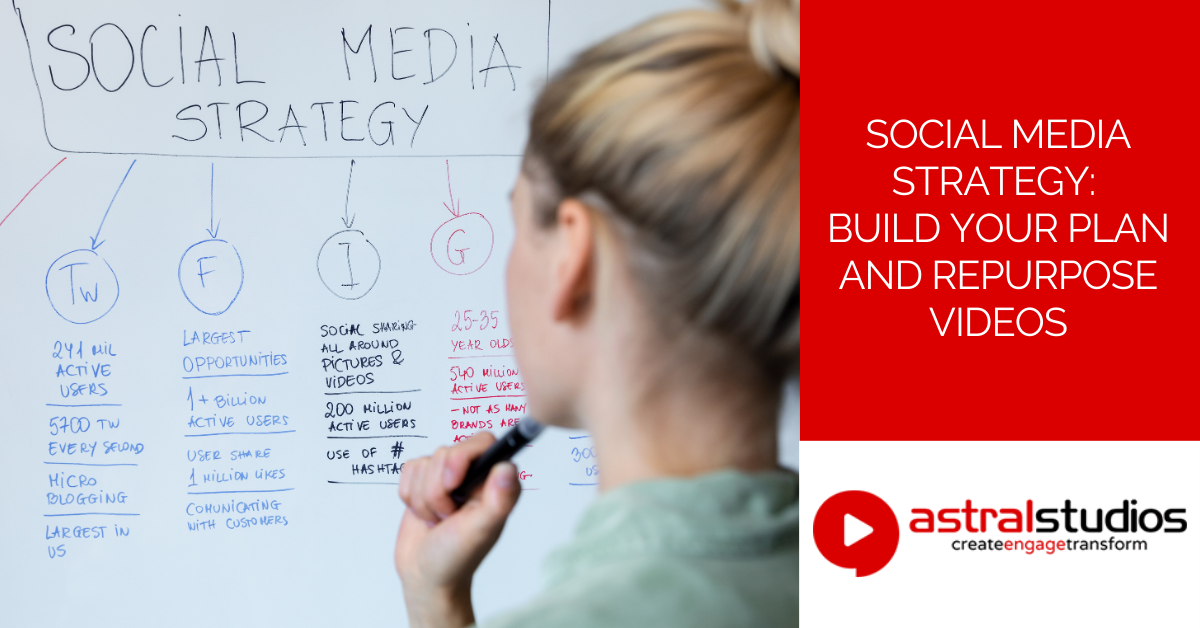
Social Media Strategy: Build Your Plan and Repurpose Videos
Last Updated: 6 months ago by Astral Studios Staff
A strong social media strategy starts with a solid plan and the smart use of video repurposing to maximize your reach and engagement.
What Is a Social Media Strategy and How Do You Build One That Works?
If you’re trying to figure out where to start with your brand’s online presence, I get it — social media can feel overwhelming. But here’s the thing: without a clear plan, you’re basically flying blind.
A social media strategy isn’t just about posting randomly and hoping something sticks. It’s your roadmap for using platforms like Instagram, LinkedIn, or TikTok in a way that actually helps grow your business — whether that means more awareness, better engagement, or real results like leads and sales.
In this guide, I break down what a social media strategy really means and walk you through the exact steps I use to build one from scratch:
- How to set SMART goals that matter
- How to understand your audience (and why it’s non-negotiable)
- Which platforms are worth your time
- How to plan content that connects
- And yes — how to make your video content work harder for you through smart repurposing
This isn’t fluff — it’s a step-by-step approach I’ve used to help brands create focused, results-driven strategies.
Ready to stop guessing and start planning with purpose? Read on — the full guide has everything you need to build a strategy that actually works.
Why a Social Media Strategy Is Your Recipe for Success
Trying to navigate social media without a clear plan can feel a lot like trying to cook a gourmet meal without a recipe – you might get lucky, but it’s probably going to be a bit of a mess. Social media marketing is far more than just posting content and hoping for the best; it’s a dynamic blend of messaging, timing, creativity, and analytics. To truly make it work, you need a clear, purposeful social media strategy.
A social media strategy is essentially your blueprint for turning online activity into real business impact. It’s an intentional plan connecting your brand with the right people, on the right platforms, at the right time. Having a strategy helps align your efforts, amplifies your brand visibility, increases your audience reach, and ultimately drives measurable results.
This is where video content repurposing comes into the picture. Videos are powerful tools for storytelling and engagement. But their potential doesn’t stop after one use. Repurposing video content means transforming existing videos into new, diverse formats. It’s a fantastic way to derive additional value from your original videos without creating entirely new content from scratch. This practice has become incredibly popular in modern digital marketing because it’s a cost-effective and efficient method to maximise variety, accessibility, audience engagement, and extend your content’s lifespan.
In this article, we’ll walk through the foundational steps of building a robust social media strategy and then explore how leveraging video content repurposing can become a core, game-changing tactic for your brand.
Section 1: Building Your Core Social Media Strategy (The Foundational Steps)
Building a strong online presence starts with laying a solid foundation. Let’s break down the essential steps to get your social media strategy off the ground:
Step 1: Define Your Goals – Make Them SMART
Every successful social media strategy begins with clear objectives. What do you actually want to accomplish with your social media presence? Setting specific goals provides direction, helps you allocate resources effectively, and is crucial for measuring your return on investment (ROI).
Think about SMART goals – Specific, Measurable, Attainable, Relevant, and Time-bound.
- Increasing brand awareness
- Generating new leads or sales
- Growing your follower count or community size
- Boosting customer service and satisfaction
- Driving website traffic or social media referral traffic
Your social media goals should always align with your broader business objectives. Select meaningful Key Performance Indicators (KPIs) and track them to demonstrate the value of your efforts.
Step 2: Research and Deeply Understand Your Target Audience
After setting your goals, the next critical step is figuring out who your social media strategy is for. You can’t create content that connects if you don’t understand who you’re talking to.
Audience research isn’t just about basic demographics; it’s about understanding behaviors, needs, preferences, and interests. Creating detailed audience personas can be incredibly valuable.
Don’t forget to look for niche markets or specific subgroups within your broader audience – tailoring content to them can significantly increase engagement and loyalty. Understanding what kind of content your audience already engages with online is key.
Step 3: Choose the Right Social Media Channels Strategically
With your audience clearly defined, the next logical step is meeting them where they already spend their time.
There are many platforms out there, but trying to be everywhere at once can spread you too thin. Focus on the platforms where your core audience is most active.
Evaluate platform strengths based on your audience and the types of content that perform well there. For instance:
- YouTube: Great for long-form video and SEO value
- Instagram & TikTok: Ideal for visual, short-form video that taps into trends
- LinkedIn: The go-to for B2B thought leadership and professional networking
- X (formerly Twitter): Works for real-time updates
- Pinterest: Functions as a visual search engine for inspiration
- Facebook: Strong for community building and groups
Auditing your existing social media profiles can reveal what’s working and where opportunities lie.
Step 4: Identify Key Metrics and KPIs to Track Success
Connecting your social media activity to real business outcomes is vital. Focus on KPIs that are directly tied to your SMART goals.
Here are some examples of key performance metrics:
| Objective | Key Metrics |
|---|---|
| Brand Awareness | Reach, Impressions, Follower growth rate, Mentions |
| Engagement | Likes, Comments, Shares, Saves, Video views |
| Conversions | Conversion rate, Website traffic, Social media referral traffic, Leads, Sales |
Use platform analytics and external tools to monitor and analyse your data. Your metrics aren’t just for reporting; they should be the engine for continuous improvement.
Step 5: Conduct a Comprehensive Competitive Analysis
Understanding your competitive landscape is a crucial step.
Look at:
- Direct competitors (businesses offering similar products)
- Indirect competitors (those solving similar problems differently)
- Aspirational brands whose social media presence you admire
Audit their social presence:
- Which platforms are they active on?
- How often do they post?
- What types of content do they publish?
- What’s their tone and messaging?
Analysing their top-performing content can provide valuable insights and help you identify opportunities for differentiation.
Step 6: Plan Your Engaging Content Strategy
Content is the engine that powers your social media strategy. It’s what earns attention, builds trust, and drives action.
Structure your content strategy around purposeful themes, often called Content Pillars.
Examples of Content Pillars include:
- Educational content: How-to tips, tutorials, industry insights
- Entertaining or emotional content: Memes, behind-the-scenes looks, storytelling
- User-generated content (UGC): Reviews, testimonials
- Promotional content: Product features, offers
- Thought leadership: Original perspectives, trend insights
It’s important to balance your content mix. A popular guideline is the 80/20 rule:
- 80% of your posts should inform, educate, or entertain
- Only 20% should directly promote your brand
Focus on value over volume. Quality content builds loyalty. Prioritise visual-first content, as it continues to dominate across platforms.
Develop and document a consistent brand voice and style, making sure to adapt it slightly for each platform.
Step 7: Create and Manage a Content Calendar
Consistency is key on social media.
A social media content calendar keeps you on track and ensures strategic alignment without last-minute scrambling. It gives you a bird’s-eye view of what you’re posting, when and where, and how each post supports your goals.
Your content calendar should include:
- Dates and times for posting
- The platform where the content will be posted
- The content type (e.g., Image, Video, Link, Text)
- A brief description of the content
- Relevant hashtags
- A clear Call to Action (CTA)
- Any campaign or target audience specifics
- Notes for additional information
You can use spreadsheets, Google Calendar, project management tools, or dedicated scheduling tools. The calendar acts as your tactical roadmap.
Step 8: Engage Your Audience and Build Community
Social media marketing is built on two-way conversations.
Simply posting isn’t enough; you need to actively engage with your audience and build a community. This means responding to comments, participating in discussions, and listening to what your audience is saying. Balance your scheduled posts with real-time interaction.
Step 9: Evaluate, Test, and Optimize Your Strategy
Social media is constantly evolving.
Your strategy isn’t set in stone; it’s a dynamic and iterative process. Regularly monitor your performance metrics, test different content types, posting times, and calls to action. Stay updated on platform changes, algorithm shifts, and emerging trends. Use data to inform adjustments and ensure your strategy remains relevant and effective.
A social media strategy should be reviewed and adjusted periodically based on performance data.
Section 2: Unlocking Potential with Video Content Repurposing
Now that you have the foundation of your social media strategy, let’s talk about how video content repurposing can dramatically enhance your efforts.
What is Repurposing Video Content?
At its core, repurposing video content means taking videos you’ve already created and transforming them into new and diverse formats. This is different from simply cross-posting or reposting.
While those tactics have their place, repurposing requires adapting the content to fit the specific nuances of a new format or platform. It’s about getting additional value from your original video assets.
Why Video Repurposing is Crucial for Your Social Media Strategy
Leveraging video content repurposing offers numerous benefits:
- ✅ Maximising Reach and Visibility
- ✅ Efficiency and Content Creation
- ✅ Audience Engagement
- ✅ Extending Content Lifespan
- ✅ Strengthening Strategy
- ✅ Boosting SEO
Key Principles for Effective Video Repurposing
To get the most out of your video content repurposing, keep these principles in mind:
- 🔍 Strategic Clipping
- 📱 Platform Adaptation
- 🎯 Focus on Relevant Channels
- 🔄 Bake Repurposing into Workflow
- ⏳ Prioritisation
Practical Ways to Repurpose Video Content
Here are some examples of how you can transform your existing videos into various formats:
| Original Video Format | Repurposed Content Ideas |
|---|---|
| Long-Form Video (YouTube, Webinar, Tutorial) | Short clips for Reels, TikTok, YouTube Shorts, LinkedIn, X |
| Turn transcripts/insights into blog posts or articles | |
| Create infographics or graphic carousels from data/insights | |
| Convert into audio podcasts | |
| Use segments for video ads or teasers | |
| Develop tutorial videos from segments | |
| Create “Too Long, Didn’t Watch” (TLDW) video summaries | |
| Use B-roll footage or customer testimonials in shorter videos | |
| Short-Form Video (Reels, TikToks, Shorts) | Combine related short videos into a longer compilation or YouTube video |
| Transcribe key points into text posts for X or LinkedIn | |
| Use visuals/concepts for graphic carousels or infographics |
Tools to Aid Video Repurposing
While you can manually repurpose content, several tools can make the process much easier:
- Opus Clip – AI-powered clipping tool
- Canva – Design and editing tool
- Other automation platforms
Section 3: Integrating Repurposing into Your Overall Strategy
Think of repurposing not just as a task, but as a strategic tool to achieve your social media goals. It’s a powerful way to increase reach, drive engagement, and maximise efficiency.
Plan for repurposing during the initial content creation workflow. When you’re scripting a video or writing a long-form article, already think about the short clips, social posts, or graphics you could derive from it. This makes the process much more seamless.
Use repurposing to test new platforms without dedicating massive resources to creating entirely new content for them. You can also increase your posting frequency on existing channels by rotating through repurposed clips and content. Keeping your evergreen content fresh and relevant through continuous repurposing ensures it continues to provide value over time.
Future-Proof Your Digital Presence Through Strategic Planning and Smart Repurposing
Building a successful social media strategy starts with a solid foundation: clearly defined goals, a deep understanding of your audience, strategic platform selection, and a well-planned content approach. But in today’s noisy digital landscape, simply creating content isn’t enough.
This is where content repurposing, particularly video content repurposing, becomes a game-changer. It offers immense value by allowing you to scale your efforts, expand your reach, boost engagement, and drive efficiency without burning out.
Remember, both your social media strategy and your repurposing approach need continuous evaluation, testing, and adaptation. Stay updated on platform changes and trends, monitor your performance metrics, and use the data to refine your approach.
By implementing these steps and making repurposing content a core part of your workflow and social media video strategy, you can build a strong digital presence that achieves your business objectives. It takes effort, but consistency, clarity, and creativity truly pay off.
Ready to Bring Your Story to Life?
At Astral Studios , we specialize in creating high-impact video and animation content that captures attention, communicates your message, and drives results. Whether you need brand storytelling, product explainers, or social media-ready clips, we’ve got you covered — and we’ll help you repurpose your content to maximize reach and ROI.
👉 Book a free consultation today and let’s create something unforgettable together.
Frequently Asked Questions:
A social media strategy is a comprehensive plan outlining how a business or individual will use social media platforms to achieve specific goals. It involves defining objectives, understanding the target audience, selecting platforms, planning content, and measuring results.
A well-defined strategy is crucial in today’s digital landscape because it provides focus, ensures efficient use of resources (time, effort, budget), helps cut through content noise, and allows for measuring Return on Investment (ROI). It acts as a roadmap, guiding social media activities and aligning them with broader business objectives.
A strategy also sets clear boundaries for your team’s time and expertise and helps justify the value of social media to leadership by providing clearly defined metrics.
Creating a social media strategy involves careful planning and a clear understanding of your goals.
The basic components and steps include defining objectives, understanding your target audience, conducting competitor analysis, selecting the right platforms, planning your content strategy, setting a posting schedule, planning your engagement strategy, identifying performance metrics, considering resources, and setting a budget.
Other essential steps involve creating a content calendar and consistently evaluating, testing, and optimizing your approach. You might start by writing a mission statement for your social media presence.
Your social media strategy needs specific goals to ensure your valuable and limited resources (time, effort, budget) are used effectively. These goals should be tied directly to real business outcomes.
It’s essential to make your goals SMART, meaning they are Specific, Measurable, Attainable, Relevant, and Time-bound. Setting SMART goals provides direction and helps you justify your investment in social media when reporting on results.
Examples include increasing Instagram followers by a specific percentage over a set period to support a brand awareness campaign. Start with 1–3 core goals that match your current business needs.
Common social media goals include:
- Increase brand awareness
- Generate leads or sales
- Grow follower count / community size
- Improve customer service and satisfaction
- Drive website traffic or social media referral traffic
Buffer reported the top three social media marketing objectives as building brand reputation (66%), understanding customers (65%), and improving competitive positioning (63%).
Identifying and understanding your target audience is a critical step after setting goals. It goes beyond basic demographics like age, gender, and location.
You need to research their behaviors, needs, preferences, interests, and what motivates them online. This involves exploring what types of content they engage with, the platforms they use, and who they follow.
Avoiding assumptions and using data and insights are key. Creating detailed audience personas (semi-fictional profiles) is highly valuable for deeply understanding your ideal customer and tailoring content that resonates.
Platform analytics tools can show valuable breakdowns of your audience’s age, gender, top locations, and online activity times.
Social listening tools, surveys, and customer service data can uncover what your audience is saying, feeling, and expecting. Don’t assume your audience behaves the same way across all platforms; tailor your approach.
With your audience clearly defined, the next step is meeting them where they already spend their time. Selecting the right platforms is a strategic decision. You shouldn’t spread yourself too thin; consider those platforms that make the most sense based on your industry and target audience.
Focus on networks where your core audience is already active. Do your homework on your existing social media audience. Evaluating platform strengths based on audience and content types is important.
Different platforms attract different audiences and are better suited for certain purposes.
- X (Twitter): Ideal for timely updates, two-way conversations, customer support, industry commentary, and brand voice development.
- Facebook: The world’s leading platform, suitable for customer service and marketing campaigns for both B2C and B2B businesses, focusing on community-driven posts, announcements, and short-form video.
- Instagram/TikTok: Visual-first, short-form video (Reels, Stories), trends, showcasing brand aesthetic, and driving engagement.
- LinkedIn: Best for B2B, thought leadership, professional networking, case studies, industry commentary, and employee spotlights in a professional tone.
- Pinterest: A visual discovery engine for planning and saving ideas, great for evergreen content that drives website traffic and product discovery. It values long, vertical pins.
- YouTube: Ideal for long-form storytelling, tutorials, expert interviews, explainers, and deep-dive product videos, offering strong SEO value.
To track success, you need to focus on the right Key Performance Indicators (KPIs). These metrics ensure your social activity is aligned with your objectives, accountable, and optimized for real business outcomes. Focus on KPIs directly tied to your SMART goals.
- For Brand Awareness: Prioritize metrics showing how many people see and talk about your content, such as Reach, Impressions, Follower growth rate, and Mentions/share of voice.
- For Engagement: Track interactions like Likes, comments, shares, replies, Saves (on Instagram or TikTok), Click-throughs on links, and Engagement rate (total engagements ÷ reach or followers).
- For Leads and Sales (Conversions): The KPIs that matter most are Click-through rate (CTR), Website traffic from social (use UTM links), Leads collected or sign-ups from campaigns, Purchases and revenue from social media referrals, and Cost per lead (CPL) or cost per click (CPC) for paid campaigns.
- For Customer Support: When using social media for service, focus on Response rate (% of messages responded to), Average response time (how quickly you reply), Resolution rate (% of customer issues resolved), and Customer satisfaction scores (CSAT).
Why is competitive analysis important, and what does it involve?
A well-executed competitive analysis helps you identify what content performs well in your industry, where competitors are succeeding or falling short, untapped opportunities, best practices to adapt, and mistakes to avoid. Start by identifying 3–5 top competitors. Analyze their social presence, active platforms, posting frequency, content types, tone, and audience engagement. Study their top-performing posts to see what themes or formats drive engagement. Evaluate their engagement tactics, such as how they respond to comments or encourage user interaction. Use your findings to identify opportunities to differentiate your brand.
How do you plan an engaging content strategy?
Content is the engine driving your social media efforts. Your content strategy should be structured around purposeful themes or Content Pillars.
Examples of content pillars include Educational content (how-tos, tutorials), Entertaining or emotional content (memes, storytelling), User-generated content (UGC), Promotional content (products, offers), and Thought leadership.
Balancing your content mix is important; aim for a mix where 80% of your posts inform, educate, or entertain, and 20% directly promote your brand (the 80-20 rule).
Focus on value over volume; quality content builds loyalty. Prioritize visual-first content. Develop and document a consistent brand voice and style guide that covers tone, visuals, and formatting.
Ask your followers what they want from you for content inspiration.
A social media content calendar helps you stay consistent without scrambling for last-minute ideas. It’s a dynamic document used as a tactical roadmap. It should include:
- Dates and times for when each post will go live
- Platform where the content will be posted
- Content type (e.g., Image, Video, Link, Text, Carousel, Poll)
- Content Description or post details, including copy and primary visuals
- Hashtags
- Call to Action (what you want your audience to do)
- Notes (additional information or follow-up actions)
- Campaign information if the post is part of one
- Target audience specifics for the post
You can use spreadsheets, Google Calendar, project management tools, or dedicated scheduling tools to create your calendar. Regularly review your calendar based on performance metrics.
How important is engagement and community building?
The most effective social media strategies go beyond broadcasting; they build relationships.
Engagement is considered the currency of social media.
You should prioritize interaction, not just broadcast. Encourage two-way interaction by asking open-ended questions, running polls or quizzes, featuring audience replies, prompting UGC, and responding to comments and DMs quickly and personally.
Responding promptly signals that your brand is accessible, active, and community-focused. Balancing scheduled posts with real-time engagement is key.
Effective social media marketing isn’t static; your strategy should change over time. It’s a dynamic and iterative process.
You should review performance regularly. Create a monthly or quarterly rhythm to review your KPIs and pull performance data. Use these reviews to spot trends and inform content tweaks, scheduling shifts, or campaign pivots.
Constant testing of different posts, campaigns, and strategies allows you to understand what works and refine your plan in real-time. Stay updated on platform changes, algorithm shifts, and emerging trends.
What is repurposing video content and why do it?
Repurposed video content entails transforming existing videos into new and diverse formats. The potential of videos doesn’t end with a single use. Repurposing provides valuable opportunities for brands to maximize their video assets.
It’s a strategic tool to achieve goals like increasing reach, driving engagement, and maximizing efficiency.
Repurposing video content helps you expand your content’s reach to new audiences. It enables you to create more content without burning out.
Repurposing also boosts SEO efforts by creating multiple content pieces targeting similar keywords. It can help you be omnipresent across different platforms.
What are some unique ways to repurpose video content?
There are many ways to repurpose video content. Examples include:
- Turn an explainer video into a video ad
- Use video content to promote itself by creating short, intriguing teasers. Teasers provide a sneak peek, generate curiosity, drive traffic to main videos, and are highly shareable on social media
- Create memes, which are cost-effective for increasing brand awareness and engagement
- Transcribe and structure key points from video (like a webinar) into written form for a blog post. Incorporating visuals and calls-to-action can increase engagement and conversions. Transcribing ensures broader reach and better SEO rankings
- Transform a webinar into a condensed “Too Long, Didn’t Watch” (TLDW) video summarizing key points
- Repurpose webinars into tutorial videos by breaking down complex topics into step-by-step guides. This caters to different learning styles, helps viewers implement knowledge, and strengthens expertise
- Create animated graphics and GIFs from video clips using software, frame-by-frame illustration, motion tracking, animated text/icons, or animated transitions
- Convert snippets from long-form video or written content into Instagram and Pinterest infographics
- Reuse bits and pieces (tips, techniques, strategies) across different pieces of content, even if they use the same format, by adding a new spin or example
Repurposing should be viewed not just as a task, but as a strategic tool to achieve your goals. It’s a low-lift way of boosting your online presence.
Think about repurposing opportunities from the moment you are reviewing a content brief; it’s a strategic part of content creation with an eye on lifecycle and future engagement.
Keeping repurposing at the center of content creation ensures you don’t have to spend many hours repackaging posts later. You can use repurposing to test new platforms or increase posting frequency. It helps keep evergreen content fresh and relevant.
Repurposing content requires adapting it to each format and platform. You do not need to repurpose content for every channel; focus only on the channels you are already active on or trying to build a community on.
Executing fewer repurposing tasks consistently will drive way more growth than trying to do all things at once and getting burned out.
Yes, various tools can help with social media strategy and content repurposing. There are online applications to help you easily manage multiple social media platforms.
Examples include Buffer, Hootsuite, Later, Meta Business Suite, and Sprout Social for scheduling and management.
Platform analytics (Facebook/Meta Insights, Instagram Analytics, X Analytics, LinkedIn Analytics) and Google Analytics provide valuable audience data.
Social listening tools help monitor conversations and trends. BuzzSumo can show content your audience is sharing based on keywords.
Google Ads Keyword Planner can help identify trending terms and audience interests. Sprout Social offers tools for competitive analysis, sentiment analysis, content performance tracking, AI-assisted content creation, and customer care management.
Tools like Opus Clip specifically help in repurposing video content, allowing you to take a long video and automatically clip out segments suitable for short-form vertical content or even horizontal clips based on specific criteria.


