


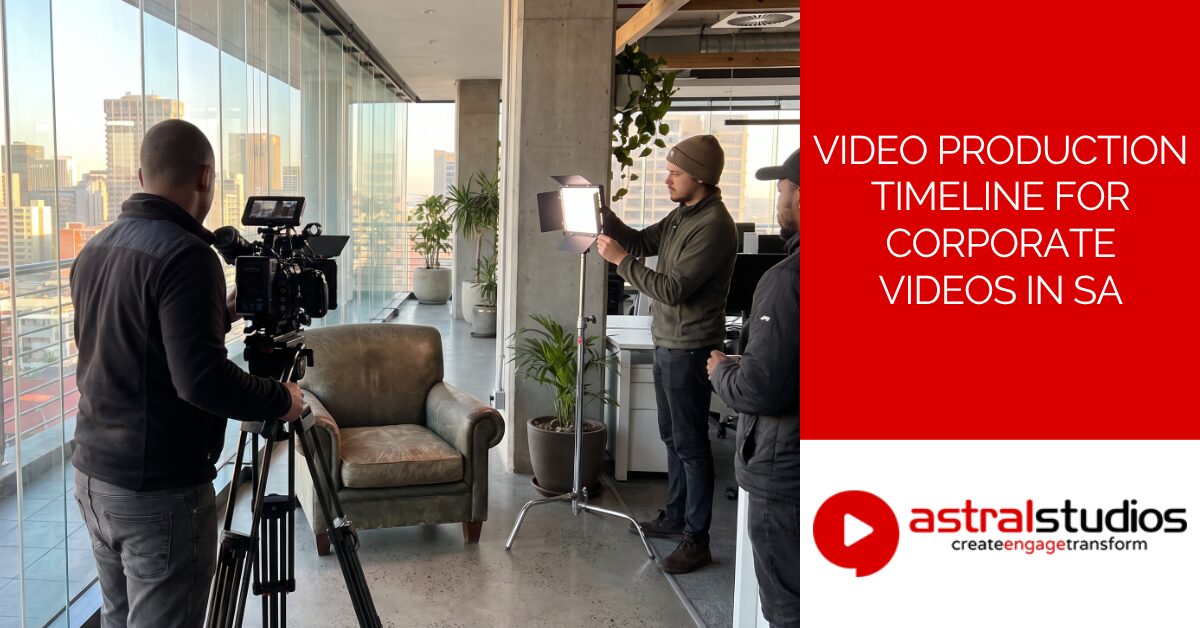
Video Production Timeline for Corporate Videos in SA
Last Updated: 1 week ago by Astral Studios Staff
Every video production timeline works differently, but patterns do exist. How long does it take to produce a corporate video in South Africa? Most projects need four to eight weeks, brief to delivery. This guide breaks down exactly why, stage by stage.
Here’s a story I hear often from South African marketing managers. A CFO wants a video by Friday. The brief lands on a producer’s desk on Monday. Nobody budgeted time for scripting or approvals. That mismatch between expectation and reality causes real stress.
Video production timelines confuse a lot of first-time clients. This article walks through every stage. You’ll know exactly what to expect, and why.
Quick Answer: How Long Does a Corporate Video Take?
The short answer: four to eight weeks. That’s from an approved brief to a finished video. A short promo can move faster. Animation or multi-location shoots often take longer. Keep reading for the full breakdown by video type and stage.
What Affects a Corporate Video Production Timeline
Not every video takes the same time to make. Several factors move the needle. Here’s what actually matters.
Video length and format
Length matters less than people assume. A one-minute video still needs a full production process. Even short videos need scripting, filming and editing.
Number of filming locations
Every extra location adds travel time. It also adds setup and pack-down time on the day. Two locations in one province is manageable. Add a second province, and it adds days, not hours.
Live action vs animation vs a hybrid approach
Live action needs a crew, a location and good weather. Animation needs none of that, but takes longer to build frame by frame. A hybrid project often takes the longest of all.
How many people are on camera
More presenters mean more schedules to coordinate. Executives are busy people. Getting five diary slots to align isn’t easy.
Revision rounds built into the process
Most quotes include two or three rounds of feedback. Extra rounds add days each time. Vague feedback slows things down more than clear feedback ever could.
How fast your team reviews each stage
This is the biggest variable of them all, in my opinion. A fast, single decision-maker saves weeks. A slow committee of ten can double the timeline.
Corporate Video Production Timeline by Video Type
Different video types need different amounts of time. Here’s a rough guide, based on typical South African productions.
| Video type | Typical timeline |
|---|---|
| Short promo (60 to 90 seconds) | 3 to 5 weeks |
| Standard corporate video (2 to 3 minutes) | 4 to 6 weeks |
| Testimonial or case study video | 2 to 4 weeks |
| Training or e-learning module | 6 to 10 weeks |
| 2D animated explainer | 4 to 7 weeks |
| 3D animation | 6 to 10 weeks |
| Documentary-style brand video | 6 to 12 weeks |
| Multi-location production | 8 to 12 weeks |
These ranges depend on scope, feedback speed and location count. Treat them as a starting point, not a guarantee. A written quote will confirm your actual timeline.
The Three Stages of Corporate Video Production, and How Long Each Takes
Every corporate video moves through three stages. Understanding each one helps you plan better.
Pre-production: briefing, scripting and planning
This stage usually takes one to three weeks. A producer meets you, discusses goals, and drafts a script. Locations get scouted. Shot lists get built. Nothing gets filmed yet, but this stage shapes everything else.
Production: the filming day or days
Filming itself often takes one to three days. It’s the shortest stage, and the most visible one. Cameras roll, interviews happen, b-roll gets captured. Crew size shifts depending on the shoot’s complexity.
Post-production: editing, colour grading and sound
Post-production takes the longest, usually two to four weeks. An editor builds a rough cut first. Then comes colour grading, sound mixing and graphics. Captions get added last, before final delivery.
Why Visual Storytelling Takes as Long as It Does
Editing isn’t just trimming clips together. Good storytelling needs craft, and craft takes time.
B-roll footage and why it adds time
B-roll is the supporting footage around your main shots. Think hands typing, machines running, people at work. It fills gaps and adds texture to the story. Capturing good b-roll can double a shoot day.
Colour grading, and why it’s not just a filter
Colour grading shapes mood, tone and brand consistency. It’s a craft skill, not a one-click Instagram filter. A skilled colourist can take hours on a single scene. That precision is why post-production timelines exist.
Motion graphics and branded on-screen elements
Logos, lower thirds and animated titles all need building. Each element is designed, animated and tested separately. Small details, but they add up fast.
Sound design, music licensing and audio mixing
Sound gets less attention than visuals, but it matters just as much. Licensed music needs clearing before use. Dialogue needs cleaning and balancing. A quiet, polished soundtrack takes real time to build.
Captions and subtitles for accessibility and multilingual reach
Captions matter for accessibility, and for social media viewing habits. In South Africa, subtitles in isiZulu, Sesotho or Afrikaans often get added too. Multilingual versions extend the post-production stage.
South African Factors That Can Add or Save Time
South Africa has its own logistics to plan around. A few local factors shape your timeline too.
Filming permits for public locations
Filming on public streets or government property needs a permit. The Gauteng Film Commission recommends applying at least two weeks ahead. Durban and Cape Town have their own film offices too, with similar lead times.
Weather and seasonal planning
Johannesburg gets most of its rain between November and March. Winter months tend to be drier, with better light for filming. Planning an outdoor shoot? Aim for the dry season if you can.
Multi-province shoots and travel logistics
A Joburg-based crew filming in Cape Town needs flights and accommodation. That adds days before a single frame gets shot. Local crew hire can sometimes solve this faster.
Government, NGO and IGO approval chains
Government and NGO clients often need more sign-off layers. Procurement processes can add weeks before a project even starts. Build this into your planning from the outset, not as an afterthought.
A word on load shedding
Load shedding barely affects production schedules in 2026. It’s not the daily disruption it once was. Eskom’s own outlook flags a possible return around 2029, according to recent reporting on Eskom’s adequacy study. That’s worth a passing thought for long-term content plans.
What You Can Do to Keep Your Video on Schedule
You have more control over the timeline than you think. A few habits make a real difference.
Have a clear brief before the first call
A clear brief saves everyone time, right from the start. Know your objective, audience and message before you brief anyone. Vague briefs lead to vague videos, and slower timelines.
Nominate one decision-maker
Too many voices slow every review round down. Pick one person to collect feedback and sign off. It sounds simple, but it saves real time.
Confirm locations, talent and logistics early
Sort out locations and availability before the brief is finalised. Last-minute changes cause the most common delays in any shoot.
Turn around review rounds quickly
The fastest way to blow a timeline? Slow feedback. Aim to respond within two or three working days. Momentum keeps a project moving; delay kills it.
Can You Rush a Corporate Video Production Timeline?
Sometimes yes, but rushing changes the project. Fewer revision rounds, tighter scheduling, and often a higher price. I’ve heard of a business cramming eight weeks into two. It worked, but something had to give. Fewer creative options, less room for reshoots. If your launch date is fixed, say so immediately. Early warning matters more than anything else.
Is AI Speeding Up Corporate Video Production in South Africa?
A bit, but not as much as the hype suggests. AI tools now handle transcription and rough captions quickly. Auto-generated rough cuts exist, but they rarely survive a client review untouched. Editorial judgement, the sense of what to cut and when, still needs a human. In my opinion, AI is a time-saver on the boring bits. It’s not yet a shortcut for storytelling itself.
Need a Realistic Timeline for Your Project?
Every project is different, so guesswork only gets you so far. Contact us for a production timeline tailored to your video, from Astral Studios.
Glossary of Terms
- Pre-production: The planning stage before filming, covering briefing, scripting and logistics.
- Production: The filming stage, when cameras actually roll.
- Post-production: The editing stage after filming, covering cuts, grading, sound and graphics.
- B-roll: Supporting footage used alongside main interview or presenter shots.
- Colour grading: Adjusting a video’s colour and tone for mood and consistency.
- Motion graphics: Animated text, logos and on-screen design elements.
- Revision round: A round of client feedback and edits during post-production.
- Storyboard: A visual plan showing each scene before filming begins.
- Rough cut: An early, unpolished version of an edited video.
Frequently Asked Questions
How long does it take to produce a 2-minute corporate video in South Africa?
Most 2-minute corporate videos take four to six weeks. That’s from an approved brief through to final delivery.
Can a corporate video be made in under two weeks?
Sometimes, for a simple, single-location video. Expect fewer revision rounds and a higher rush fee.
Does a longer video always take longer to produce?
Not always. A longer video with one location can move faster. A short video across five locations often takes longer.
Why does post-production take longer than filming?
Filming captures raw footage in days. Turning it into a polished story, with grading, sound and graphics, takes weeks.
Do government or NGO videos take longer than private corporate ones?
Often, yes. Extra approval layers and procurement processes usually add time before filming even begins.
Does paying a rush fee guarantee a faster timeline?
It helps, but it isn’t a guarantee. Crew availability and edit-suite capacity still set the outer limit.


