


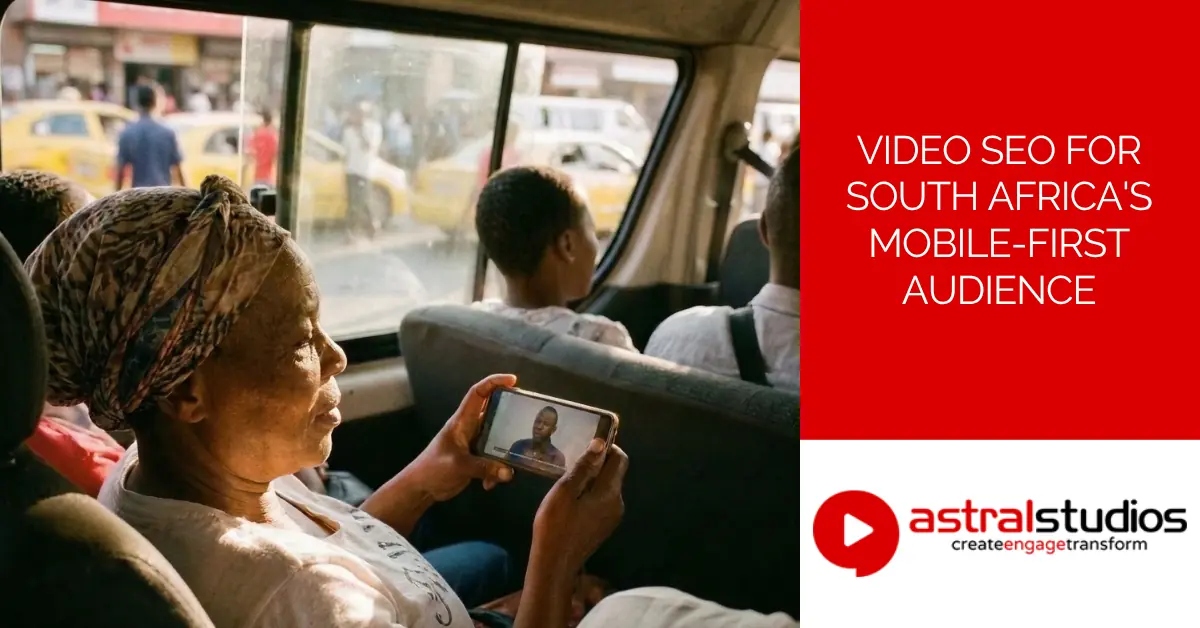
Video SEO for South Africa’s Mobile-First Audience
Last Updated: 4 weeks ago by Astral Studios Staff
Video SEO helps your videos actually get found, and this guide explains how it works for South African audiences. A friend who runs a small marketing agency once told me about a client’s video that racked up thousands of views. Great news, right? Except almost nobody watched past the first ten seconds, thanks to a huge file size and painfully slow load times on mobile data. That video looked successful on paper. It wasn’t. If you’re producing video content and wondering why it isn’t showing up in search results, or why people bounce before it even loads, this article is for you.
What Video SEO Actually Means
Let’s start with the basics before diving into the local specifics.
Video SEO in Plain Terms
Video SEO is the practice of making your videos easy to find. Search engines and AI tools need to discover, understand, and recommend your content. Without it, even a brilliant video can sit unwatched.
Why Video SEO Matters More Than Ever in 2026
Video shows up in a meaningful chunk of Google search results these days. YouTube remains the world’s second largest search engine too. That’s a massive amount of search traffic going untapped by businesses who skip this step entirely.
Why South Africa Needs Its Own Approach
Most video SEO advice online comes from markets with cheap, reliable fibre. South Africa doesn’t quite work that way, and that changes the calculation significantly.
South Africa’s Mobile-First Reality and What It Means for Video
This is the part most global guides miss entirely, and it’s worth understanding properly.
How South Africans Actually Access the Internet
The majority of South Africans access the Internet through mobile data, not fixed broadband. Fixed home Internet reaches a relatively small slice of the population, particularly outside wealthier metro areas. If your video strategy assumes everyone has fibre at home, it’s built on a shaky foundation.
Video Is Already the Biggest Data Drain
Video streaming makes up a huge share of data consumption on South African networks, both mobile and fixed. Mobile operators have flagged this trend repeatedly in their own reporting. People are watching video constantly, but every megabyte comes at a real cost to the viewer.
What This Means for File Size and Compression
A bloated, uncompressed video file isn’t just annoying. It’s expensive for the person trying to watch it on mobile data. Proper compression keeps quality intact while shrinking file size, and it directly affects whether someone sticks around to watch or gives up halfway through loading.
Page Speed as a Ranking Factor
Google factors page speed into its search rankings. A slow-loading video page hurts everyone, but it hurts more here, where data costs shape user patience. Think of it like asking someone to wait in a queue with the meter running. They won’t hang about for long.
Where Should Your Video Live? Website vs YouTube
This trips up a lot of businesses starting out, and it’s worth getting right early.
Hosting on YouTube: Pros and Cons
YouTube gives you massive reach and built-in search functionality from day one. The downside is that viewers stay on YouTube, not your website, so you’re sending traffic elsewhere.
Embedding on Your Own Website: Pros and Cons
Hosting on your own site keeps visitors where you actually want them. It requires more technical setup though, including proper compression and hosting infrastructure that can handle the load.
Can You Do Both?
Most businesses do both, and honestly, this makes the most sense. Host the video on YouTube for reach, then embed it on the relevant page of your website as the primary content. You get visibility on two fronts at once.
The Technical Building Blocks of Video SEO
Now for the mechanics that actually move the needle.
Video Titles, Descriptions, and Keywords
Write for the person searching, not for an algorithm. A clear, honest title that matches what someone’s actually looking for beats a clever one every time. Include your keyword naturally, without forcing it in.
VideoObject Schema Markup
This is a bit of code that tells search engines exactly what your video is about. It sounds technical, and it is, but it doesn’t require rebuilding your whole website. A developer can usually add it fairly quickly to existing pages.
Video Sitemaps Explained
A sitemap is basically a map of your website for search engines. It lists out your pages so Google knows what exists and where to find it. Most websites generate page and post sitemaps automatically.
A video sitemap works the same way, but just for video. It’s a separate list that specifically points search engines toward your video content. This helps Google find and index your videos properly, rather than missing them entirely.
Getting Your Video Sitemap Working
Here’s the practical bit. Most WordPress sites already run an SEO plugin, and some of these include video sitemap functionality as a built-in feature or a paid add-on. Worth checking your plugin’s settings first, since you might already have this without realising it.
If your plugin doesn’t cover video sitemaps, a dedicated plugin can generate one for you automatically whenever you publish new video content. This is usually the simplest route for most businesses, since it avoids manual updates entirely.
Once the sitemap exists, submit it to Google Search Console. This tells Google exactly where to look, rather than waiting for it to stumble across your content on its own. It’s a quick, mostly set-and-forget step once it’s in place.
Thumbnails and Click-Through Rate
A strong thumbnail often decides whether someone clicks at all. It’s the cover of the book, so to speak, and people absolutely do judge it.
Captions, Transcripts, and Why They Matter More Than You’d Think
This section covers ground that’s genuinely underexplored, especially for South African audiences.
The Difference Between Captions, Subtitles, and Transcripts
Captions show spoken dialogue and sound cues on screen. Subtitles translate dialogue into another language. A transcript is the full text of everything said, usually provided separately from the video itself.
How Transcripts Help Search Engines Understand Your Video
Search engines can’t watch a video the way a person does. A transcript gives them text to index, which helps them understand exactly what your content covers and match it to relevant searches.
A Word of Caution on Auto-Generated Captions
YouTube automatically generates captions for uploaded videos, which sounds convenient at first. The trouble is, it’s prone to mishearing words, especially names, technical terms, or anything with an accent it doesn’t quite recognise. Misspelled or garbled captions don’t help your SEO, and they can look a bit sloppy to viewers too.
The good news is you can manually edit these captions once YouTube generates them. It’s worth doing properly if the video matters to your business, whether that’s a client-facing piece or anything with your brand name in it. A few minutes of cleanup goes a long way.
Multilingual Captions for South African Audiences
South Africa has eleven official languages, and that diversity is a genuine opportunity here. Captioning content in isiZulu, Afrikaans, Sesotho, or other local languages helps reach a wider slice of your actual audience, not just English speakers. It’s a step that’s often overlooked, and it shouldn’t be.
Accessibility as a Genuine Side Benefit
Captions also help viewers watching without sound, which happens constantly on mobile in offices, taxis, or public spaces. It’s a small addition with a genuinely wide payoff.
Video SEO in the Age of AI Search
This is the part everyone’s talking about right now, so it deserves proper attention.
How AI Tools Are Changing the Way People Search
A growing share of searches now end with an AI-generated summary rather than a list of blue links. Tools like Google’s AI Overviews are reshaping how people find information altogether.
Can Your Video Get Cited by an AI Assistant?
Well-structured content with a clear transcript gives AI tools something solid to reference. There’s no guarantee, but the same fundamentals that help traditional search also support this newer kind of visibility.
Does Traditional Video SEO Still Matter?
Yes, absolutely. Clear structure, genuine usefulness, and technical accessibility underpin both traditional search rankings and AI-powered results. Nothing here gets thrown out. It just gets an extra layer added on top.
Video SEO for South African Businesses, NGOs, and Government
Generic advice online rarely accounts for this kind of audience, so let’s fix that.
B2B and Corporate Video: What Changes
Corporate audiences take longer to make decisions, and LinkedIn often plays a bigger role than search alone. Video SEO still matters here, but it works alongside a broader distribution strategy.
NGO and Government Video: A Different Kind of Search Intent
People searching for NGO or government content usually want programme information or public communication, not a sale. The SEO principles stay the same, but the intent behind the search shifts entirely.
Internal Training Video: Does SEO Even Apply?
Not really, and that’s worth saying clearly. Internal or unlisted content doesn’t need public SEO treatment. Save the effort for videos meant to be found by the public.
Practical Steps to Improve Your Video’s Search Visibility
Here’s a straightforward checklist to work through.
Research What People Are Actually Searching For
Before filming anything, find out what your audience is genuinely typing into Google. This shapes your title, your script, and your whole approach.
Name Your File and Write Your Metadata Before Uploading
Rename your raw video file with relevant keywords before uploading it anywhere. Write your description and metadata thoughtfully, rather than as an afterthought.
Keep an Eye on Video Length and Viewer Retention
Longer isn’t always better. A shorter video that holds attention beats a long one that loses viewers halfway through, every single time.
Link to your video from relevant blog posts and other pages on your site. Backlinks from other reputable websites help too, since they signal credibility to search engines.
How to Know If Your Video SEO Is Working
Measurement matters, otherwise you’re just guessing.
Realistic Timelines for Seeing Results
Video SEO isn’t instant. Expect weeks rather than days before you notice meaningful movement in rankings or traffic.
Website Traffic vs YouTube Views: Which Metric Matters More
This depends entirely on your goal. If you want people on your website, track website traffic and time on page. If brand reach matters more, YouTube views tell a different, equally useful story.
Simple Ways to Track Progress Without Expensive Tools
Google Search Console and YouTube Analytics both offer solid free data. You don’t need an expensive toolkit to get started and see what’s working.
Frequently Asked Questions
Does video SEO work differently on mobile data compared to fibre?
Yes, largely because of file size and page speed. Compressed video and fast-loading pages matter more when viewers are watching on mobile data rather than fibre.
Should I host my video on YouTube or my own website?
Most businesses benefit from doing both. Host on YouTube for reach, and embed the video on your own website to keep visitors on your site.
Do captions actually help my video rank better?
Yes. Captions and transcripts give search engines text to index, helping them understand what your video covers and match it to relevant searches.
Can AI search tools like Google AI Overviews reference my video?
It’s possible. Well-structured video content with a clear transcript gives AI tools something solid to reference, though there’s no guarantee of citation.
How long does it take for a video to start ranking?
Video SEO usually takes weeks rather than days to show meaningful results in rankings or traffic.
Is video SEO worth it for a small South African business?
Yes. Basic steps like proper titles, descriptions, and compression cost little to implement and can meaningfully improve how easily a video gets found.
Get Your Video Content Found Where It Matters
Producing a great video is only half the job. The other half is making sure people actually find it, understand it, and stick around to watch. Whether that means a properly compressed file for mobile viewers, captions in more than one language, or a transcript that helps AI tools understand your content, these details genuinely matter here.
Contact us for help getting your videos in front of the right South African audience.
Glossary
Video SEO – The practice of optimising video content so it’s easily discovered, understood, and ranked by search engines and AI tools.
VideoObject schema – Structured code added to a webpage that tells search engines specific details about a video, such as its title, duration, and thumbnail.
Video sitemap – A file separate from a standard sitemap that points search engines specifically toward video content on a website.
Compression – The process of reducing a video file’s size while retaining as much visual quality as possible.
Transcript – A full written record of everything spoken in a video, usually provided as accompanying text.
Captions – On-screen text showing spoken dialogue and relevant sound cues, often in the same language as the video.
AI Overviews – Google’s AI-generated summaries shown at the top of some search results, which draw from indexed web content.
Generative Engine Optimisation (GEO) – The practice of structuring content so AI search tools can understand, trust, and reference it accurately.


