


What Is a Workplace Training Video? A South African Business Guide
Last Updated: 2 weeks ago by Astral Studios Staff
A workplace training video teaches employees a skill or process through video. It replaces a lecture or a lengthy manual. This guide covers what one actually is. It explains why South African businesses use them, and how to plan one properly.
A friend manages HR at a manufacturing plant. She once tried explaining a new safety procedure over email. Nobody read past the first paragraph. She filmed a two-minute video instead. Completion went from dismal to nearly everyone. That’s the whole case for workplace training video in one story.
What Is a Workplace Training Video?
A workplace training video teaches a specific skill, process, or policy through visuals and narration. It’s different from a marketing video, and different from a general company overview. The goal isn’t to impress anyone. The goal is for someone to watch it, understand it, and do the task correctly afterward.
How Workplace Training Video Differs From Onboarding and Induction Video
These three get mixed up a lot, and it’s worth untangling them. Onboarding covers company culture, systems, and the first-week paperwork walk-through. Induction is safety and compliance-specific, PPE, hazards, emergency procedures. A training video sits alongside both, but focuses on an ongoing skill or process, not a once-off welcome. If you’re specifically after safety induction, our safety induction video cost guide covers that ground properly.
Common Types of Workplace Training Video
Different goals call for different formats. Here’s a rough guide to matching format with purpose.
| Type | Typical length | Best suited to |
|---|---|---|
| Seminar-style or explainer | 5 to 15 minutes | Policy, compliance, procedure explanation |
| Demonstration or process | 3 to 10 minutes per module | Technical tasks, equipment, standard procedures |
| Scenario-based | 5 to 12 minutes | Soft skills, customer service, conflict handling |
| Micro-learning or refresher | 1 to 3 minutes | Quick reinforcement, small updates |
Most businesses end up using a mix, not just one format across the board.
Why South African Businesses Are Investing in Workplace Training Video
Consistency Across Multiple Sites and Remote Teams
A business with branches in three provinces has a problem. Every trainer explains things slightly differently. A video removes that variation entirely. Everyone watches the same explanation, delivered the same way, every time.
Supporting a Multilingual Workforce
South African workplaces are genuinely multilingual, and training content needs to reflect that. A safety procedure explained only in English misses a chunk of the audience. Subtitled or dubbed versions solve this properly, and it’s worth budgeting for from the start rather than as an afterthought.
Workplace Training Video and Your B-BBEE Skills Development Scorecard
Here’s where it gets nuanced, and worth getting right. Training spend can count toward Skills Development scorecard points. But that applies to accredited training programmes, not video content by itself. A polished training video supports delivery of an accredited programme. It doesn’t automatically become accredited just by existing. Check the actual treatment with your Skills Development Facilitator before assuming it counts.
SETA Accreditation: What Video Can and Can’t Do On Its Own
Accreditation attaches to a training provider and a registered programme, not to a video format. A video company can produce excellent training content. It cannot accredit that content on its own. If you need NQF-registered credit for the training, you’ll need a registered provider involved, alongside the video. You can check a provider’s accreditation status through your relevant SETA, such as the Services SETA’s provider database.
Choosing the Right Format for Your Workplace Training Video
Live Action vs Animation
This is a genuinely detailed decision, and we’ve covered it properly elsewhere. Our guide on planning a training video on a South African budget walks through when each format makes sense.
Seminar-Style, Demonstration, and Scenario-Based Formats
Match the format to what you’re actually teaching. Policy content suits a seminar-style explainer. A physical task suits demonstration footage. Soft skills, handling a difficult customer, giving feedback, suit a short scripted scenario far better than a lecture ever could.
How Long Should a Workplace Training Video Be?
Somewhere between 8 and 20 minutes works well for a general session. Beyond 20 minutes, attention drops off sharply, and it shows in completion rates. Compliance-heavy content can run a bit longer if it must. Refreshers should stay under three minutes. Break anything long into smaller modules instead of one marathon video.
Planning a Workplace Training Video: South African Considerations
Briefing a Video Company on Content You Understand and They Don’t
You know your disciplinary procedure. Your video company doesn’t, and shouldn’t need to guess. Write down every step before the first call, in plain language. A site visit or a walkthrough with a supervisor saves everyone time later.
In-House Filming vs Professional Production
A quick phone recording is genuinely fine for an internal update nobody outside the team will see. My honest take: for anything going into a permanent training library, invest in proper audio and lighting. Bad sound is the single biggest reason people stop watching a training video early.
Production and Delivery Logistics
Backup power on shoot days is worth asking about, though it’s less of a headache than it used to be. Load shedding isn’t the daily disruption it was a couple of years ago. Still, Eskom’s own October 2025 system adequacy outlook flagged a real risk of it returning around 2029, as ageing coal capacity retires faster than new supply comes online. Worth a quick check with your production team, not a reason to panic. For remote or low-connectivity sites, ask whether the final video can be downloaded, not just streamed. A mine site with patchy signal needs offline access, not a buffering wheel.
Keeping a Training Video Library Updated as Policies Change
Policies change. Procedures get revised. A single, monolithic 40-minute training video becomes outdated fast, and reshooting the whole thing is expensive. Modular production, several short videos instead of one long one, means you can replace a single module without touching the rest.
Where Video and Visual Storytelling Fit Into Workplace Training
Why Demonstration Beats Description
Telling someone how to operate a machine safely only goes so far. Showing them the actual sequence, hands on the controls, removes the guesswork entirely. This is the whole argument for video over a written manual, in one sentence.
Using Real Workplaces, Real Staff, and Real Scenarios
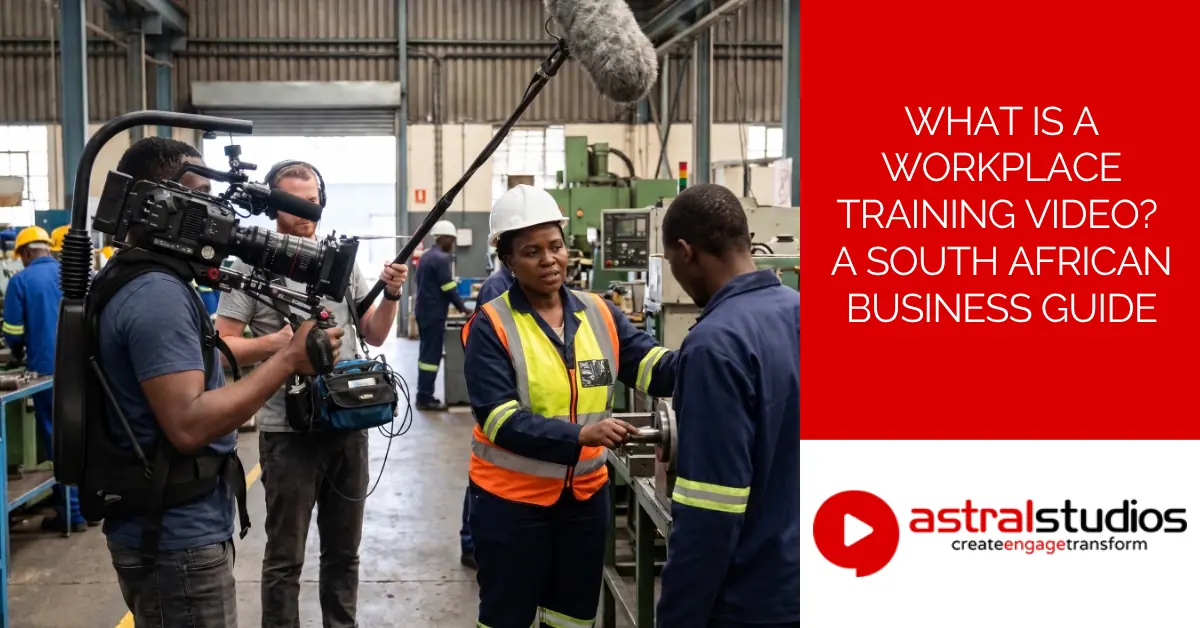
A client requested training footage filmed on their actual factory floor. Not a generic studio setup standing in for it. Staff recognised the machines, the lighting, even the noise in the background. Recognition builds trust in the content faster than polish ever does.
Hybrid Live Action and Animation for Restricted or Hazardous Environments
Some scenarios genuinely can’t be filmed safely. A confined space rescue, a chemical spill response, a serious equipment failure. Animation steps in for exactly those moments. Film what’s safe and straightforward, animate what isn’t, and the video still feels like one coherent piece.
Building a Visual Training Library, Not a One-Off Video
Think of a training shoot as building an asset, not ticking a box. The same production day often suits staff photography too, portraits for the intranet, workplace imagery for internal comms. Planning both together tends to work out more efficient than commissioning them months apart.
Measuring Whether a Workplace Training Video Actually Works
Completion Rates vs Real Behaviour Change
A 95% completion rate looks great on a report. It tells you almost nothing about whether anyone actually changed how they work. Completion measures attention, not comprehension. Worth remembering before you call a high number a success.
Practical Ways to Track Effectiveness Without Expensive Tools
A short sign-off quiz after the video catches the basics. Tracking incident or error rates before and after rollout tells you more. So does asking supervisors, plainly, whether they’ve noticed a difference on the floor.
Workplace Training Video vs Other Training Formats
Video vs Classroom Training
Classroom training allows questions in real time, which video can’t replicate. Video wins on consistency and repeatability instead. Most businesses end up using both, not choosing one over the other entirely.
Video vs Written Manuals and SOPs
A manual is a good reference document after training, not a great teaching tool on its own. Video teaches the sequence. The manual backs it up afterward, for the moment someone forgets a step.
When You Need More Than a Video
Formal, NQF-registered qualifications need a registered training provider and a structured programme behind them. A video supports that delivery. It isn’t a substitute for the accredited programme itself.
Frequently Asked Questions
What’s the difference between an onboarding video, an induction video, and a training video?
Onboarding covers company culture and first-week processes. Induction covers safety and compliance specifically. A training video teaches an ongoing skill or procedure, separate from either.
Can workplace training video spend count toward B-BBEE skills development points?
It can, but only when the video supports an accredited training programme. The video itself isn’t accredited. Confirm treatment with your Skills Development Facilitator before assuming it qualifies.
How long should a workplace training video be?
Around 8 to 20 minutes works for general training. Compliance content can run longer. Refreshers should stay under 3 minutes, and long topics work better split into modules.
Should training videos be produced in-house or by a professional video company?
Quick internal updates work fine filmed in-house. For anything going into a permanent training library, professional audio and lighting make a real difference to how long people actually watch.
How often should a workplace training video library be updated?
Whenever the underlying policy or procedure changes. Modular production makes this cheaper, since you can replace one section instead of reshooting the whole video.
Do workplace training videos need to be available in multiple languages?
Not legally required in most cases, but strongly worth it for a multilingual workforce. Subtitled or dubbed versions significantly widen who actually understands the training.
Ready to Build Your Training Video Library?
Planning starts with knowing what you’re actually trying to teach, and to whom. Contact us for a workplace training video quote tailored to your business, from Astral Studios.
Glossary
- SETA (Sector Education and Training Authority) – A body responsible for skills development and accreditation within a specific industry sector.
- QCTO (Quality Council for Trades and Occupations) – The body now responsible for accrediting occupational qualifications in South Africa.
- Workplace Skills Plan (WSP) – A document outlining a company’s planned training activities for the year, submitted to the relevant SETA.
- NQF (National Qualifications Framework) – South Africa’s system for classifying and registering recognised qualifications.
- Skills Development Facilitator (SDF) – A person or consultant who manages a company’s skills development reporting and strategy.
- Micro-learning – Short, focused training content, usually under three minutes, aimed at reinforcing a single point.
- Modular production – Building a training video as several short, independent sections rather than one long video.
- B-BBEE Skills Development scorecard – The section of the B-BBEE scorecard measuring a company’s spend on accredited training.


