


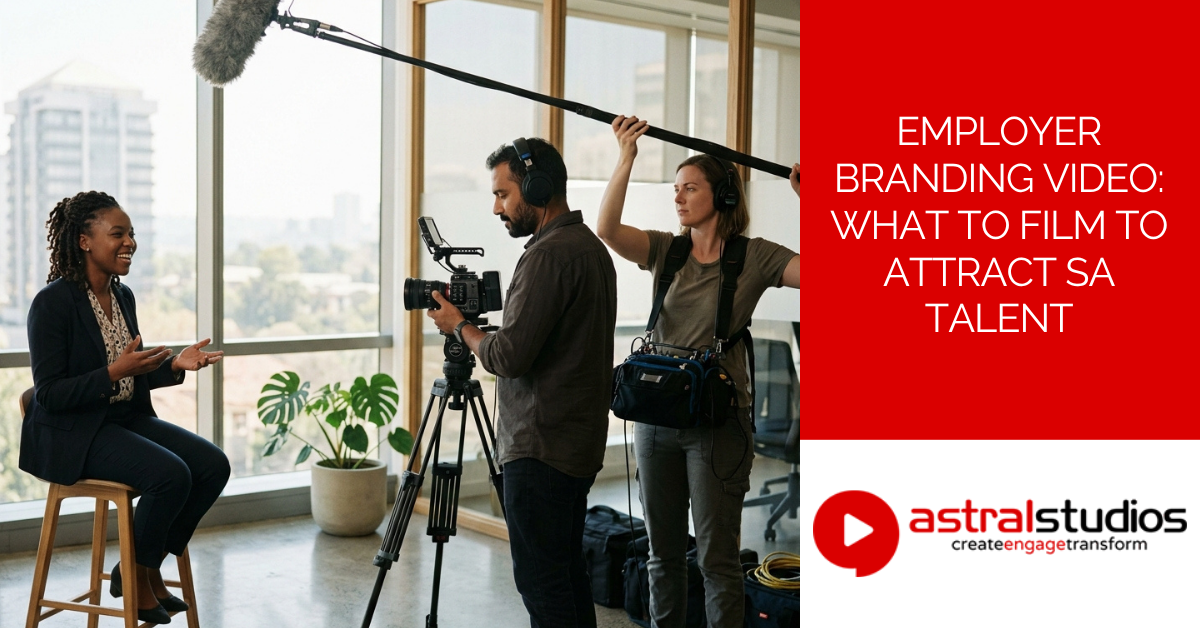
Employer Branding Video: What to Film to Attract SA Talent
Last Updated: 4 hours ago by Astral Studios Staff
Employer branding video shows candidates what working at your company feels like. This guide covers what to film and how to film it. It also covers consent and cost in South Africa.
A client requested a careers video for their artisan roles. Their careers page used stock photos of people in suits. Nobody on their shop floor wore a suit.
Candidates spot that gap fast. A stock photo tells them you have nothing real to show. Real footage fixes that, and it costs less than a bad hire.
What Is an Employer Branding Video?
An employer branding video shows the real experience of working for you. It answers one question for the candidate: “Would I fit in there?”
The film sells your whole employer brand, not one vacancy. That brand rests on your employee value proposition (EVP). That is the promise you make to staff in return for their work.
Employer Branding Video vs Recruitment Video vs Culture Video
People mix these up. They overlap, but each one does a different job.
| Video Type | Purpose | Typical Length | Where It Lives |
|---|---|---|---|
| Employer branding video | Shows the full promise to future hires | 2-3 minutes | Careers page, LinkedIn |
| Recruitment video | Sells one open role | 30-60 seconds | Job boards, social ads |
| Culture video | Shows your values and daily life | 1-2 minutes | Website, social media |
Most companies need all three in time. Start with the main employer brand film. Then cut the other two from the same shoot. A company profile video covers the business as a whole. An employer brand film focuses on the people.
Why Video Matters for Talent Attraction in South Africa
Candidates research you before they apply. They check your careers page, your LinkedIn and your reviews. Written claims are easy to make. Video is much harder to fake.
The talent market adds pressure. Reports on skills emigration keep making headlines, especially for engineers and tech workers. Skilled people have options abroad. So your pitch to them must be sharper.
Employer reputation is also a public contest. The Top Employers Institute certifies companies in South Africa every year. Names such as Telkom, Eskom and JTI appeared among the 2026 certified employers. Those brands then use that status in their hiring content.
My view: you do not need a badge to compete. You need proof that candidates can see. Video gives them that. It helps retention too. Read video strategies to improve employee retention and HR videos for onboarding, policy and culture for the inside-the-company side.
Start With Your EVP Before You Film
A video without a clear EVP becomes a pretty montage. Candidates forget it within a minute. Use this quick method:
- Pick three promises you can keep. For example, training, job security or flexible hours.
- Match each promise to a person who proves it.
- Match each person to a place where you can film it.
- Cut any promise you cannot show on camera.
That last step stings. It also saves you from empty claims. If you cannot film it, candidates will not believe it.
What to Film: The Employer Branding Video Shot List
Film for the questions candidates ask. What is the work like? Who will I work with? Will I grow here? Each shot below answers one of them.
The Day in the Life
Follow one employee from arrival to knock-off. Use a handheld camera or a gimbal. Film real tasks, not staged meetings. Pick roles from across the business, not only head office.
Real Employee Stories
Interview three to five people. Keep each answer short in the edit. Ask open questions. For example, ask “What surprised you in your first month?” Or try “What did you learn here that you could not learn elsewhere?”
Film them in their own workspace, not the boardroom. People relax where they work. Let them answer in their home language, then add subtitles. Our guide on how many languages your video needs helps you decide.
The Workplace Tour
Show the spaces a new hire will use every day. Think factory floor, site office, canteen and parking. Candidates in industry look for safety culture. So film the induction, the PPE and the clean workstations. A 360-degree tour also helps applicants who live far away.
Team and Leadership
Film a short team intro with names and roles on screen. Add one leader, kept brief and human. Skip the scripted boardroom speech. Nobody believes it. A leader who talks about their own first job feels far more real. For more, see personal branding videos for leaders.
Values in Action
Do not tell people your values. Film them. A mentoring session counts. So does a safety stand-down or a community clean-up. If you can’t film a value, drop it from the script.
Graduate and Early Careers Stories
Plenty of young South Africans search for graduate programmes every month. Film the arrival day, the buddy system and a first project. Keep it short, vertical and honest. Let a recent graduate talk about the nerves, not just the wins.
| Shot | What to Capture | Length in the Edit | Best Use |
|---|---|---|---|
| Day in the life | One employee, arrival to knock-off | 30-60 seconds | Reels, careers page |
| Employee stories | 3-5 short interviews | 10-20 seconds each | Main film, LinkedIn |
| Workplace tour | Daily spaces, safety, canteen | 20-30 seconds | Job listings |
| Team and leader | Names, roles, one short leader clip | 15-20 seconds | Main film |
| Values in action | Mentoring, safety, community work | 15-30 seconds | Social media |
| Graduate story | Arrival day, buddy, first project | 30-45 seconds | Campus campaigns |
Visual Storytelling Tips for Employer Branding Video
Show, Don’t Tell
Replace narrator claims with a shot that proves them. “We care about safety” becomes a supervisor running a toolbox talk. One real scene beats ten adjectives.
Natural Light and Real Spaces
Skip heavy set dressing. Let people work. Capture glances, laughs and small moments. Prepare your staff too. Share what to wear on camera before the shoot day.
Clean Sound
Audio matters more than camera spec. Use lapel mics and a quiet room. Pick licensed music that doesn’t sound like every other careers video. Load shedding no longer derails shoots like it once did. Still, pack backup power.
B-Roll That Does Real Work
Film hands, tools, screens and handshakes. B-roll covers your cuts and shows the scale of the business. Shoot twice as much as you think you need.
Captions, Lower Thirds and Light Graphics
Most people scroll with the sound off. Burn in captions. Add names and job titles on screen. Use simple motion graphics for numbers, such as years of service. Read about closed captions and SASL and motion graphics costs.
Cast Your Real Workforce
Show the people who actually work there. That means a mix of race, gender, age and role. Show them working as equals. Skip tokenism. Candidates spot a staged “diverse” shot at once. If your leadership team lacks diversity, don’t fake it. Film what is true.
Plan Vertical Cutdowns
Shoot with a vertical video (9:16) frame in mind. Plan one main film plus three to five short cuts. Each cut should work alone. Our social media strategy guide shows how to repurpose one shoot.
Real People or AI Avatars?
Hiring runs on trust. An AI avatar can explain a leave policy. It can’t prove your culture. My advice: use real employees for anything that makes a promise. Read more on AI in video production. Also compare live action or animation for explainer sections.
Reaching Frontline and Mobile-First Candidates
Many South Africans apply for jobs on a phone. Data is costly. So keep files light and videos short. Add captions every time. Our guide on video SEO for a mobile-first audience covers the technical side.
Film the roles that rarely get airtime. Think drivers, artisans, security officers, retail staff, call centre agents and plant operators. These people watch employer videos too. Offer a subtitled version in the main language of the region.
A 30-second cut also travels well on WhatsApp. Recruiters can share it with one tap.
Filming Staff Under POPIA: Get Consent First
Employees on camera need clear, written consent. A job contract does not cover marketing use. The Protection of Personal Information Act (POPIA) covers this. A person’s image and voice count as personal information.
A good consent form says where the video will appear. It says how long you will use it. It also explains how staff can withdraw. Staff must feel free to say no, with no penalty.
Plan for people who leave. Set a review date for the footage. The Information Regulator publishes guidance on POPIA. Confirm the details with your legal adviser. Our filming consent checklist is a good place to start.
Where to Publish Your Employer Branding Video
One film can work in many places. Match the cut to the platform.
| Platform | Best For | Ideal Length | Format |
|---|---|---|---|
| Careers page | Serious applicants | 2-3 minutes | Horizontal, captioned |
| Careers24 and PNet listings | Active job seekers | 30-60 seconds | Link or embed, check rules |
| Professionals and graduates | 60-90 seconds | Square or vertical | |
| Instagram Reels, TikTok, YouTube Shorts | Young talent | 15-45 seconds | Vertical 9:16 |
| WhatsApp and recruiter emails | Frontline roles | Under 30 seconds | Light file, captioned |
Check each job board’s video rules first. Careers24 and PNet may handle video differently. Ask your staff to share the film too, but never pressure them.
Employer Branding Video Cost in South Africa
Here is a guide for 2026. These are indicative ranges, excluding VAT. Your quote will vary with your brief.
| Employer Branding Video Type | Approximate Cost (excl. VAT) |
|---|---|
| Single culture video, 1-2 min, one location | R15,000 – R35,000 |
| Employer brand film, 2-3 min, plus 3 cutdowns | R35,000 – R75,000 |
| Multi-site series, 5-8 short videos | R75,000 – R150,000 |
| Premium multi-region, multi-language campaign | R150,000 – R400,000+ |
The number of people on camera moves the price most. Sites, languages and cutdowns come next. Travel and safety inductions add more. One UK studio lists employer brand projects from about £5,000. UK prices do not convert neatly to Rand. Treat that as a rough benchmark only.
For wider context, see how much a corporate video costs and the video production cost guide. Most projects take four to six weeks. The video production timeline shows each stage.
Common Mistakes to Avoid
- Using stock footage that doesn’t match your real workplace
- Filming only senior staff
- Promising a culture that employees don’t feel
- Scripting interviews until they sound rehearsed
- Skipping captions and vertical cutdowns
- Skipping consent forms
- Making one video and never updating it
How to Measure Whether the Video Works
Track views and watch time first. Then track careers page visits and applications. Watch applicant quality, not just volume. Ask new hires what they watched before they applied.
Refresh the film every one to two years. Teams change and so does your story. For the trust angle, read testimonial videos versus case studies.
How to Brief a Production Company
Have these ready before you call:
- Your EVP and the roles you want to attract
- Locations and who will be on camera
- Languages and platforms
- Timeline and budget range
Use the video production brief template. You can also read how to brief a production company.
Ready to Show Talent What Working With You Feels Like?
Contact us for an employer branding video quote from Astral Studios. Email info@astralstudios.co.za or call +27 (0) 11 467 4499. You can also visit the Showcase page to see examples of past work.
Glossary of Technical Terms
Employer brand: How current and future staff see you as a place to work.
Employee value proposition (EVP): The promise you make to staff in return for their work.
Talent acquisition: The process of finding and hiring skilled people.
Candidate experience: How a job seeker feels at every step of your hiring process.
B-roll: Extra footage that covers your interviews. Examples include tools, spaces and teamwork.
Talking head: A shot of one person speaking to the camera or interviewer.
Cutdown: A shorter version of a finished video. Often made for social media.
Lower third: Text at the bottom of the screen. It shows a name and job title.
Vertical video: Video shot in a 9:16 frame for phones.
Gimbal: A handheld stabiliser that keeps moving shots smooth.
Lapel mic: A small clip-on microphone for clean interview sound.
Closed captions: On-screen text of the audio. Viewers can switch them on or off.
POPIA: The Protection of Personal Information Act. It governs how you use personal information.
Consent form: A signed document where a person agrees to appear on camera.
Virtual tour: An online walkthrough of a workplace, often in 360 degrees.
Frequently Asked Questions
What is an employer branding video?
It is a video that shows what working at your company is really like. It features real employees, real spaces and your core promises to staff.
What should an employer branding video include?
Include a day in the life, short employee stories and a workplace tour. Add team introductions and proof of your values.
How long should an employer branding video be?
Aim for two to three minutes for the main film. Social cutdowns work best between 15 and 45 seconds.
How much does an employer branding video cost in South Africa?
Most standard films fall between R35,000 and R75,000. Simple culture videos start near R15,000. Large campaigns can pass R150,000.
Do I need employee consent to film for an employer branding video?
Yes, get written consent first. State where and for how long you will use the footage. Confirm the details with your legal adviser.
Can I film an employer branding video on a smartphone?
Sometimes. It suits quick social clips. A main brand film needs better sound and lighting. A producer can tell you which parts to shoot in-house.
Where should I publish my employer branding video?
Start with your careers page and LinkedIn. Then add short cuts to Instagram, TikTok, YouTube Shorts and WhatsApp.
Can I use AI avatars instead of real employees?
You can for simple explainers. Real employees work better for culture and promises. Candidates trust real faces more.


